Proof by Contradiction: Master This GCSE Math Trick
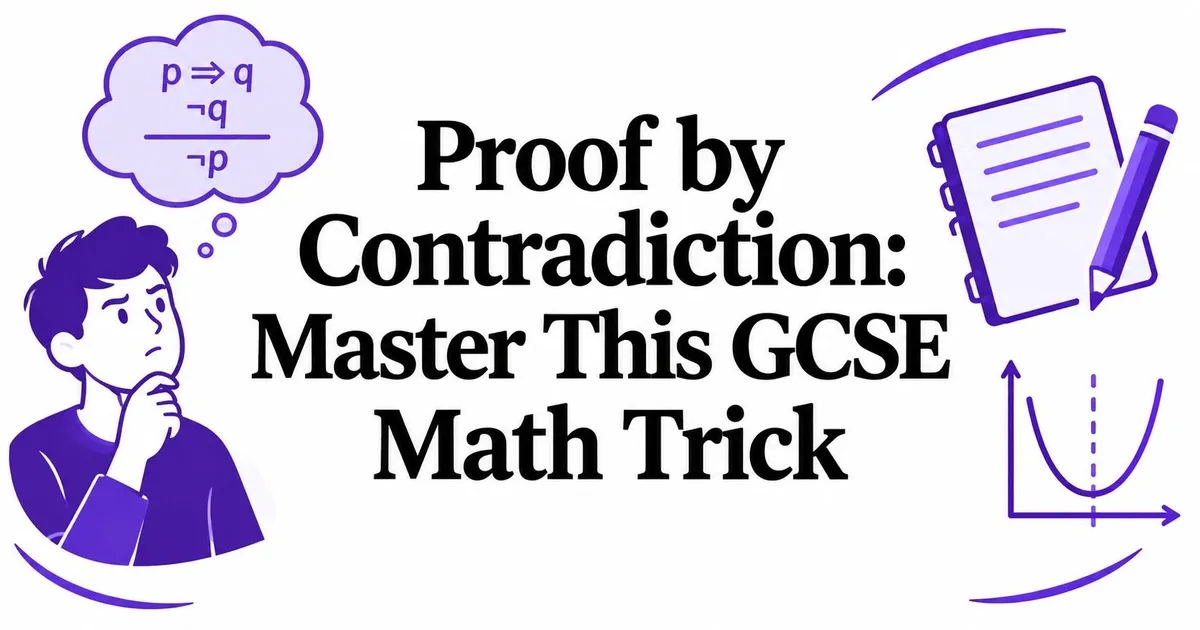
Proof by contradiction means assuming your statement is false to show it must be true. It's the move that turns a dead-end idea into a clean exam proof, and OCR's proof guidance shows why students often stumble here, they lose track of what they're assuming and what they're proving, then end up with something that feels like logic but isn't OCR proof delivery guide.
You've probably seen this kind of question in class, stared at the page, and thought, “I know the answer, but how do I prove it?” That gap between guessing and proving is exactly where contradiction proofs either work brilliantly or fall apart.
Why You Need to Know Proof by Contradiction
You know the answer, write it down, and move on. Then the mark scheme asks for proof. That is where many GCSE and early A-Level students lose marks: a correct guess gives the destination, but a proof must show why every other route fails.
Proof by contradiction gives you a controlled way through problems where direct algebra becomes awkward. Begin by accepting the opposite of the statement. Use the definitions, facts, and algebra provided, and continue until that assumption produces something impossible. The impossibility is the evidence. It shows that the opposite statement cannot be true, so the original statement must hold.
The lost keys version
Suppose you are looking for lost keys. You first test the possibility that they are not on the kitchen table. You check the bag, coat, car, and other sensible locations. If the alternatives are eliminated, the table becomes the only explanation left. The reasoning is useful because each check removes a possibility, rather than just making the table seem likely.
Mathematical contradiction works in the same way. The common trap is to assume the result halfway through, then present calculations that support it. That may confirm your expectation, but it does not test the opposite statement. Another error is to find one example that fails and call it a contradiction. A counterexample disproves a universal claim. A contradiction proof shows that the assumption itself leads to an impossibility.
A practical test helps: point to the exact line where the assumed statement clashes with a known fact or a mathematical condition. If you cannot identify that clash, the proof is incomplete.
The aim is a traceable chain of reasoning. Examiners need to see how the assumption leads to the contradiction, not merely that the final answer happens to be correct.
The Three Steps to a Flawless Proof
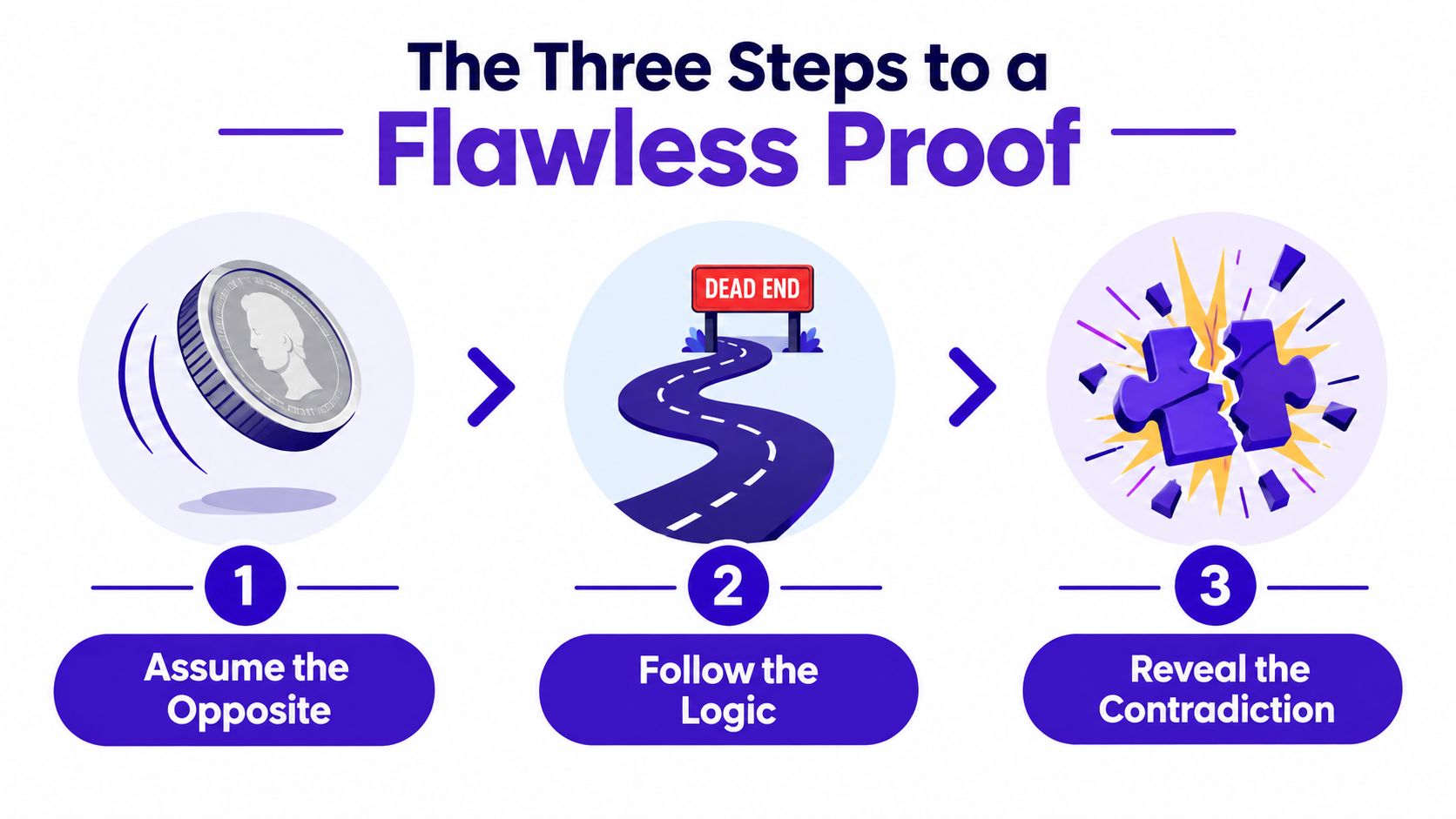
Step 1, assume the opposite
Start by writing the negation of what you want to prove. If the statement says something is true, your first job is to write the version that says it isn't true, or that it could fail in some way. That opening line matters more than students think, because OCR notes that learners often struggle to identify the correct assumption and lose track of the difference between what's assumed and what's being proved OCR proof delivery guide.
Step 2, follow the logic
Now use the given facts, definitions, and algebra. Don't jump straight to the finish line, and don't subtly swap in the answer you already wanted. The whole job is to stay loyal to the false assumption long enough for it to corner itself.
Step 3, reveal the contradiction
A contradiction is a point where the false assumption clashes with something known to be true. That clash might be a number that can't exist, a statement that says both yes and no, or an impossible equation. Once that happens, you conclude the original statement must be true.
A useful way to think about this is a maze with one blocked tunnel. You don't need to explore every tunnel in the building, just the one you chose at the start. If it ends in a wall, that's enough.
The proof succeeds when the contradiction is unavoidable, not when the final line sounds confident.
If you want a structured revision route for this topic, methods of proof for A Level maths is a useful place to compare contradiction with the other proof methods students need to know.
The Logic Behind the Method
A contradiction proof follows a strict logical rule: a statement cannot be true and false in the same sense at the same time. Start by assuming the claim is false. If that assumption leads to an impossibility, the assumption must be rejected, leaving the original claim supported.

The contradiction is the destination, not an accidental slip in your algebra. Your calculation should show that the opposite assumption cannot coexist with a definition, fact, or rule already accepted in the question. Students often lose the thread by treating a plausible answer as proof. A result only counts when the reasoning makes the alternative impossible.
Why assuming the opposite is legal
Assuming the opposite is a test, not a claim about reality. You temporarily allow the negation of the statement, then follow its consequences carefully. If those consequences conflict, the negation fails. That gives you a reason for accepting the original statement.
For example, if a claim says that a number has a particular property, begin by granting that it does not. The algebra then acts like a stress test. Every step must follow from the assumption and the given information, until the assumption demands something mathematics does not allow.
This logic appears alongside other proof methods in A-Level study. Students comparing approaches can review methods of proof for A Level maths, while the MasteryMind proof revision covers proof work for further mathematics.
Make the logic visible on the page: state the negated assumption, show each consequence, identify the precise impossibility, then link it back to the original claim. Naming the contradiction matters. Without that final connection, your working may show an impossible result while failing to prove what the question asked.
GCSE and A-Level Worked Examples
A student may know the rule, then stall when the question names a particular number or expression. Work through the contradiction in full, because a guessed answer is not a proof. The subject changes between GCSE and A-Level, but the logical pressure remains the same.
GCSE style example
To prove that (\sqrt{2}) is irrational, assume the opposite: (\sqrt{2}) is rational. Write it as (\frac{a}{b}), where (a) and (b) have no common factor.
Squaring gives
[
2=\frac{a^2}{b^2},
\qquad a^2=2b^2.
]
Therefore (a^2) is even, so (a) is even. Let (a=2k). Substitution gives
[
4k^2=2b^2,
\qquad b^2=2k^2.
]
Thus (b) is even as well. Both (a) and (b) share a factor of (2), contradicting the choice of (\frac{a}{b}) in simplest form. The contradiction shows that the assumption was false, so (\sqrt{2}) is irrational.
Notice the exact point of failure. The proof does not establish the result because the algebra looks convincing. It establishes it because the assumption forces a fraction that cannot be in simplest form.
A-Level style example
For an A-Level example, prove that there are infinitely many primes. Assume instead that only finitely many primes exist, and list them as (p_1,p_2,\ldots,p_n). Form the number
[
N=p_1p_2\cdots p_n+1.
]
Dividing (N) by any listed prime leaves remainder (1), so none of those primes divides (N). Yet every integer greater than (1) has a prime divisor. That divisor would be a prime missing from the list, contradicting the assumption that the list contained every prime. Therefore, there are infinitely many primes.
The final sentence identifies both the contradiction and the original claim. Practise comparing examples with the MasteryMind proof revision, then ask whether each step rules out the assumption or merely rearranges it.
Avoiding Common Exam Pitfalls
The biggest mistake is not algebra. It's confusion about the type of proof. Students write something that looks polished, but they've drifted into contrapositive reasoning, or they've just rewritten the opposite statement without ever creating a contradiction.
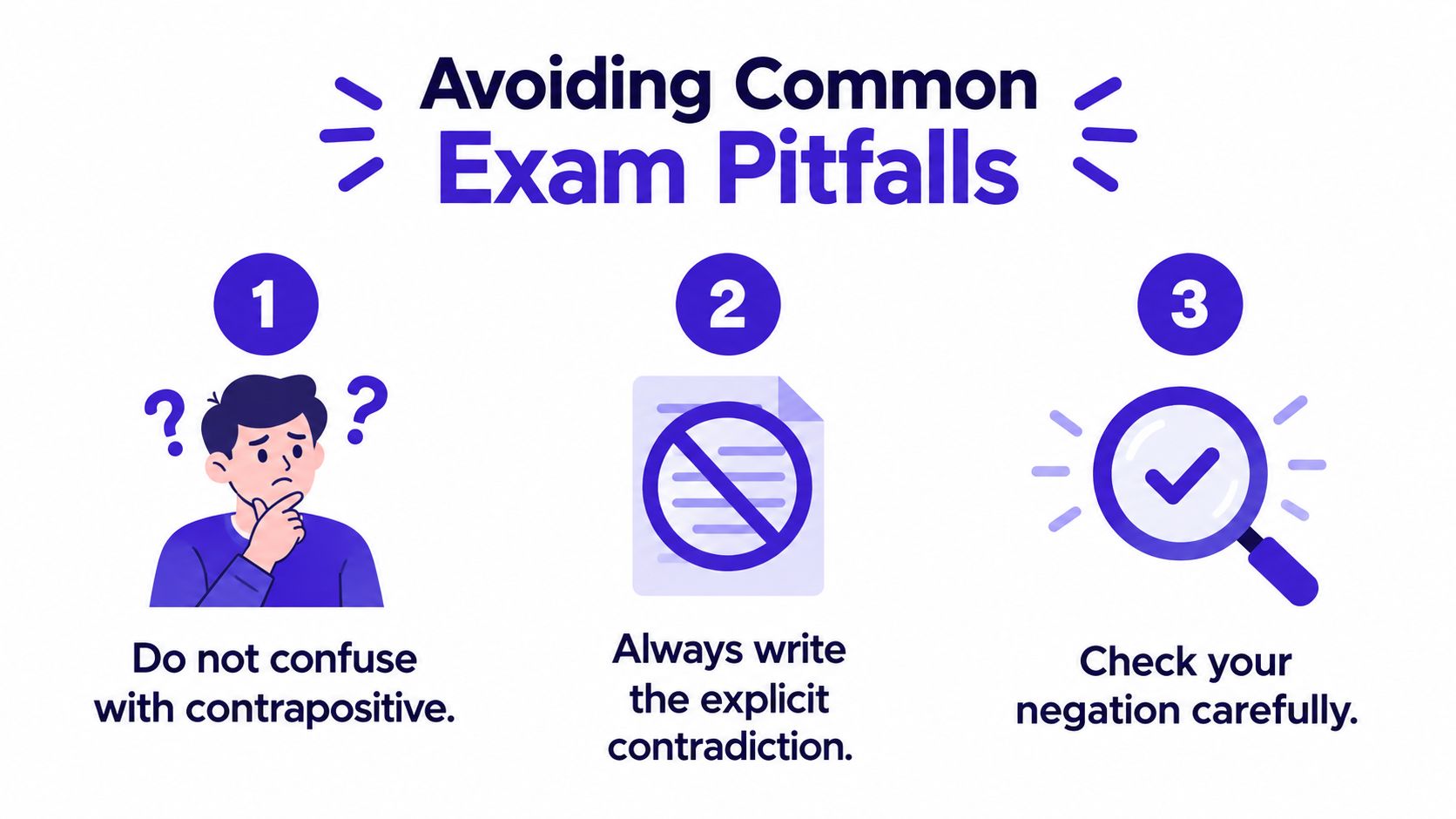
The three traps that cost marks
- Confusing the method: Proof by contradiction is not the same as contrapositive. If you swap them, your whole argument can still look logical while proving the wrong thing.
- Skipping the contradiction: Writing the negation alone is not enough. You need the point where the false assumption collides with a known fact or an impossible result.
- Dropping the conclusion: A tick mark or a confident pause doesn't count as a mathematical ending. The final sentence should say the statement is true because the opposite led to a contradiction.
AQA and OCR-style marking rewards clarity, not performance. If your proof leaves the examiner guessing where the contradiction happened, or what exactly was proved, they can't give full credit even if the underlying idea was close.
The easiest fix is to be boringly explicit. Write the assumption, write the contradiction, then write the conclusion in one clean sentence. That habit protects you from the most common presentation losses.
Write for the examiner who has no patience for mind reading.
A lot of weaker scripts also blur the line between “I found something odd” and “I proved impossibility”. Those are not the same. Odd-looking algebra might just mean you need to simplify better, while a real contradiction means the assumption itself has broken.
If you're using digital practice, how AI marking works can help you understand why systems and teachers both want the contradiction stated plainly, not hidden inside loose prose.
Structuring Your Answer for Top Marks
A contradiction proof that earns top marks is easy to read because every line does one job. A messy proof forces the examiner to search for your logic, and that's where good work gets undercounted.
| Element | What to Include |
|---|---|
| Starting assumption | The negation of the statement you want to prove |
| Working | A clear chain of deductions from the assumption |
| Contradiction | A statement or result that cannot be true |
| Conclusion | A direct sentence that the original statement is true |
A partial-mark answer usually does the maths but hides the logic. A full-mark answer makes the logic obvious, so the contradiction can be spotted without effort. That's the difference between “I think I know what you meant” and “I can award the mark”.
Keep notation tidy, avoid jumps, and never leave the ending implied. If the proof feels too short, it probably isn't the length that's the problem, it's the missing logical bridge.
MasteryMind gives UK learners GCSE and A-Level maths practice that includes proof-by-contradiction work, plus examiner-style feedback that checks the logic step by step. If you want to practise this topic in a format that matches real exam expectations, visit MasteryMind and use it alongside your past papers and class notes.
Ready to master this topic?
Practise with quizzes, blurt exercises and exam questions on MasteryMind.
7 days Premium · Then free forever · No card, no charge