Psychology Research Methods Revision: Key Guide 2026
You're staring at a research methods question, your notes are open, and somehow every definition you've ever learnt has vanished. You know what a laboratory experiment is, but the question is about a school study involving sleep, a strange sample, and a significance test. Suddenly, “evaluate” looks less like an instruction and more like a personal attack.
That's the trap with psychology research methods revision. You're not mainly being asked to recite a glossary. You're being asked to diagnose a scenario, select relevant concepts, apply them accurately, and make a judgement about the quality of the research. This guide treats methods as a decision-making skill, with the examiner-style writing that turns knowledge into marks.
Why Research Methods Revision Feels So Hard
Many students revise research methods by making pages of definitions. That feels productive because the page fills quickly. The difficulty arrives in the exam, when the question doesn't ask, “What is a random sample?” It gives you a study where a teacher recruits volunteers from one class and asks you to explain the sampling method, identify a limitation, or suggest an improvement.
The problem is a mismatch between knowing a term and using a term. A definition might earn knowledge credit, but an applied answer must connect the term to the details in the scenario. Evaluation then requires another move, such as explaining why that feature affects validity, reliability, ethics or the usefulness of the findings.
Examiner-minded rule: Name the concept, point to the scenario, explain the consequence.
UK revision materials often cover methods, ethics, sampling and statistics clearly, but they give less attention to turning an unfamiliar scenario into a complete answer. That gap matters because practical-investigation expectations, including those outlined in OCR's research-methods practical handbook, require students to carry out and evaluate different methods. Knowing the label is only the starting point.
The three moves behind the marks
A useful way to read a methods question is through the assessment objectives.
- Knowledge: State what the method or concept means. This is your accurate terminology and description.
- Application: Show how the concept appears in the study. Use the people, procedure, variables or data named in the question.
- Evaluation: Explain why the choice is useful or problematic, then weigh it against the aim of the research.
A student might write, “A laboratory experiment has high control.” That's knowledge. A stronger answer adds, “Because the researcher controls the testing environment, differences in attention are less likely to result from background noise.” That applies the idea. A judgement goes further: “However, the controlled setting may feel unlike ordinary classroom learning, so the findings might not transfer well beyond the study.”
This is why a long answer can still score poorly. Two sides of vague evaluation aren't automatically better than a shorter answer that repeatedly links method, scenario and consequence. Examiners pay for relevant reasoning, not handwriting stamina.
Why novel scenarios change your revision
Current UK-facing revision resources increasingly direct students towards active recall, mixed-topic practice and unfamiliar scenarios rather than copying summaries. The practical implication is straightforward: revise by answering questions before rereading notes, then repair the exact weakness exposed by your mistake.
Research methods also rewards flexible thinking. A questionnaire might provide numerical responses, but it can also contain open questions producing qualitative data. An experiment might be highly controlled, but that doesn't make it automatically the best choice. The correct answer depends on the research aim, the participants, the setting and the type of data required.
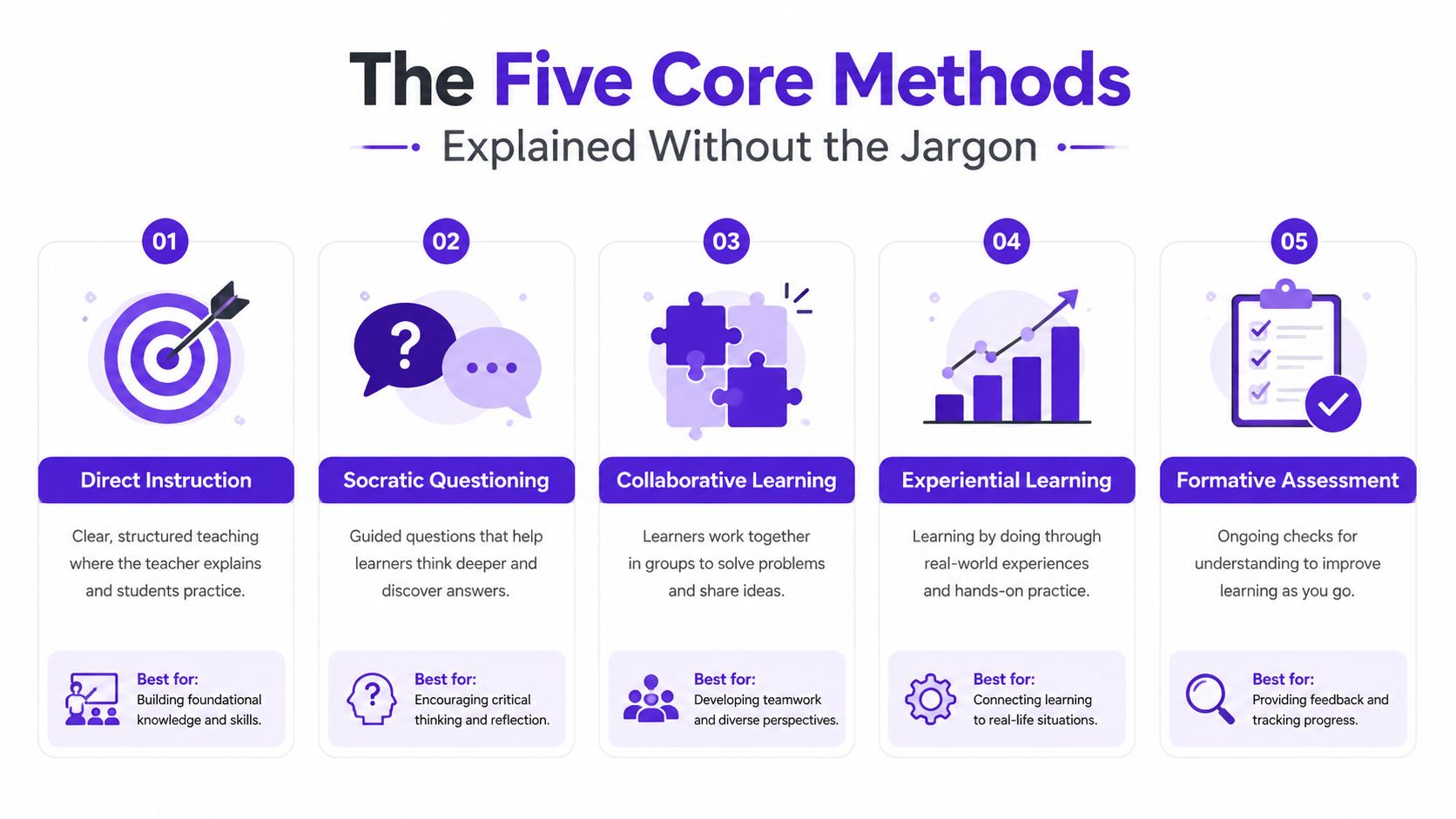
The Five Core Methods Explained Without the Jargon
Start with the research question. If you can identify what the researcher wants to discover, method choice becomes much less mysterious.
Experiments test whether one thing causes another
An experiment changes an independent variable and measures its effect on a dependent variable. For example, a researcher could compare memory performance after quiet revision and revision with background music. The researcher controls other conditions as far as possible, which helps establish cause and effect.
A laboratory experiment offers strong control, but an artificial setting may reduce ecological validity. A field experiment takes place in a natural environment, so behaviour may be more realistic, although control becomes harder. A natural experiment uses an independent variable that the researcher can't randomly allocate, while a quasi-experiment compares naturally existing groups, such as people with and without a particular diagnosis.
Observations record behaviour rather than asking about it
An observation is useful when the behaviour itself matters. A researcher might record how often pupils look away during a lesson, using an observation schedule with clearly defined categories. This can capture behaviour that participants may forget, misunderstand or present inaccurately in a questionnaire.
Naturalistic observations usually provide realistic behaviour, but the researcher may have less control over what happens. Participant observation can give rich access to a group, though the observer's involvement may influence behaviour. Structured observations make recording easier and can improve consistency, but they may miss unexpected details.
Correlations measure relationships
A correlation examines whether two variables change together. For instance, a researcher might measure revision time and test performance, then check whether students who revise more also tend to score higher.
Correlation does not establish causation. A third variable, such as previous attainment, could influence both revision time and test performance. Correlational research can reveal useful patterns and is suitable when manipulating a variable would be impractical or unethical, but it can't prove that one variable caused the other.
Self-report asks participants directly
Questionnaires gather responses from many people efficiently, while interviews allow more detailed answers. Closed questions are easier to compare, but they can restrict what participants say. Open questions may reveal richer explanations, although analysing them takes more interpretation.
Self-report also creates risks. Participants might forget accurately, guess what the researcher wants, or give socially desirable answers. A well-designed question avoids leading wording and makes the response options clear. “How often do you revise?” is less useful if the available answers overlap or make one response seem more respectable.
For more detail on making procedures clear and repeatable, students can use these research methods reproducibility tips. If you want specification-focused practice, you can also find Psychology Alevel resources.
Case studies investigate one case deeply
A case study focuses closely on one individual, group, organisation or unusual situation. Researchers may combine interviews, observations, records and test results to build a detailed picture.
The strength is depth. The weakness is generalisability, because one case may not represent other people. Case studies can also take considerable time and may involve subjective interpretation, so researchers need transparent procedures and careful checks.
| Method | Data type | Strength | Weakness |
|---|---|---|---|
| Experiment | Usually quantitative | Can test cause and effect through control | May lack realism |
| Observation | Quantitative, qualitative or both | Records behaviour directly | Observer effects and interpretation can affect findings |
| Correlation | Quantitative | Identifies relationships between variables | Cannot demonstrate causation |
| Self-report | Quantitative, qualitative or both | Accesses opinions and experiences | Answers may be inaccurate or socially desirable |
| Case study | Often qualitative, with possible quantitative data | Provides detailed understanding | Findings may not generalise |
When a scenario feels unfamiliar, ask three questions: What is the aim? What data is needed? What can the researcher realistically change or observe? Those answers usually narrow the method quickly.
Sampling, Validity, Reliability and Ethics as One Toolkit
These topics are easier when you stop treating them as four unrelated boxes. Think of a study as a cup of tea. Sampling decides who gets the cup, validity asks whether it really tastes like the tea you intended to make, reliability asks whether the recipe produces the same result again, and ethics asks whether you behaved properly while making it.
Sampling determines whose behaviour you're studying
A random sample gives members of the target population a fair chance of selection. A systematic sample follows a fixed selection process. A stratified sample reflects important subgroups in the population. Opportunity sampling uses people who are readily available, while volunteer sampling relies on people choosing to take part.
Each method creates trade-offs. A volunteer sample may contain people who are especially interested in psychology, while an opportunity sample may overrepresent one class or friendship group. A sample can be large enough to produce plenty of data and still be poorly matched to the target population.
A useful exam sentence follows this shape:
“The researchers used opportunity sampling because they recruited students from their own lesson. This is practical, but the sample may not represent students in other schools because the participants share a similar setting.”
For practice with sampling decisions and bias, you can browse Kuraplan bias worksheet and then write your own scenario-based explanation.
Validity asks whether the study supports the conclusion
Internal validity concerns whether the procedure measured what it claimed to measure, without another variable explaining the result. Ecological validity asks whether the task and setting resemble real life. Population validity concerns whether findings can be generalised to the wider group the researcher wants to understand.
Reliability is different. A reliable measure produces consistent results, perhaps across time or between observers. A measure can be reliable but invalid, like a clock that is consistently wrong. In an observation, clear behavioural categories and observer training can improve inter-observer reliability. In a questionnaire, consistent wording and standardised instructions can reduce variation caused by the procedure.
Ethics must be applied to the actual scenario
Relevant issues may include informed consent, deception, protection from harm, privacy, confidentiality, the right to withdraw and debriefing. Don't list every principle you remember. Select the one raised by the study and explain the practical fix.
If researchers conceal the true aim, for example, they should justify the deception and provide a proper debrief afterwards. If a study records sensitive personal information, confidentiality and secure handling become central. The strongest answers explain both the risk and the safeguard.
Before committing to a judgement, run this quick check:
- Sample: Who took part, and who is missing?
- Design: What could affect the dependent variable apart from the independent variable?
- Measure: Does the task capture the behaviour or construct claimed?
- Repeatability: Could another researcher follow the same procedure?
- Ethics: Which participant right needs protection?
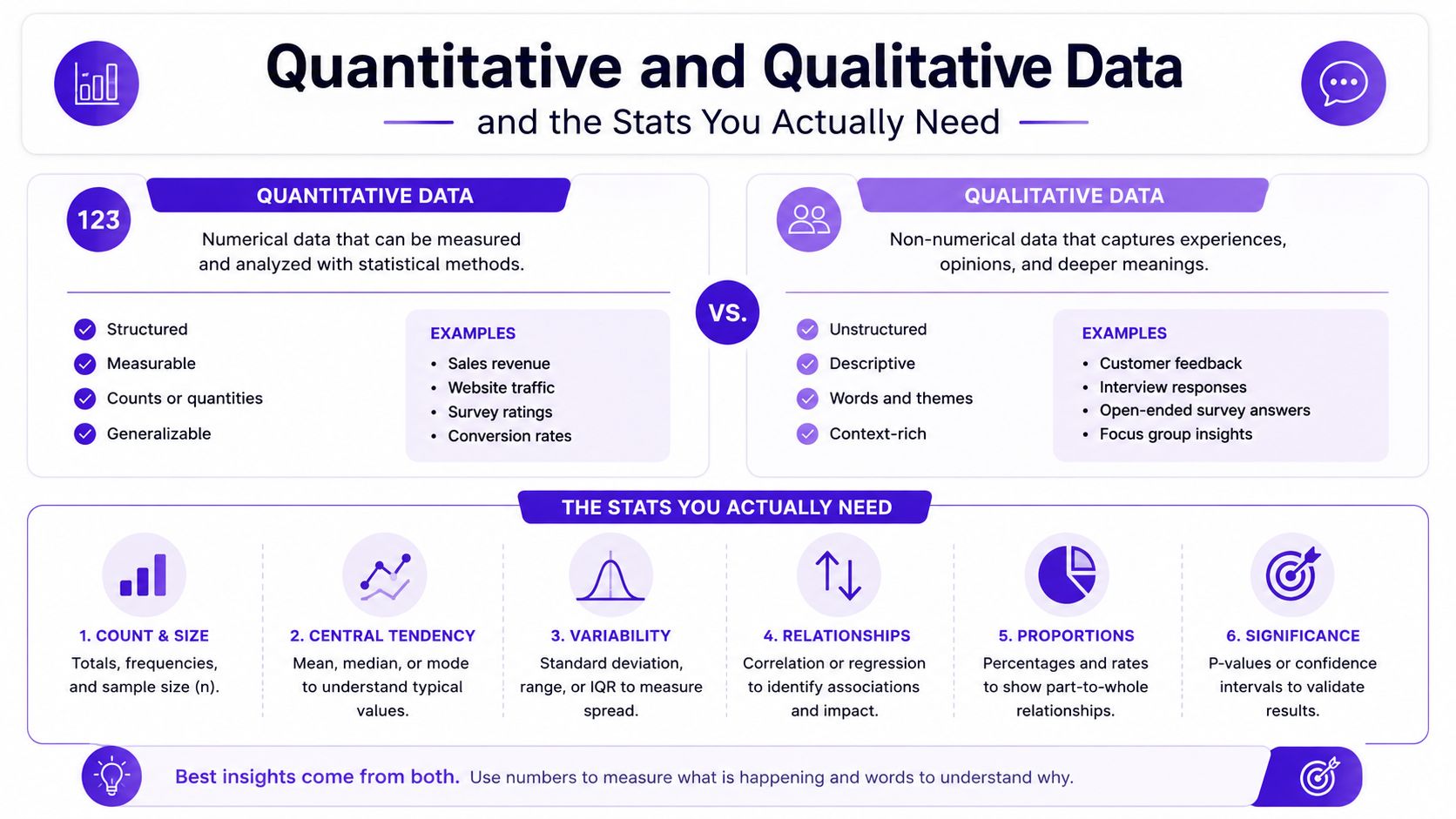
Quantitative and Qualitative Data and the Stats You Actually Need
Numbers aren't the whole of research methods, but they're often where confidence disappears. The first distinction is simple: quantitative data is numerical, while qualitative data is descriptive and meaning-rich.
A reaction-time score is quantitative. A participant's explanation of why they lose concentration is qualitative. Questionnaires can collect either type, depending on whether they use fixed response options or open questions. Researchers choose the data type that fits the question, not the one that looks most impressive in a results table.
Measurement levels control what calculations make sense
Nominal data places responses into categories, such as study method chosen. Ordinal data ranks responses, but the distance between ranks isn't necessarily equal. Interval data has equal gaps between values but no meaningful absolute zero, while ratio data includes equal intervals and a meaningful zero.
For central tendency, the mean uses every score but can be distorted by extreme values. The median identifies the middle score and works well when data is skewed. The mode is the most frequent value and can be useful for categories.
Dispersion tells you how spread out the scores are. The range is quick to calculate but depends heavily on the highest and lowest values. Standard deviation provides a more informative picture of how scores vary around the mean, where required by the specification.
Inferential statistics need interpretation, not incantation
A significance value helps researchers judge whether a result is unlikely to have occurred by chance under the null hypothesis. Students often lose marks by writing, “The result is significant, therefore the hypothesis is true.” A better answer states what the result suggests and then recognises the limits of that conclusion.
The test must fit the design and data. Ask whether the study uses a relationship or a difference, whether the participants are related or unrelated, and whether the data meets the assumptions of a parametric test. A test chosen for the wrong design can weaken the analysis even if the calculation is accurate.
A graph also needs more than a description. Identify the pattern, compare the relevant groups or variables, and connect the result to the aim. If one condition has a higher mean score, say what that means for the research question, then mention variation if the spread makes the difference less convincing.
Students who need to rebuild the mathematical basics can use GCSE statistics revision, then return to psychology questions where the statistics have a research context.
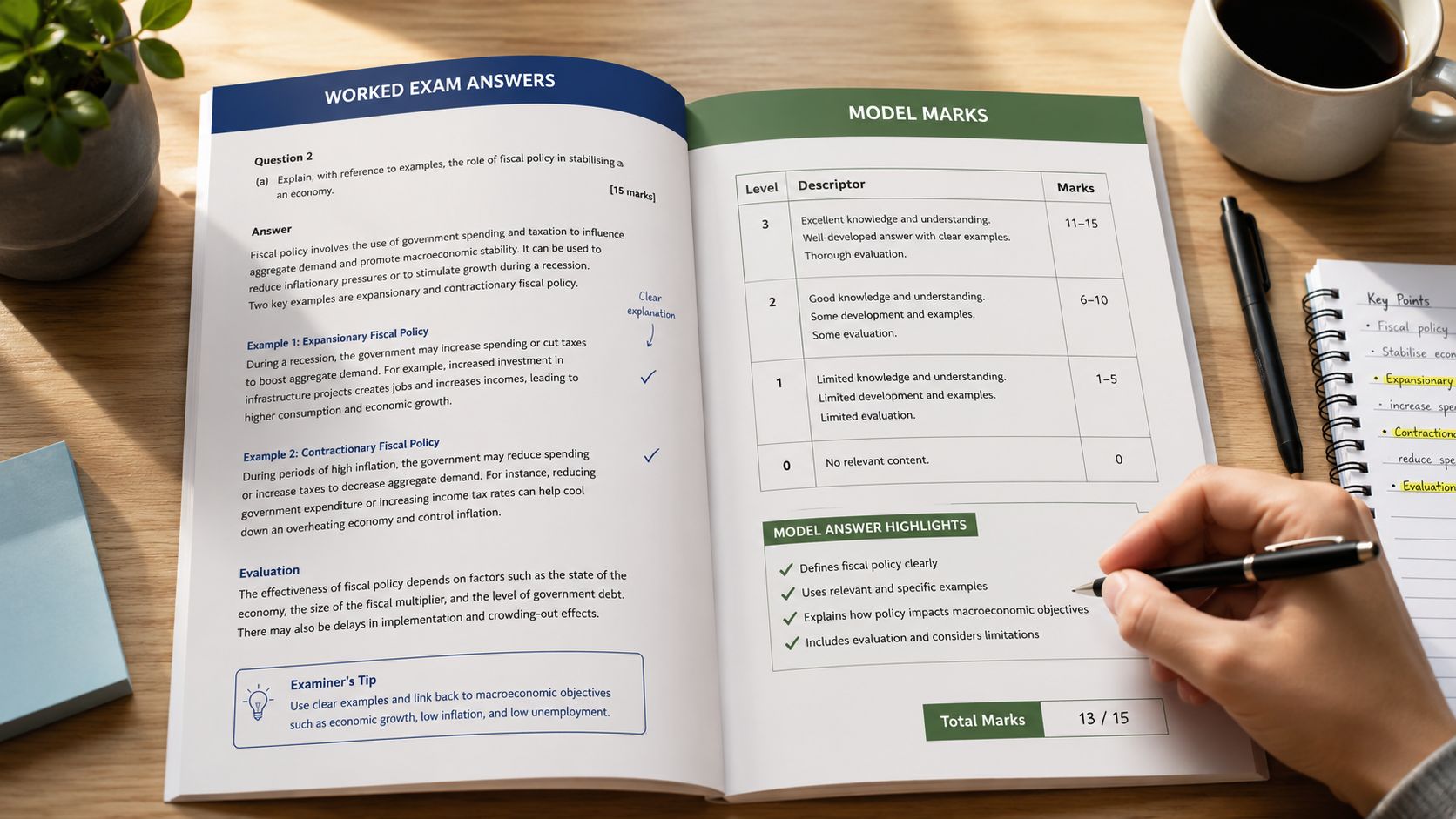
Worked Exam Answers and Model Marks
A strong answer doesn't sprinkle terminology over a page and hope the examiner is impressed. It builds a chain from method, to scenario, to consequence, then reaches a reasoned judgement.
A realistic extended question
Question: A psychologist wants to investigate whether background music affects concentration in sixth-form students. Students complete a concentration task either in silence or while listening to music. The psychologist recruits volunteers from one psychology class. Discuss the use of an experiment for this investigation.
A basic opening might define an experiment and describe the independent and dependent variables. That establishes knowledge, but it doesn't yet show control of the scenario.
Model paragraph with AO focus:
“An experiment is a research method in which the researcher changes an independent variable and measures its effect on a dependent variable. In this investigation, the independent variable is listening condition, either silence or background music, and the dependent variable is performance on the concentration task.” (AO1 plus AO2)
This paragraph earns its value by naming the variables precisely. It doesn't waste space defining every possible experiment type.
“An advantage is that the psychologist can standardise the procedure by giving every student the same instructions, task and time limit. If the music condition is the only planned difference, changes in concentration-task performance are more likely to result from the listening condition rather than inconsistent instructions.” (AO1, AO2 and AO3)
Notice the link: control is not merely “good”. The answer explains what control reduces and why that matters.
“However, the investigation uses volunteers from one psychology class. These students may differ from the wider sixth-form population in motivation, prior knowledge or interest in psychology. This limits population validity, so the findings may not apply to students who weren't represented in the sample.” (AO2 and AO3)
That is stronger than saying “volunteer sampling is biased”. It identifies the likely source of bias and connects it to generalisation.
“A further issue is ecological validity. Completing a short concentration task under instructions may not represent how students normally study with music. The experiment could therefore provide a clear test of the immediate effect of the listening condition, but it may not show how background music affects concentration during ordinary revision. Overall, the experiment is suitable if the aim is to test a controlled difference between silence and music, although a more representative sample and a realistic study task would strengthen the conclusion.” (AO3 and judgement)
The final sentence does three useful things. It returns to the aim, weighs the strength against the weakness, and suggests improvements that follow logically from the evaluation.
The short application version
Question: Explain one ethical issue in the investigation. (4 marks)
“Because participants are volunteers, they should receive enough information to give informed consent before completing the concentration task. They should also be told that they can withdraw their data without penalty. This protects their autonomy, especially if the music is unpleasant or the task causes discomfort.”
This answer doesn't list every ethical guideline. It identifies a relevant issue, applies it to the study and explains why the safeguard matters.
Before writing, mark the command word. Outline usually needs accurate description. Explain needs a reason or consequence. Discuss requires balance and a conclusion. Evaluate needs strengths, weaknesses and a judgement tied to the question.
For more opportunities to compare your structure with real exam formats, use A-Level Past papers. Mark your own response by highlighting knowledge in one colour, scenario application in another and evaluation in a third. If one colour barely appears, you've found the repair job.
Revision Strategies That Match How Memory Actually Works
Rereading feels smooth because the page looks familiar. Retrieval feels harder because you have to produce the answer without the notes, which is exactly why it exposes gaps more effectively.
A UK pilot randomised controlled trial tested a spaced-learning model using 24-hour gaps between revision sessions and 10-minute spaces within sessions. It was the only tested model in that trial to significantly improve attainment compared with control, with d = 0.19 and p < 0.05, as reported in the Frontiers in Education study. Student engagement also significantly predicted higher attainment, so spacing only helps when you complete the retrieval cycles.
A UK-hosted evidence synthesis reported a meta-analytic estimate of g = 0.74 for spaced retrieval practice compared with massed retrieval, while another meta-analysis of mathematics learning found an overall spacing benefit of g = 0.282, with a 95% confidence interval from 0.188 to 0.376 (ERIC record). The sensible revision conclusion isn't that every topic improves identically. It's that distributing retrieval across days is generally more dependable for long-term retention than compressing everything into one frantic session, with the exact gain depending on the task.
A practical two-week cycle
- Days one to three: Retrieve definitions and identify methods from short scenarios, without notes.
- Days four to seven: Mix sampling, ethics, validity and data questions. Record each error as a repair prompt.
- Days eight to ten: Write short application answers, then improve one paragraph using the mark scheme.
- Days eleven to fourteen: Complete mixed-topic questions under time pressure and revisit only the weak areas.
Use 30 to 45-minute blocks rather than waiting for a heroic evening when you'll apparently become a different person. A flashcard app, a voice note or a microlearning tool can all work, provided you answer before checking. If you're comparing tools, this guide to find the right microlearning platform may help you judge which format suits your routine. You can also explore spaced repetition for GCSEs for a broader explanation of scheduling retrieval.
Common Misconceptions and a Practicable Weekly Routine
A laboratory experiment isn't automatically the best method. It may offer excellent control but poor realism. A correlation isn't a failed experiment, either. It answers a different kind of question and becomes weak only when someone treats association as proof of causation.
Reliability and validity aren't synonyms. A measure can be consistent without measuring the intended construct. Qualitative data isn't “worse” than quantitative data, and a significant result doesn't prove a hypothesis beyond all doubt.
Try this weekly routine:
- Monday: Retrieve one method and apply it to a new scenario.
- Tuesday: Practise sampling, ethics and validity in short answers.
- Wednesday: Complete a statistics interpretation question.
- Thursday: Write one extended evaluation paragraph.
- Friday: Do a mixed-topic quiz before rereading notes.
- Weekend: Complete an exam question, mark it, and create a repair set from every missed point.
Teachers and parents can help by asking, “What detail in the scenario proves that?” rather than supplying the answer. Current UK-facing revision guidance increasingly favours question before rereading and targeted repair after mistakes. That's a much sturdier habit than highlighting an entire textbook until it glows.
MasteryMind offers UK-aligned psychology practice covering research methods, sampling, experimental design, ethics and data handling, with questions matched to command words and mark allocations. Visit MasteryMind to practise scenario diagnosis, active recall and examiner-style answers in a structured revision routine.
Ready to master this topic?
Practise with quizzes, blurt exercises and exam questions on MasteryMind.
7 days Premium · Then free forever · No card, no charge