Revise a Level Chemistry: Proven a* Strategies
You can tell when A-Level Chemistry revision is going wrong. The notes are neat, the highlighters are busy, the flashcards are sorted, and the marks still aren't moving. That's usually because the work feels like revision, but it isn't producing exam performance.
A-Level Chemistry is a big subject in England, with 27,662 candidates entered in Ofqual's June 2024 results data, and AQA's June 2024 Chemistry Advanced statistics showing a wide spread from 9.0% at A* to 100.0% overall, which tells you straight away that the subject rewards precision, not busywork. Ofqual's June 2024 A-Level outcomes data makes the scale clear. If you want to revise A Level Chemistry properly, you need a method that treats it like a performance problem, not a stationery problem.
Why Most A-Level Chemistry Revision Quietly Fails
Mia's desk looks serious. Four folders, colour-coded tabs, a stack of revision guides, and a drawer full of flashcards she hasn't touched in weeks. She's been “doing Chemistry” every evening, but most of that time has gone into reading, underlining, and telling herself the topic looks familiar.
That's the trap. Familiarity isn't retrieval, and retrieval is what gets marks.
Treat revision like an engineering problem
A-level Chemistry has three moving parts, content, exam technique, and stamina. If one of them is weak, the paper exposes it fast. That's why the subject is better approached through the specification and timed practice than through rereading notes, especially because the UK system is built around linear, terminal assessment and synoptic recall across the full course, as reflected in contemporary revision guidance and official subject content.
The official subject content says the required knowledge and understanding make up approximately 60% of an A level specification, and OCR's content guide says the core content is also approximately 60% of the overall specification. The UK government subject content document and OCR's content guide both make the same point in different language, which is useful because it tells you what the exam is really built from. The rest is application, structure, and handling questions under pressure.
Practical rule: if your revision session didn't force you to recall, write, calculate, or explain something from memory, it probably wasn't Chemistry revision.
Stop judging effort, start judging output
Students often count hours. Teachers count what came out of those hours. The cleanest way to think about it is simple, if you can't answer a question without your notes, you haven't learnt it well enough yet.
That's why the rest of this method runs in phases. First you diagnose what's weak. Then you build a timetable around the specification. Then you drill by paper style and command word, because past papers and timed papers matter far more than passive rereading for a subject assessed through structured objectives. The whole point is to make every hour do a job.
Diagnose First or You'll Just Gloss Over the Same Gaps
Start with one real paper, not a topic checklist. Sit it closed-book, under timed conditions, and mark it properly with the official mark scheme. Anything less honest and you'll get a comforting lie.
Sort every mistake into one of four buckets
You're not looking for a vague list of “weak topics”. You're looking for patterns. Every lost mark belongs in one of four buckets.
| Error Bucket | What It Feels Like | Fix | Time Cost |
|---|---|---|---|
| Content gap | “I didn't know what this was asking” | Relearn that point from the specification and do targeted questions | Medium |
| Maths or symbol slip | “I knew the idea, but the calculation went sideways” | Rework the method and redo similar questions slowly | Low to medium |
| Command-word misunderstanding | “I wrote the right chemistry, but not in the right form” | Compare your answer to the mark scheme language | Low |
| Careless timing | “I ran out of time and rushed the end” | Practise section pacing under exam conditions | Medium |
Use that grid effectively. A lot of students blame “hard topics” when the problem is often wording or timing. One Year 13 student I worked with thought mechanisms were killing her grade. The diagnostic showed something else entirely. She was dropping marks on equilibria calculations and losing easy marks because she read outline as if it meant describe.
Convert the paper into a hit-list
Once the paper is marked, list the missed areas and rank them by two things, how often the topic appears in mark schemes, and how heavily it sits in your specification. That gives you a short hit-list, usually eight to twelve topics. Don't try to “revise everything” equally. That's how students spread themselves thin and end up strong on the bits that were already safe.
Good diagnostic work is uncomfortable. If your first attempt felt fine, you probably made it too easy.
The goal is not to catalogue weakness for the sake of it. The goal is to find the small number of fixes that will move the grade fastest. If you do that, your revision stops being a blur and starts becoming a sequence.
A Realistic Week-by-Week Revision Timetable

A timetable only works if it matches the shape of the exam, not the shape of your mood. A sensible lead-in to A-Level Chemistry usually has four phases, content review, weak-area drilling, full timed papers, then final consolidation and mark-scheme analysis. That structure lines up with the staged revision model used in strong UK guidance, including 12+ weeks of content review, 8–12 weeks of weak-area practice, 4–8 weeks of full timed papers, and 2–4 weeks of harder questions and mark-scheme work, with students often aiming for at least 10 full past papers before the exam and leaving the last 2–3 papers for the closest exam-condition check. Leading Tuition's Chemistry revision guide lays that out clearly.
Shape the week before you obsess over hours
A workable week often looks like this:
- Two content sessions, for the priority topics from your diagnostic.
- Two past-paper sessions, one topic-based, one timed.
- One maths drill, especially if calculations are leaking marks.
- One practical or required practical review, because those questions are easy to neglect.
- One rest evening, because exhausted revision is sloppy revision.
That mix matters. Content keeps the specification alive. Papers make you perform under pressure. Maths and practicals stop the “easy” marks from disappearing.
If you've got fewer weeks, compress the phases, but don't cut the paper stage. Cutting the timed work is how students stay overconfident right up to results day. If you do four subjects, split the week by subject priority, not by equal guilt. Chemistry gets the heavier share when the diagnostic says it does.
Move topics from review to drill
A topic stays in review until you can answer standard questions without notes. It moves into drill when you can do it under time pressure, with mixed questions, and still explain your working. Then it earns mastered when you can return to it after a gap and still perform.
The timetable is not a promise that every week will go perfectly. It's a guardrail. If you keep seeing the same topic in review for three weeks, that isn't bad luck. It means the work isn't changing.
For students who want extra structure, Online Revision for A-Level can sit alongside a paper pack and a textbook, but the plan still has to start with your own diagnostic. A platform can help organise the work. It can't choose your weak spots for you.
Tactics That Actually Work for Each Chemistry Area
Generic advice falls apart in Chemistry because the subject is not one thing. Organic, physical, inorganic, and the maths running through all of them ask for different habits. If you revise them the same way, you'll waste time.
Organic chemistry needs pattern drilling, not pretty summaries
Organic is where students waste hours making reagent cards and still freeze at the paper. The better move is to sketch mechanisms from memory, then check every arrow against what the question asked. Practice the same reaction family in different forms, because exam questions love to disguise a familiar pattern.
Useful check: if you can't draw the mechanism without looking at your notes, you don't know the mechanism yet.
One sharp tactic is to do timed sketches of arrows, conditions, and intermediates in short bursts, then force yourself to explain why the nucleophile or electrophile attacks where it does. That keeps the chemistry connected to the mark scheme, not just the page. If you want a video-based classroom style resource to support that kind of teaching, using video in class is a sensible way to think about it, but the main gain still comes from the student drawing the mechanism, not watching it.
Physical chemistry lives and dies on working
Equilibria, rates, energetics, electrochemistry. These are the marks students think they understand until the algebra starts. The clean habit here is to write the units, the sign, and the method line by line. Clean working is not decoration, it's the mark.
Inorganic chemistry rewards fast comparison
The periodic table and transition metals are easier to remember when you compare them. Odd-one-out questions, mini-tables, and short recall grids work better than endless flashcards because they force you to notice trends, not just labels. If you can explain why one ion behaves differently from the others, you're closer to the exam style.
Maths is not separate from Chemistry
Logs, standard form, rearranging equations, and simple proportional reasoning crop up everywhere. Do five-minute drills. Keep the steps neat. If the final answer goes wrong but the method is clear, A-level marking can still reward the method mark, which is why slow, legible working is worth more than guessing quickly.
For a board-specific way to practise by question style, Exam Practice for A-Level is one option among several digital tools, but only if it pushes you into timed answering and feedback. If it just serves you more notes, it's not helping.
Decoding Command Words and Mark Schemes
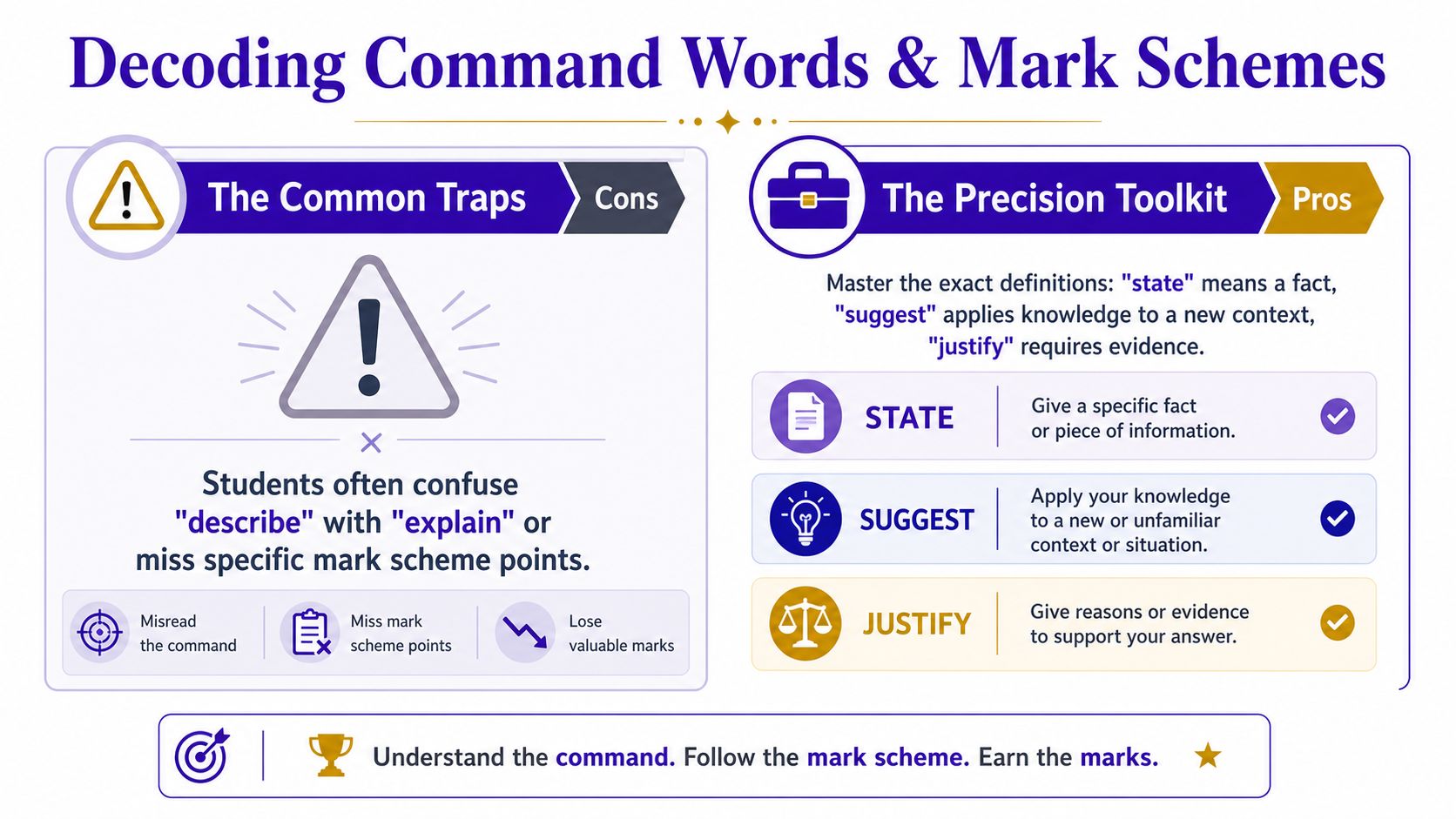
A student can know a decent amount of Chemistry and still leave marks behind because the answer does not match the command word. That is why a paper can feel easy in the room and sting later in the results. The chemistry was there, but the examiner was asking for a different shape of answer, a fact, a process, a linked explanation, or a judgement.
Learn the words the way examiners use them
State wants a brief fact. Describe wants what happens, in sequence or in observable terms. Explain wants the reason behind it. Outline wants the main idea, not every detail. Discuss needs balance. Evaluate needs judgement backed by chemistry.
Students often lose marks because they write too much, too little, or the right ideas in the wrong order. Keep a small command-word sheet from your own papers, with examples of answers that scored well and the phrases that earned the credit. A GCSE mark scheme guide can help you understand how examiners allocate credit across different command words.
Read the mark scheme sideways
The mark scheme is not a script to copy. It shows the evidence that earns credit, and that is what you need to train for. Read a question backwards if you have to, from the marks to the kind of points the examiner is likely looking for. That helps you stop giving three weak comments when the paper really wants one clear explanation and one application.
AQA's resource list is useful because it shows how scattered the support material can be, with quizzes and other links but no single tidy route through the exam language. AQA's Chemistry resource list makes that plain. The board gives you the specification and the resources, but you still have to learn how to answer in mark-scheme language.
Practicals, Required Practicals and the Paper 3 Trap
Required practicals are where solid students lose marks. They know the theory, then Paper 3 asks about variables, control, precision, risk, graphs, or evaluation, and the answer turns vague. Examiners usually want the logic of the experiment, not a shopping list of apparatus.
Revise the experiment, not just the name
For each required practical on your board, write a short method from memory. Then add the reason for each step. Why is that piece of equipment used? Why is the temperature controlled? Why is a measurement repeated? If your answer is “because that's what we did in class”, you haven't revised it properly.
The shortest useful routine is a design-a-method prompt for each practical. It forces you to think like the examiner. You don't need a full lab report. You need precise language about variables, control, precision, and how you would improve reliability if the results looked messy.
Paper 3 rewards discipline under pressure
Unseen practical questions often hide marks in graphs, anomalous results, and risk assessment language. A weak answer says “do it carefully”. A stronger answer names what is monitored, what is kept constant, or what is measured repeatedly. That shift in wording matters because the mark scheme is looking for specific control.
A useful memory rule: if a practical answer sounds like something you'd say in conversation, tighten it until it sounds like something a chemist would write.
Choose resources that actually test recall
Students get drowned by video clips, revision guides, short-form content, and flashcards that never demand a proper answer. Keep the shortlist tight. Use a board-specific past-paper pack, the official mark scheme for the same year, and one concise textbook. Online, use the Royal Society of Chemistry's education material for visualisation, your board's examiner reports, and a question bank that matches your specification. A-Level Past papers are the main thing to bank once the basics are in place.
Digital tools only earn their place if they do one of five jobs well, adaptive questions, command-word feedback, spaced repetition, exam-condition tracking, or a topic dashboard. MasteryMind is one UK example that aligns questions to AQA, Edexcel, OCR, and WJEC, gives examiner-style feedback, and tracks progress by topic. If a tool only rewrites notes or spits out flashcards without testing recall, leave it alone.
| Job to Be Done | Best Paper-Based Option | Best AI/Digital Option | What to Avoid |
|---|---|---|---|
| Learn required practicals | Specification notes plus your own method write-ups | A question bank that asks method and evaluation questions | Passive video-watching without retrieval |
| Practise Paper 3 style | Official past papers and mark schemes | Topic-matched exam-mode practice | Random question banks from the wrong board |
| Tighten command words | Your own annotated past-paper answers | Feedback that flags wording and AO issues | Flashcards with no application |
| Fix recurring mistakes | Reattempts of the same questions | Progress dashboards by topic | Rewriting notes as if that were revision |
Tracking Progress and Sticking With It Until Results Day
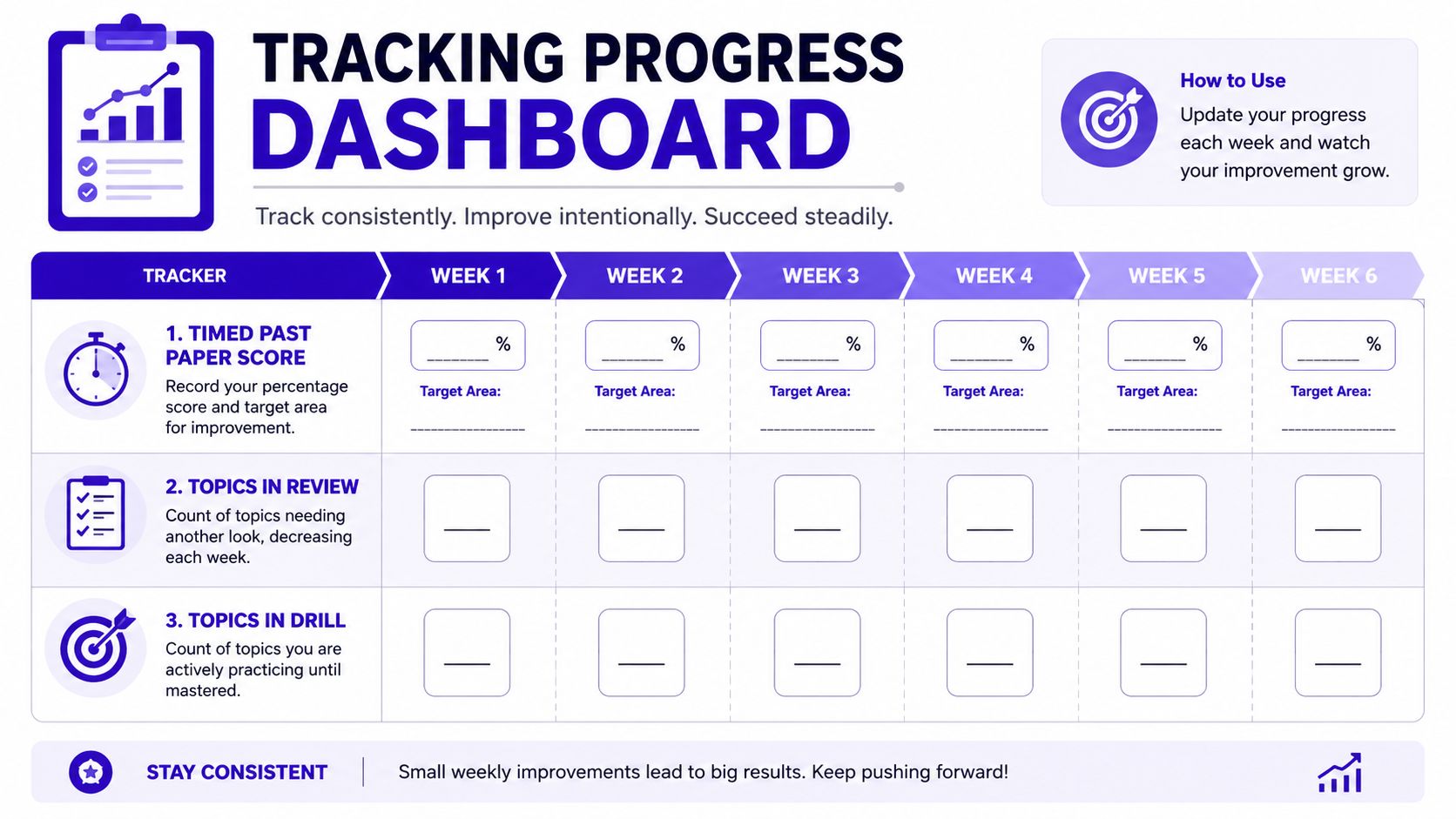
A revision plan only works if you can see movement. Each week, write down three things, your timed past paper score, how many topics are still in review, and how many are in drill. Add one note on maths accuracy. That's enough to show whether the work is changing anything.
Read the dashboard honestly
If your score is stuck, don't panic. Ask whether the plateau is content or technique. If the same topics keep appearing in review, you still have a knowledge gap. If the topics are there but the score is flat, the problem is usually wording, timing, or careless execution. The answer changes the fix.
Use the final fortnight properly
The last two weeks should not be about stuffing in new content. They should be about harder questions, mark-scheme comparison, and getting your answers sharper. Sleep, food, and one proper rest day matter more than another tired paper done badly.
The students who do best are not the ones who look busiest. They're the ones who keep retrieving the right content under exam conditions until it starts feeling routine.
If you've done the diagnostic, built the timetable, banked a stack of papers, and started your command-word phrasebook, you're already ahead of most of the field. Chemistry is hard, but it isn't mysterious. It only looks that way when revision is passive.
MasteryMind gives you board-aligned Chemistry practice, examiner-style feedback, and topic tracking, so you can turn a weak diagnostic into a proper revision plan. If you want timed questions, command-word feedback, and a way to see whether your Chemistry score is moving, visit MasteryMind and use it alongside your past papers.
Ready to master this topic?
Practise with quizzes, blurt exercises and exam questions on MasteryMind.
7 days Premium · Then free forever · No card, no charge