How to Revise a Level Physics the Smart Way
You've got the notes open, the revision playlist on, and a physics paper that still looks like it was written in another language. That's the normal starting point for a lot of students, whether they're trying to rescue a grade or push from strong to top-end. The problem usually isn't effort, it's that the effort goes into the wrong places, so the same lost marks keep coming back.
Where Most A Level Physics Revision Goes Wrong
A lot of students revise A Level Physics by building neat notes, colour-coding them, and telling themselves they're covered. Then the first timed paper comes back with the same weak explanations, missing units, and shaky command-word answers that were there last time. That's not a knowledge problem on its own, it's a revision-method problem.
The practical balance matters. One UK revision guide recommends weighting revision at about 40% on concepts and formulae and 60% on exam-question practice, which fits the way A Level Physics is assessed in real papers (Save My Exams revision tips). Physics rewards students who can use ideas under pressure, not just recognise them on a flashcard.
What students often get wrong
They spend too long making material look organised and too little time making it exam-ready. Examiner reports, as that same UK guidance notes, keep showing the same problems, weak explanation, missing units, and poor reading of command words. If you've ever lost marks on a question you “knew”, that's usually where the leak is.
Practical rule: if your revision feels calm but your marks don't move, you're probably practising recognition, not recall.
For a bit of structure while you work, a perfect lofi study setup can help you sit down and stay there, but the music isn't the fix. The fix is a revision loop that makes every paper tell you what to do next.
Mapping the Specification Before You Open a Past Paper
Start with the specification, not the paper. Split it into short statements, then mark each one as secure, shaky, or unseen. That gives you a one-page confidence grid you can build in an evening and keep updating after every session.
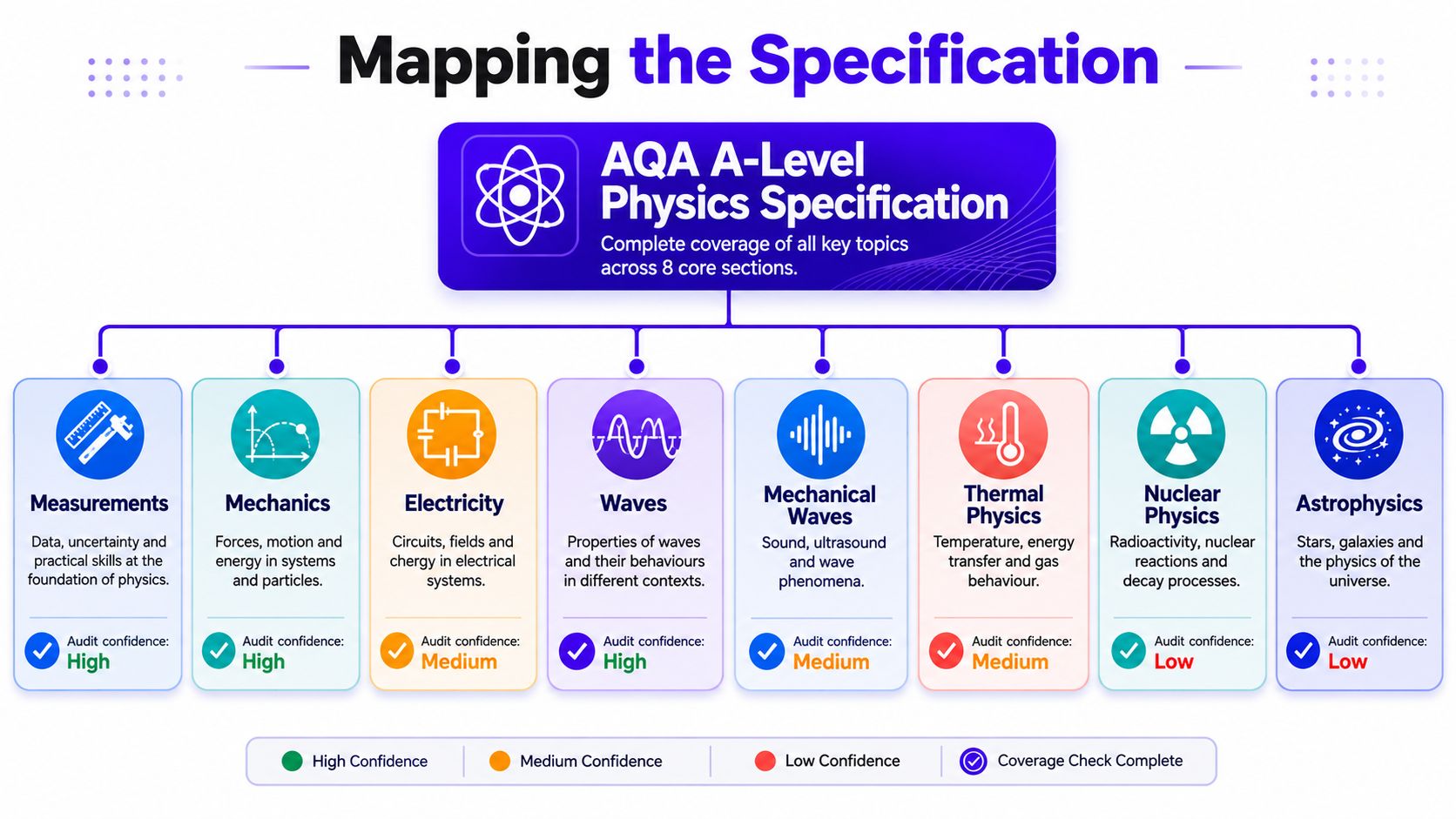
AQA groups the core course into Measurements and their errors, Particles and radiation, Waves, Mechanics and materials, Electricity, Further mechanics and thermal physics, Fields and their consequences, and Nuclear physics (AQA specification at a glance). That order isn't random. Mechanics and Electricity are load-bearing foundations, because later topics keep leaning on them in calculations, graphs, and explanations.
Build the map in a sensible order
Begin with the topics that feed the rest of the course. If Mechanics is shaky, later work on fields and motion gets harder fast. If Electricity is patchy, you'll feel that weakness again when questions start mixing ideas and requiring clean method marks.
Useful habit: don't ask “have I revised this topic?”. Ask “can I answer the short statements inside this topic without looking?”
The A-Level Past papers link is useful once your grid exists, because it gives you somewhere to test the topics you've flagged. Without the map, students jump straight into papers, hit unfamiliar areas too early, and mistake panic for lack of ability. With the map, every paper has a purpose.
The Diagnostic Loop That Replaces Endless Note-Taking
Timed questions should drive revision, not just end it. Do a short paper or topic set, mark it carefully, and log every lost mark by error type. Then reteach only the sub-skill that caused the loss, not the whole chapter again.
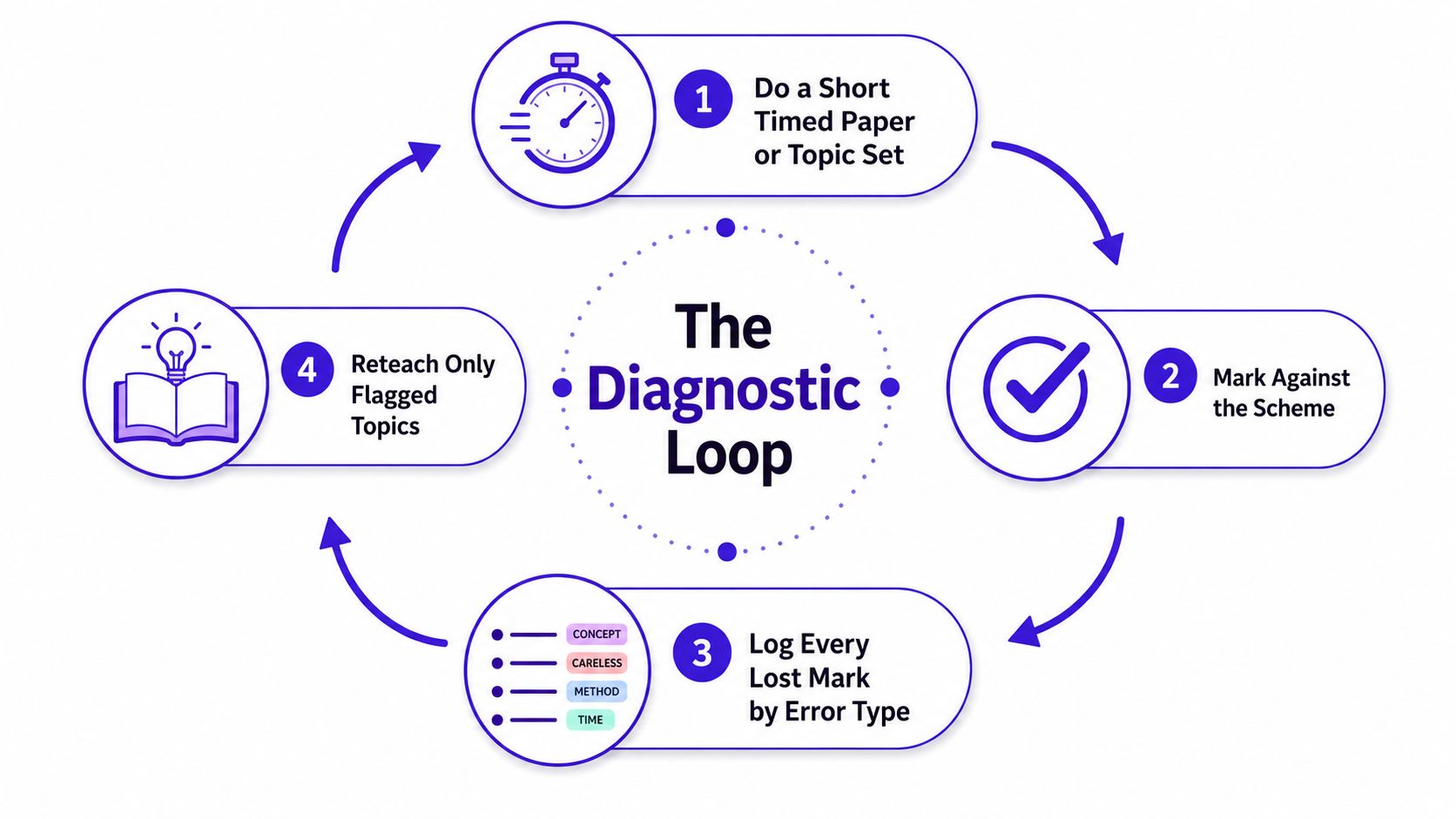
A strong way to sort mistakes is into five buckets, concept gap, equation-recall problem, algebra mistake, unit-conversion error, and weak practical interpretation. That classification turns a vague complaint like “I'm bad at SHM” into something concrete enough to fix. The most useful benchmark from the physics revision framework in the brief is to solve 5 to 10 representative questions per topic before moving into mixed-topic timed sets (Physics revision checklist by topic and exam season).
A worked example from one lost mark
Say a student loses three marks on a simple harmonic motion question because they forgot to convert ms to s. That isn't really a concept failure. It's a unit-conversion error, and the correction should be tiny, fast, and specific.
The fix might take ten minutes. Rewrite the conversion, do one similar question, then add a note in the error log saying “watch time units before substitution”. That single log entry now has a job, and it stops the same mistake from slipping through again.
Use colour with purpose
A red/amber/green grid keeps the whole syllabus visible. Red topics need reteaching now, amber topics need another round of practice, and green topics only need occasional maintenance. That way, revision time goes where it will change marks.
Exam Practice for A-Level fits this loop because you can treat each set as evidence, not entertainment. The point isn't to do more work, it's to stop repeating the wrong work.
Active Recall and Spaced Practice Without the Faff
Re-reading feels safe, but it doesn't tell you whether you can produce the answer. Active recall means testing yourself from memory. Spaced practice means coming back to the same idea later, after some forgetting has happened, so the memory has to work harder.
One good place to lean on while you build the habit is this science-backed study music guide, especially if silence makes you fidgety. Music won't make physics easier, but it can help you keep the routine going long enough for the routine to matter.
Three habits that work in real student lives
- Daily Blurt Challenge: spend ten minutes saying curriculum objectives out loud from memory, then check what you missed.
- Friday weak-topic review: go back to last week's worst questions and redo them before the memory goes stale.
- Index-card rotation: sort cards into daily, every three days, and weekly piles so weak ideas come back at the right intervals.
That approach matches the issue many learners have. A Y13 revision guide from a UK school recommends varying activities, self-assessing weak areas, and revisiting them a week later, which tells you students need a process, not just more notes (Y13 revision guidance).
If you want a cleaner explanation of the method, the page on how to use active recall fits neatly with this routine. The main point is simple. Test, leave, return, test again.
Cracking Command Words and Mark Scheme Logic
Physics marks don't just live in the final number. They live in the wording, the sequence of steps, and the way you show the physics. That's why two answers that look similar on the page can score very differently.
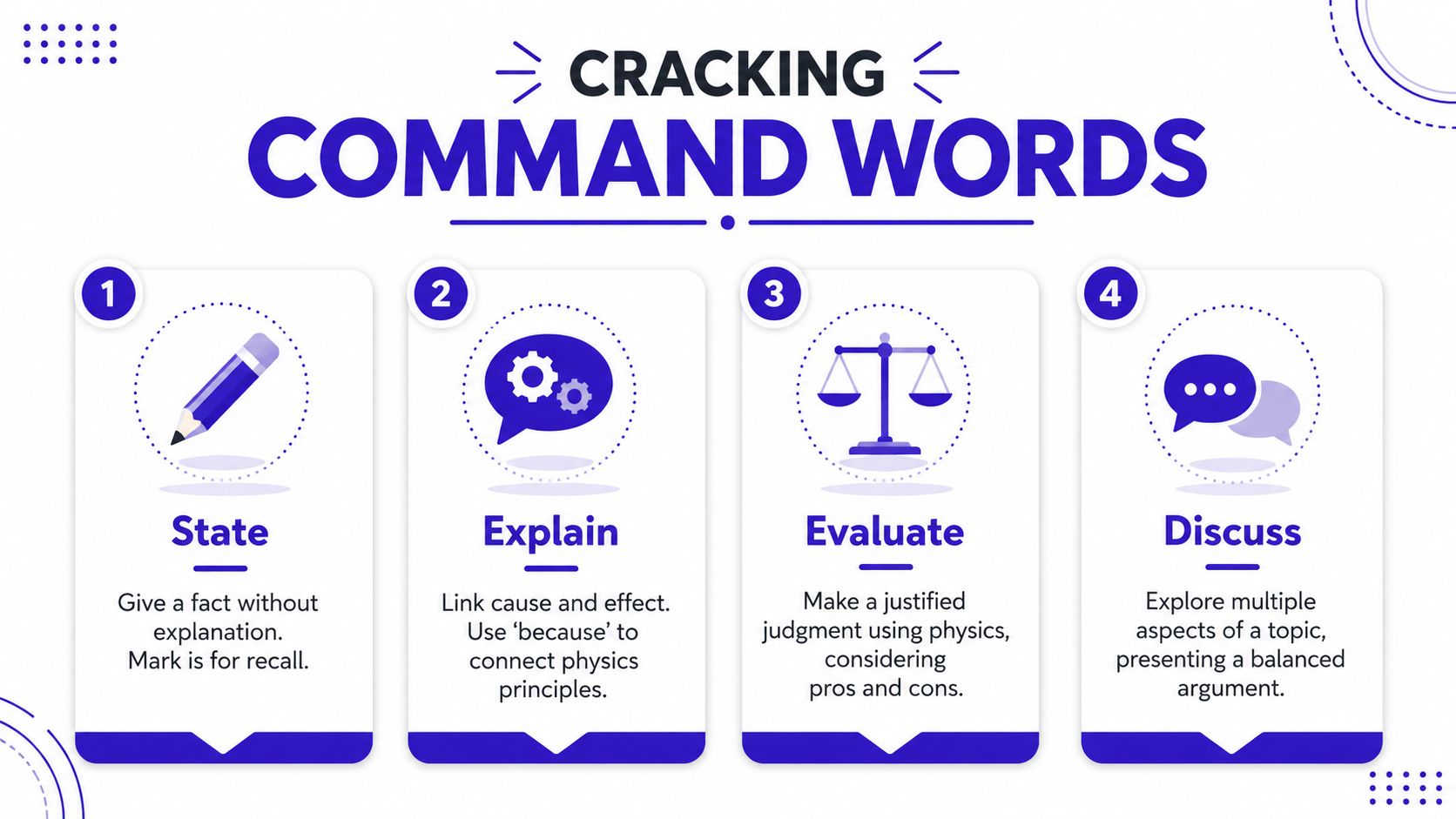
Read the command word first
State means give the fact. Explain means link cause and effect. Evaluate means make a justified judgement, and Discuss means weigh more than one aspect before reaching a balanced answer. If a student writes an explanation for a state question, they often waste time. If they give a bare fact for an explain question, they leave marks behind.
Show the method, not just the answer
Calculation questions usually reward the route as much as the result. Write the equation, substitute values, rearrange clearly, and carry units through the line. OCR's A Level Physics A specification says 40% of the marks available in written examinations are for mathematical assessment at Level 2 in a physics context, and the regulatory guidance says at least 40% of marks should assess mathematical applications and at least 15% should assess practical scenarios (OCR specification).
That's why a clean working line matters. If you jump straight to the answer, the marker may have nothing to credit. If you show the rearrangement and the unit check, you give the examiner places to award method marks even when the final figure is wrong.
A useful way to think about a 6-mark response is this. A 3-mark answer often has the right idea but thin physics, while a 6-mark answer shows the mechanism, uses the right terms, and stays tied to the question. That gap is where marks are usually won.
Revising the 12 Core Practicals Without a Lab
Practical revision still matters even when you're nowhere near a bench. A level Physics courses must include a minimum of 12 core practical activities, opportunities to develop the techniques listed in Appendix 5c, and they are 100% externally assessed with no coursework units (Pearson guidance). That means practicals show up in written questions, not lab reports.
The drills that stick
First, write the apparatus list and method steps from memory. Then check what you missed and repeat until the sequence comes out clean. Next, sketch the graph you'd expect before looking at the standard result, because that trains you to spot shape, gradient, and relationships rather than just memorising finished diagrams.
The third drill is uncertainty work on supplied data. Use values, tables, and graphs that already exist, then practise identifying control variables, describing anomalies, and explaining why a result looks odd. That's the sort of language examiners reward in scenario questions.
| Skill | Best Solo Drill | Common Mark-Loss |
|---|---|---|
| Method recall | Write the full procedure from memory | Missing key steps or order |
| Graph prediction | Sketch the expected shape before checking | Wrong gradient or axes |
| Uncertainty | Work through a data set by hand | Forgetting units or propagation logic |
A practical question rarely asks, “Can you do the experiment tomorrow?”. It asks whether you can interpret what happened and explain it clearly. That's a different skill, and it can be trained alone.
Sample 4, 8 and 12-Week Revision Schedules
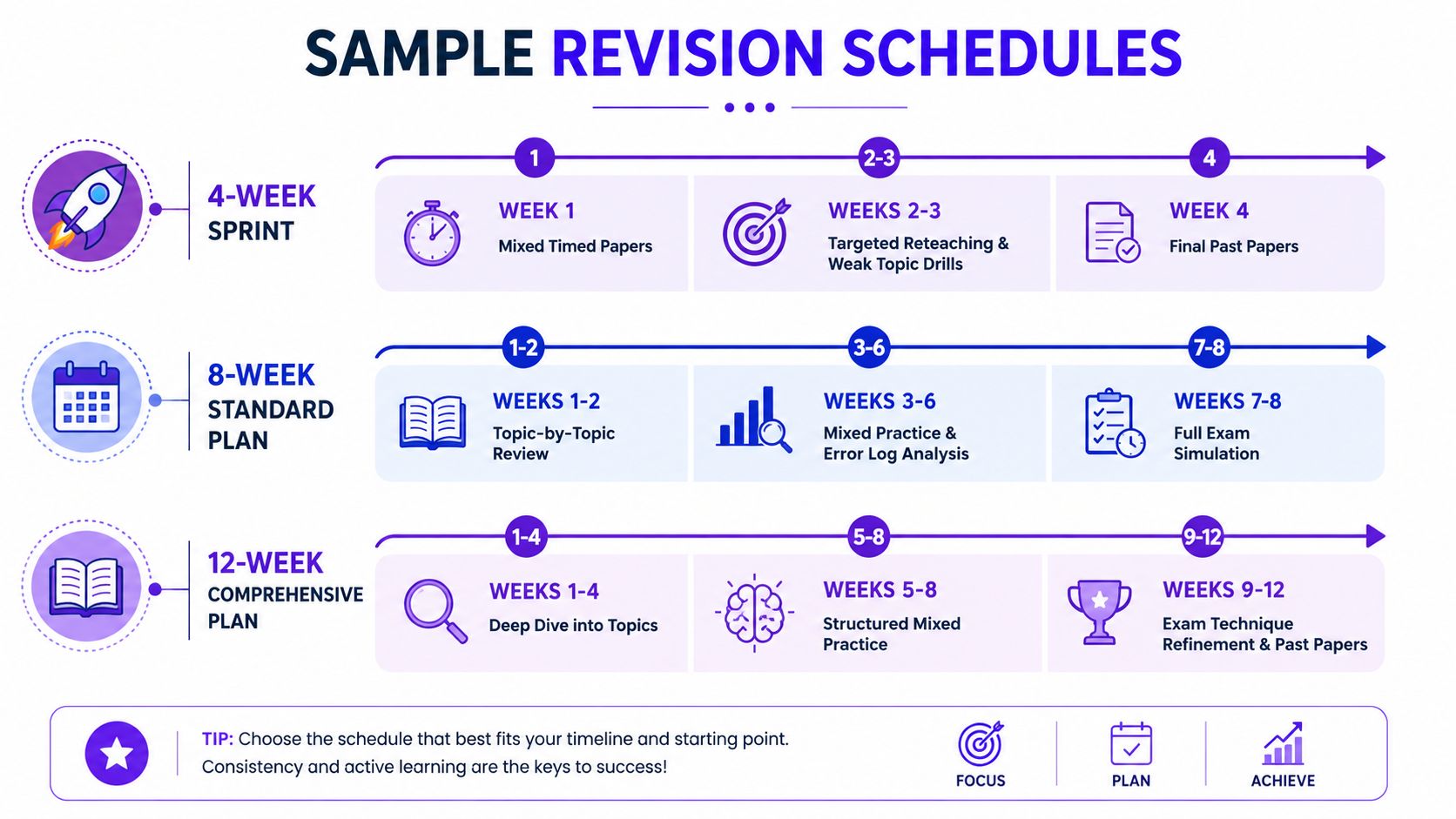
A good schedule is just the diagnostic loop stretched across a calendar. The safest version for most students is the 8-week plan, because it leaves enough time to learn, test, fix, and retest without pretending every week will be perfect. If you're starting late, the 4-week sprint can still work. If you're rebuilding from the ground up, the 12-week plan gives you room to repair the basics.
The 4-week sprint
Week 1 should be mixed timed papers, so you find the biggest leaks quickly. Weeks 2 and 3 should focus on targeted reteaching and weak-topic drills. Week 4 should be full past papers, done under proper time pressure, with error logs beside you.
This plan only works if you stop polishing notes and start attacking the mark losses. If life gets in the way, drop the extra reading first, not the diagnostic paper.
The 8-week standard plan
Weeks 1 and 2 are for topic-by-topic review, using your confidence grid to choose the order. Weeks 3 to 6 should move into mixed practice and error-log analysis, because that's where the key pattern spotting happens. Weeks 7 and 8 should feel like full exam simulation, with timing, silence, marking, and correction.
This is the best place to correct the recurring errors that examiner reports keep flagging, missing or wrong units, vague explanations that skip the physics, failing to show working for method marks, misreading command words like describe versus explain, and treating estimates as guesswork instead of Fermi-style order-of-magnitude reasoning. Those are habits, not personality traits, so they can be trained out.
The 12-week rebuild
Weeks 1 to 4 are for deep dives into the topics that are still shaky. Weeks 5 to 8 should become structured mixed practice, with the red topics revisited often. Weeks 9 to 12 should shift into exam technique refinement and past papers, because by then the content needs to be automatic.
This matters even more for students dealing with bigger gaps. The Education Policy Institute reported in 2024 that disadvantaged pupils were still around 19 months behind their better-off peers at the end of secondary school (EPI 2024 report). That's why generic rereading isn't enough. Revision has to diagnose misconceptions and target higher-order gaps.
A clean swap-list helps on busy weeks. Re-reading notes becomes self-quizzing. Highlighting becomes summarising from memory. Passive watching becomes pause-and-recall.
For board-aligned practice, Online Revision for A-Level is one place to put the loop into action, especially if you want questions matched to command words and mark allocation. Tomorrow morning, print the specification, build the confidence grid, and book one diagnostic mini-paper for the weekend.
If you want a revision system that matches how A Level Physics is marked, use MasteryMind to practise by topic, command word, and exam style. It gives you a place to run the same diagnostic loop described here, then tighten the weak spots with feedback you can act on.
Ready to master this topic?
Practise with quizzes, blurt exercises and exam questions on MasteryMind.
7 days Premium · Then free forever · No card, no charge