Rounding and Estimation for GCSE Maths
The calculator shows 1495.8 and the question wants the nearest pound. A friend has already written 31.4 for a sum that should have stayed unrounded a bit longer. Exam week is close, whether you're catching up or pushing for the top grade, and rounding and estimation is where a sound method still drops the accuracy mark.
Read this the way a maths teacher talks it through, with the numbers a colleague would check. Each rule sits next to a figure and a mark-scheme habit.
Why Rounding and Estimation Are Different Jobs
Say the shop has three items at £498.60. Round each price to £500 and multiply by three and you get £1,500. The exact bill is £498.60 × 3 = £1,495.80. Both figures are honest. They just aren't doing the same job.
The same shop total, drawn as two different jobs:
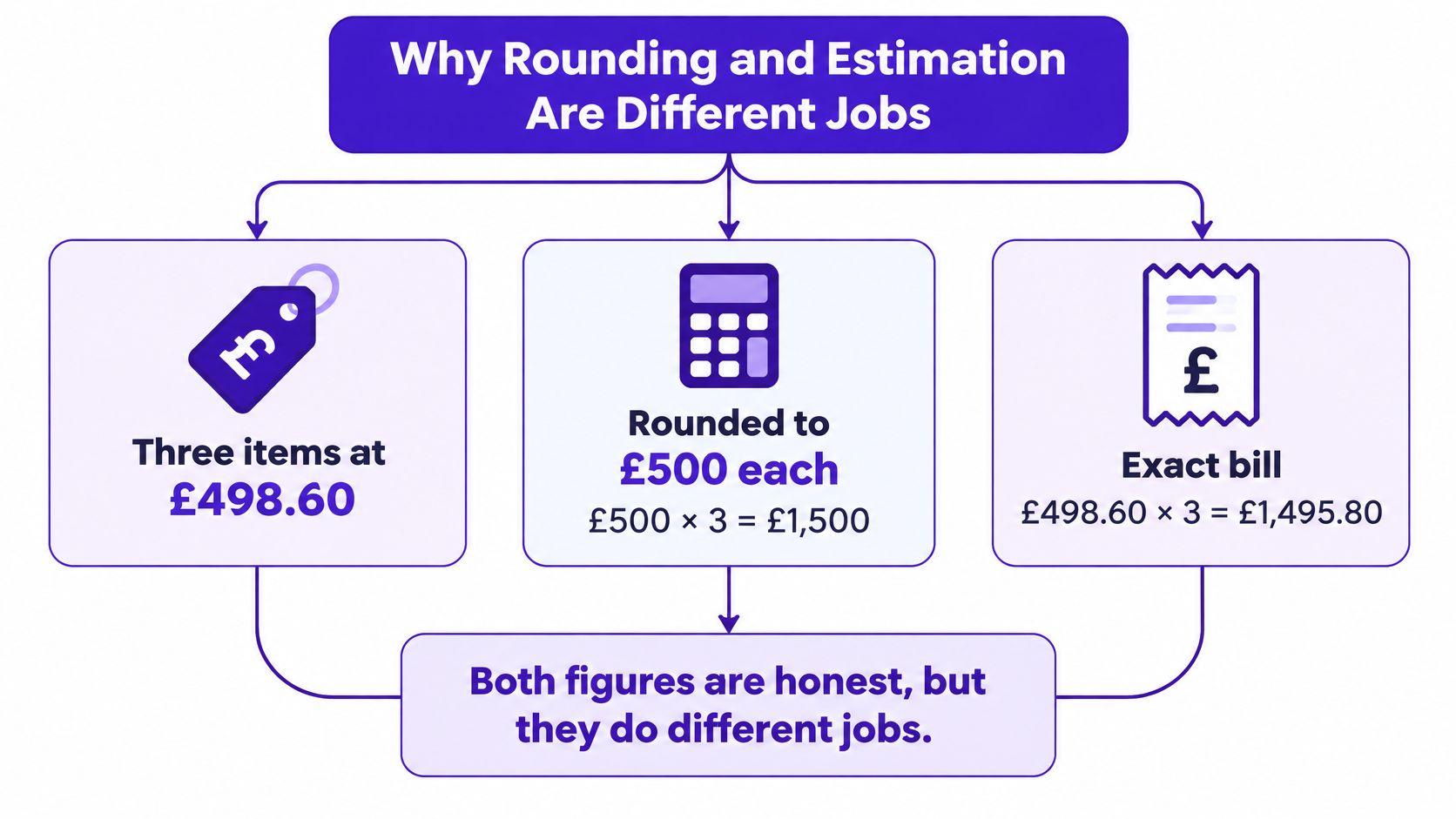
Rounding states a number to a required accuracy. Estimation predicts the size of a result, checks a calculator display, and shows up a slipped decimal or a wrong unit.
The national curriculum in England mathematics programmes of study treats the two skills as related but distinct. Pupils approximate to judge the order of magnitude, check a calculation, and decide whether an answer is reasonable. That is more than the rule that 5 or more rounds up. GCSE content also expects you to check calculator and technology answers by estimation.
Extra digits aren't extra truth
A long decimal can look precise while the inputs were already rounded. A medicine dose, a money total and a quick product don't share one tolerance. Rounding 498 to 500 is fine for a rough product. The same step on a dose, a financial total or a measurement can change the decision you should make. How far an estimate may drift before it signals an error depends on the scale and the units, not on a slogan.
Three questions run through the rest of this piece. Which digit decides the round? Do you estimate before the calculation or after it? What interval does a rounded measurement stand for?
Read the command word before you touch the number.
Rounding Rules You Can Apply Straight Away
Circle the deciding digit before you change anything. The table is the lookup. The notes underneath walk the rows you encounter.
| Rule | Deciding digit |
|---|---|
| Nearest integer | Tenths. 46.5 becomes 47 |
| Nearest 10 | Units. 465 becomes 470 |
| Nearest 100 | Tens. 450 becomes 500 |
| 1 decimal place | Hundredths. 3.141 becomes 3.1 |
| 2 decimal places | Thousandths. 2.675 becomes 2.68 |
| 1 significant figure | Digit after the first non-zero. 0.00462 becomes 0.005 |
| 2 significant figures | Digit after the second significant figure. 498.6 becomes 500 |
| 3 significant figures | Digit after the third significant figure. 3.1415 becomes 3.14 |
| Truncated to 2 decimal places | Cut, do not round. 3.141 becomes 3.14 |
Decimal places
Count places after the point, then look only at the next digit.
3.141 to 1 decimal place keeps the 1 and looks at the 4 in the hundredths. Four is below 5, so the answer is 3.1. Write "3.1 to 1 d.p." so the accuracy is visible.
2.675 to 2 decimal places keeps 2.67 and looks at the 5 in the thousandths. Five rounds up, so the 7 becomes 8 and the answer is 2.68.
Significant figures
Start at the first non-zero digit. Leading zeros after the point aren't significant. They're placeholders so the size stays right.
0.00462 to 1 significant figure starts at the 4. The next digit is 6, which rounds up, so you get 0.005. Dropping the zeros to write 5 would multiply the number by a thousand.
498.6 to 2 significant figures starts at the 4. The second significant figure is 9, and the next digit is 8, so 49 rounds to 50. You must keep the zero and write 500, not 50.
3.1415 to 3 significant figures uses 3, 1 and 4. The next digit is 1, which is below 5, so the answer stays 3.14.
Nearest ten, hundred, and a cut instead of a round
Nearest integer, nearest 10 and nearest 100 use the same half-up rule on positives.
- 46.5 to the nearest integer looks at the tenths digit 5 and becomes 47.
- 465 to the nearest 10 looks at the units digit 5 and becomes 470.
- 450 to the nearest 100 looks at the tens digit 5 and becomes 500.
Truncation cuts rather than rounds. 3.141 truncated to 2 decimal places is 3.14, even though the next digit is 1. If the question says "truncate" or "write down the first two decimal places", don't apply the 5 rule.
Practical rule: On a positive number, GCSE half-up treats a deciding 5 as a round away from zero. For a negative such as −1.5, follow the instruction in the question. Don't invent a second convention in the exam hall.
Circle the deciding digit in your working, then write the accuracy on the answer line, for example 3.14 to 2 decimal places.
Estimation Strategies That Catch a Wrong Answer
Try the strategies in the order you'd use them under timed conditions. A sensible estimate has a job. It predicts size, or it audits a display. It isn't a second final answer unless the question says "estimate".
Three ways to test a result before you commit to it:
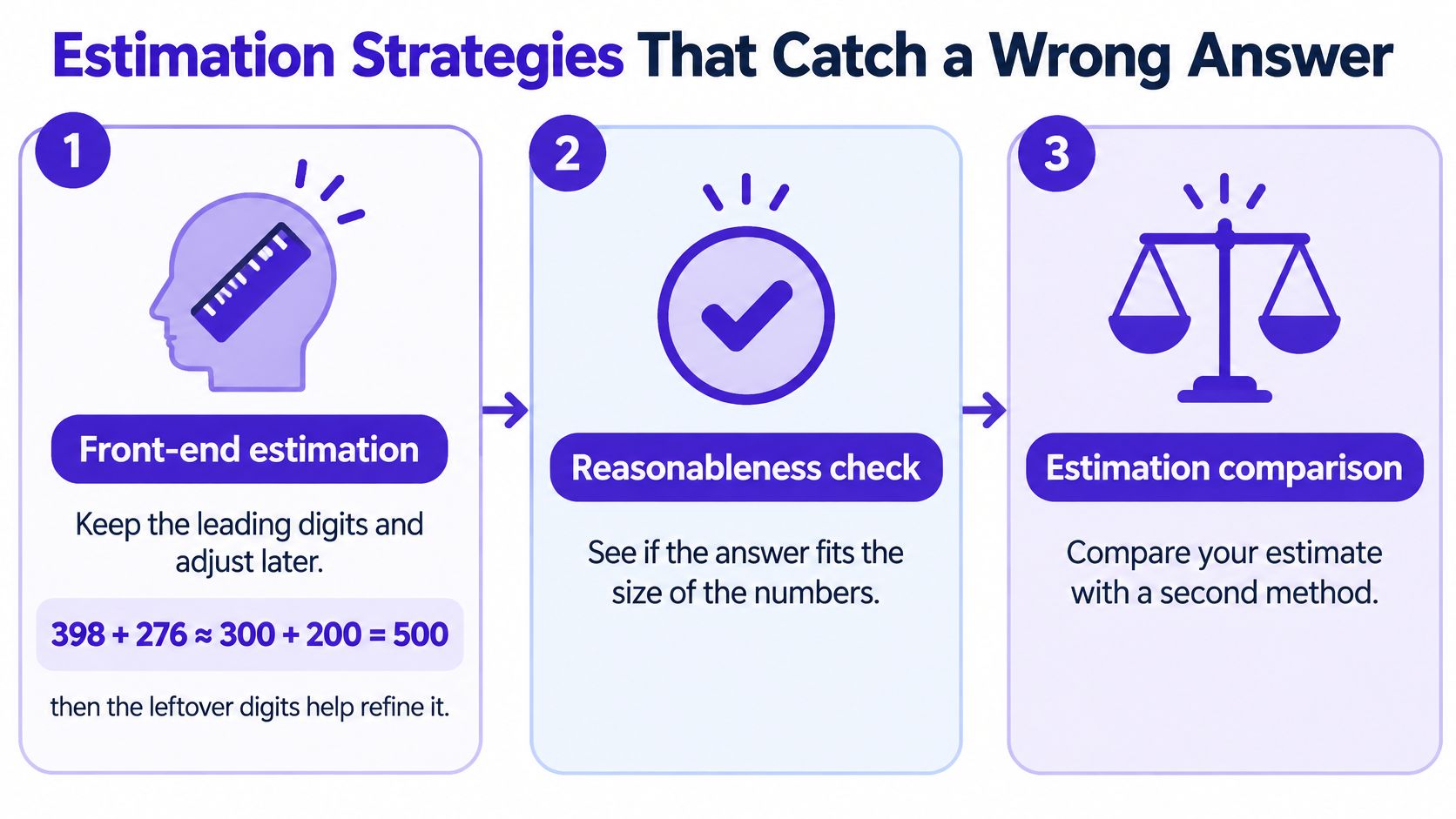
1. Front-end estimation for a sum
Keep the leading digits, add them, then bring the leftovers back in.
398 + 276 is about 300 + 200 = 500. The leftovers are 98 and 76, about 170, so a sensible total sits near 670. The exact sum is 674. If your calculator says 574 or 764, the estimate has already told you a digit was mistyped. Use this before a long addition when you want the size, and again afterwards if the display looks odd.
2. Rounding first for a product
Round each number to 1 significant figure, then calculate.
48.7 × 6.2 is about 50 × 6 = 300. The exact product is 301.94. A display of 3,019.4 is out by a factor of ten. Redo it. Don't "fix" it by moving the point.
Estimate before the product when you want to know whether the answer should be hundreds or thousands. Estimate after it when you're checking a calculator line you don't trust.
A 1-significant-figure product can easily sit 10 to 20 percent away from the exact value. That gap is enough to expose a wrong order of magnitude. It isn't tight enough to check pence, a dose or a bound. Keep the full calculator value until the question asks you to estimate.
3. Compatible numbers for a division
Swap the numbers for a nearby pair that divides cleanly.
312 ÷ 48 is near 300 ÷ 50 = 6. The exact quotient is about 6.5. An answer of 0.65 or 65 has the right digits and the wrong size. Show the compatible pair in your working so the method mark has something to land on.
If you want a short walk-through of the same habit on a calculator display, this clip is worth five quiet minutes:
Error Intervals from Rounded Measurements
3.2 cm to 1 decimal place isn't the single length 3.2 cm. Any length from 3.15 cm up to but not including 3.25 cm rounds to 3.2. In symbols, 3.15 ≤ length < 3.25. The lower bound is included. The upper bound isn't, because 3.25 would round up to 3.3.
The half-unit is half the place you rounded to. Nearest centimetre uses half a centimetre. One significant figure on 500 uses half of 100, which is 50. Two decimal places on a measurement in metres uses half of 0.01 m, which is 0.005 m.
| Stated value | Accuracy |
|---|---|
| 3.2 cm | 1 decimal place. 3.15 cm ≤ length < 3.25 cm |
| 500 | 1 significant figure. 450 ≤ value < 550 |
| 2.50 m | 2 decimal places. 2.495 m ≤ length < 2.505 m |
| 7.3 | Truncated to 1 decimal place. 7.3 ≤ value < 7.4 |
Truncation isn't the same interval
7.3 truncated to 1 decimal place runs from 7.3 up to but not including 7.4. There is no half-unit below 7.3, because anything smaller would already have been cut to 7.2. If you write 7.25 ≤ x < 7.35 on a truncation question, you've answered a rounding question instead.
A rectangle, then a published score
A rectangle is 6 cm by 4 cm, both to the nearest centimetre. The minimum area uses both lower bounds. 5.5 × 3.5 = 19.25 cm². The maximum area uses both upper bounds. 6.5 × 4.5 = 29.25 cm². Quoting "24 cm²" as if the sides were exact throws away the whole bounds mark.
The same half-up habit shows up outside the classroom. Secondary accountability measures guidance for 2025 to 2026 states that published progress scores use normal rounding. Digits below 5 round down, and 5 or above round up, so 0.09540 becomes 0.10. A boundary digit changes the reported figure.
Two neat intermediate roundings can disagree and both look tidy. Keep guard digits and round once at the end, unless the question demands an estimate. On a difference or a quotient, pair the bounds the opposite way. For 12 − 5, both to the nearest whole number, the smallest value is 11.5 − 5.5 = 6 and the largest is 12.5 − 4.5 = 8.
If you want board-style items on this, AQA maths practice for GCSE students is one place to rehearse the inequality line until it is automatic.
Worked GCSE and A-Level Calculations
Four short solutions, in rising difficulty. Each one shows an unrounded line, an estimate where it earns its keep, and the final rounded line. The mark follows the command, not the neatness of the display.
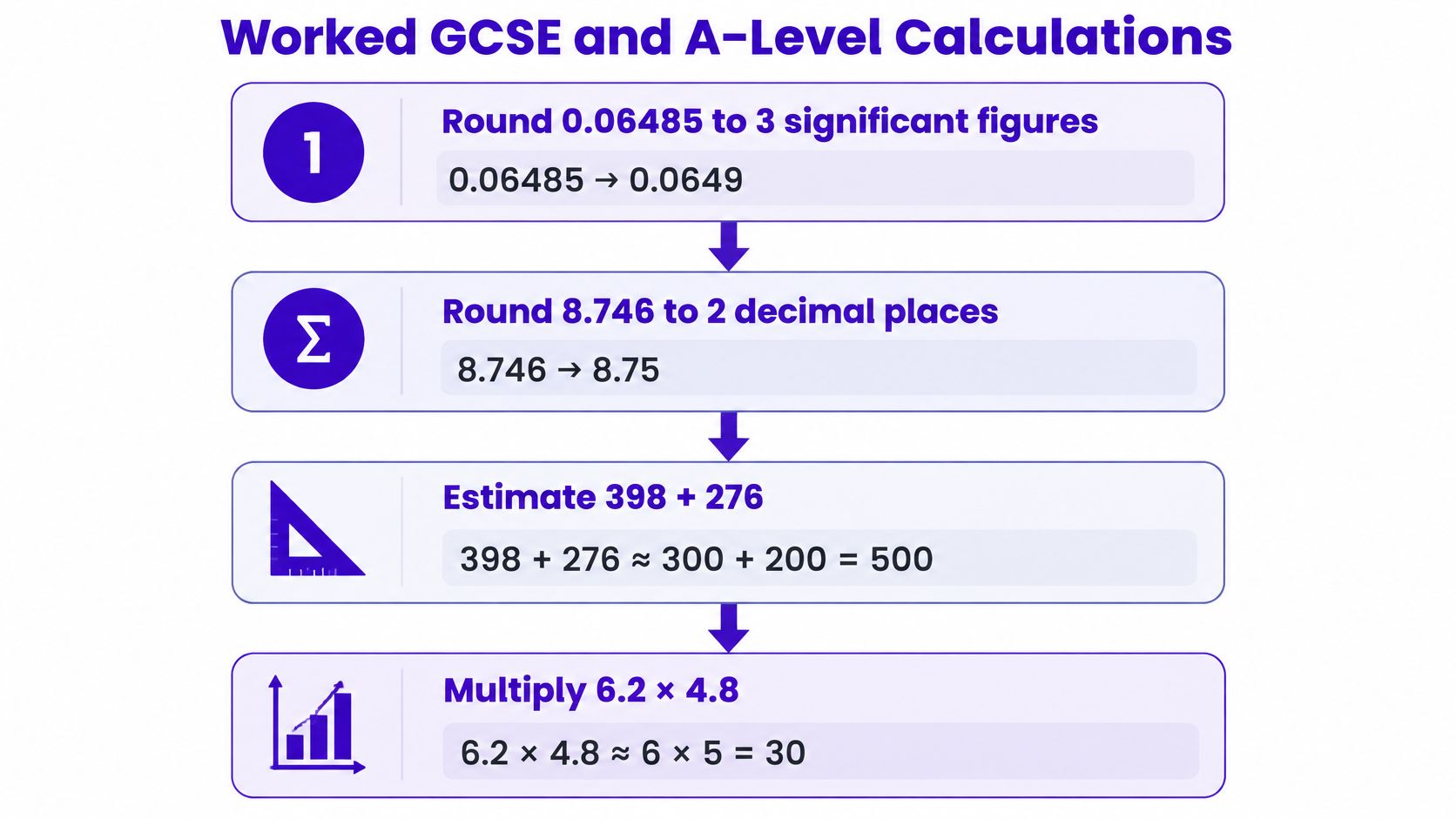
Four workings, unrounded line first:
Accuracy on a small decimal
Round 0.06485 to 3 significant figures. The first three significant digits are 6, 4 and 8. The next digit is 5, so 648 rounds up.
Unrounded digits in view: 0.0648|5. Final line: 0.0649 to 3 significant figures. The command is an accuracy command. The mark wants the rounded value and the stated accuracy, not an estimate beside it.
A speed, estimated then stated
A journey is 186 km in 2.4 hours.
Estimate first, to 1 significant figure: 200 ÷ 2 = 100 km/h. That predicts a speed in the tens or low hundreds, not thousands.
Exact line: 186 ÷ 2.4 = 77.5 km/h. To 3 significant figures that is already 77.5. The estimate is rough because 2.4 was pulled down to 2, but it still shows that 775 km/h would be a decimal slip. If the question says "estimate", 100 km/h with the rounded working is the answer. If it says "calculate, give your answer to 3 significant figures", 77.5 is the answer.
Money after a percentage chain
A calculator shows £1,248.6375 after a multi-step percentage. Keep the pence calculation exact until the end. Money rounds to the nearest penny, so the thousandths digit 7 rounds the 3 up.
Final line: £1,248.64. A 1-significant-figure check sits near £1,000, so £12,486.37 would be a point in the wrong place. The command here is money rounding, not "3 decimal places".
A standard-form power check
4.8 × 10⁵ ÷ (1.6 × 10²). Divide the decimals and subtract the powers. 4.8 ÷ 1.6 = 3, and 10⁵ ÷ 10² = 10³, so the unrounded result is 3.0 × 10³.
Estimate: 5 × 10⁵ ÷ (2 × 10²) = 2.5 × 10³. That is close enough to trust the power. The command is an order-of-magnitude check. You aren't being asked to replace 3.0 × 10³ with 2.5 × 10³ unless the wording says "estimate".
Compare your line with mark schemes for UK exam revision when you want to see which of those four commands carried the mark.
Mistakes That Change the Final Mark
Premature rounding is the expensive slip, because it can poison every line after it.
Divide 22 by 7 and round to 3.14 too early, then multiply by 10, and you get 31.4. Keep the division intact: 220 ÷ 7 = 31.428…, which is about 31.43 to 2 decimal places. The early round often costs the accuracy mark. If the later steps depend on that 3.14, it can cost the method as well. Correction: carry at least one guard digit, and round once, on the final line.
Five more slips, each with a wrong number and a fix
Mixing decimal places with significant figures. 0.00462 to 2 decimal places is 0.00. To 2 significant figures it is 0.0046. Writing 0.00 on a significant-figure question usually costs the accuracy mark only, if the method was clear. Read the words "decimal places" and "significant figures" as different instructions.
Treating a rounded measurement as exact. A bounds question on 3.2 cm that starts the interval at 3.2 has skipped the half unit. The lower end is 3.15. That fault normally costs the whole bounds method, not a trailing accuracy mark.
Dropping placeholder zeros. 500 to 1 significant figure written as 5 is a thousand times too small. The corrected value is 500. This often wipes out the answer mark and any later calculation that used the 5.
Rounding money to three decimal places of a pound. £1,248.6375 written as £1,248.638 isn't a money answer. The corrected value is £1,248.64, the nearest penny. You usually lose the accuracy mark, and sometimes a communication mark if the pound sign or the two decimal places never appear.
Trusting a long calculator tail. A display of 3,019.4 for a product whose 1-significant-figure estimate is about 300 has the wrong power of ten. Redo the sum. Keeping the long tail doesn't rescue it, and the error usually costs the final answer even when an earlier method mark survives.
Teachers can run those six lines as a live check. One wrong number, one corrected number, no second explanation of the rule.
A timed sitting is the honest test of whether the habit sticks. Exam Practice for GCSE puts a clock on mixed questions so the correction happens before the paper, not on it.
Match the Command Word Then Practise
Tick one box before you write a digit. The command word chooses the method.
- "Estimate": approximate each number first, usually to 1 significant figure, and show that working. The estimate is the answer.
- "Give your answer to" or "correct to": keep full values through the calculation, round only the final value, and state the accuracy.
- "Write down the error interval": use inequalities. Don't return a single rounded number.
- "Calculate": keep full values, then round only as instructed. For money, that is usually the nearest penny.
If two of those phrases appear, obey both. "Calculate, then give your answer to 3 significant figures" isn't an invitation to round the inputs.
Three problems, answers only after you've tried them
- 6,785 to 2 significant figures is 6,800. The deciding digit is 8, so 67 rounds up, and the zeros hold the thousands.
- A side of 12.6 cm to the nearest millimetre has bounds 12.55 cm and 12.65 cm. In a full interval, 12.55 ≤ side < 12.65.
- 39.4 × 5.1 estimated to 1 significant figure is 40 × 5 = 200. The exact product is 200.94, so the estimate is tight this time. You still wouldn't use 200 to check pence.
A five-question clock
Set a mixed set of five questions and time it. Redo any item where your estimate and the calculator display disagree by more than one order of magnitude. Then write the command word beside each of the five, and check your method against the four-way choice above. If you wrote an interval for an "estimate" question, or a single number for an error interval, that mismatch is the thing to fix, not the arithmetic.
Pull a mixed set from GCSE Past Papers and mark the command word in the margin before you start the clock.
MasteryMind is an AI revision platform for UK GCSEs and A-Levels, and it lines maths questions up with AQA, Edexcel, OCR and WJEC command words and mark allocations. Use it to drill rounding to decimal places and significant figures, estimation to one significant figure, and error intervals, then read the step-by-step check on any answer you still doubt. Start on the free plan at MasteryMind.
Choose your next course task
Use this idea with Mathematics. Confirm the qualification, awarding organisation and course version before choosing practice, assignment preparation or evidence planning.
Choose your Mathematics course