How to Stretch and Challenge GCSE and A-Level Learners

Giving students harder-looking questions isn't a stretch-and-challenge strategy. A longer worksheet can ask for exactly the same thinking as a shorter one, while a simple question followed by “justify your answer” can expose a gap that routine practice never touches.
Whether you're trying to recover an exam after leaving revision late or aiming for the highest grades, the useful question is the same: what can you do securely, and what does the next answer need? For teachers, there's another constraint: the task must produce worthwhile thinking without creating a second marking pile.
Map Stretch to Command Words and Marks
A worksheet can hold State one role of osmosis in plant cells beside To what extent does surface area affect uptake? and label both "challenge". The distance between those two questions is what stretch means: the thinking and the mark demand a learner has to meet, whatever the task looks like on the page.
Command words give you the first measurement. State asks for recall, explain asks for causal links, and evaluate asks for a supported judgement. Treat the rungs as a planning aid rather than a fixed ranking of verbs, because context shifts the demand: identifying a feature in an unfamiliar source can be harder than explaining a process the learner already knows cold. Read the command word alongside the content and the mark scheme.
Build the ladder around the answer
Assessment objective weightings vary by subject and by specification. Recall underpins every higher rung, yet practice that never leaves the bottom rung leaves much of the assessed thinking untouched.
Stretch ladder by command word
| Stretch level | Typical command words | Typical marks | Example task |
|---|---|---|---|
| Secure recall | State, define, name | 1–2 marks | Define osmosis in one sentence |
| Apply | Calculate, describe, identify | 2–4 marks | Calculate the mean rate of reaction from a results table |
| Analyse | Explain, analyse, compare | 4–6 marks | Explain why the rate of reaction slows as reactants are used up |
| Evaluate | Evaluate, to what extent, assess | 8+ marks, rising to 24 for extended essays | To what extent did the Treaty of Versailles cause the Second World War? |
These bands are typical planning ranges, and the mark allocations and command-word conventions of AQA, Edexcel, OCR and WJEC differ, so check the relevant specification before copying wording into a task.
Each rung also carries a marking cost. A definition takes seconds to check against a mark scheme; a levelled judgement takes minutes. For a learner who can name the reactants but can't yet explain collision frequency, evaluation is too large a jump. Move one rung above the learner's secure level and you get new thinking at a workload you can absorb.
Make the demand visible
Before running a set in Exam Practice for GCSE, name the answer feature you want to improve: a calculation method, a causal chain or a supported judgement. Completing a question isn't the same as practising its most demanding part.
Parents who want to recognise suitable challenge without becoming subject teachers can use Queens Online School's a parent's guide to appropriately challenging lessons as a starting point for that conversation.
Practical rule: If a learner answers the last question in a set accurately, independently and with sound reasoning, move them up one rung next time.
How to Design a Stretch Task in Five Steps
A useful stretch task makes the thinking process visible. Students need to know what they're attempting, how they'll approach it and what they'll change when the first answer falls short.
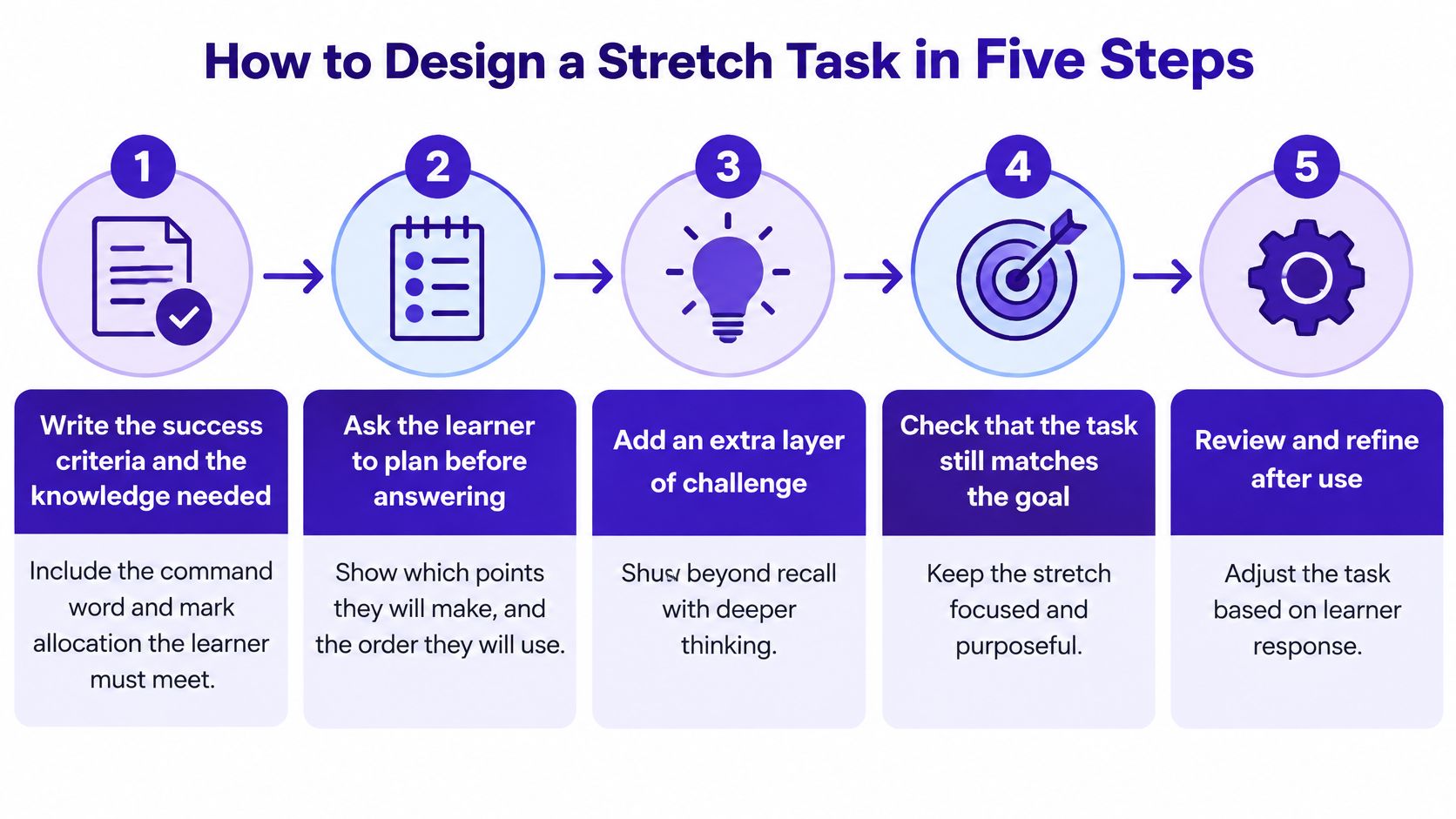
Plan the answer before increasing the demand
Write the success criteria and the knowledge needed. Include the command word, the available marks and the answer features that earn credit. For a GCSE chemistry task on reaction rates, check that the learner knows collision theory before asking them to explain a changing rate.
Ask the learner to plan before answering. They should identify their points, supporting evidence and checking method. In chemistry, that might mean selecting the relevant part of a gas-volume graph and deciding how to connect its gradient to particle collisions.
Add an extra layer of challenge. Set the task just beyond what the learner already handles independently, with the new demand visible. For example, a teacher-created six-mark practice question could extend a secure three-mark explanation by adding graph evidence and a comparison between conditions.
Monitor the approach while they work. Ask what the command word requires, which evidence supports the claim and how they can verify the result. If the student is writing about temperature when the question concerns reactants being used up, redirect the reasoning before they finish an irrelevant paragraph.
Diagnose the failed strategy, then require a revision. Examiner-style feedback should identify the missing link rather than request more detail. The learner then rewrites the explanation or briefly explains why their original approach couldn't earn the available credit.
Planning and revision deserve particular attention because they turn an attempt into something the student can learn from. The Education Endowment Foundation's metacognition and self-regulation review reports an average impact equivalent to eight additional months of progress over a year, based on 355 studies. That isn't a promised gain from a worksheet: teach the strategy within chemistry, history or maths rather than as a generic study skill.
A chemistry example from start to finish
Take a reaction between marble chips and excess acid. Start with the success criterion: explain why gas production slows, using collision theory and evidence from a graph.
The student plans a sequence: the graph becomes less steep, marble chips are consumed, less exposed solid remains available for reaction, and successful collisions occur less frequently. The stretch demand is to connect the observation to the particle explanation, not merely describe the curve.
During writing, check whether the student has confused a slower reaction with a smaller final gas volume. Feedback then names that distinction, and the revised answer must explain it correctly.
Use GCSE Past Papers to find an appropriate question and compare the response with its actual mark scheme. If the learner can't use the plan because the underlying chemistry is missing, teach that knowledge first. Guessing at unfamiliar science isn't productive challenge.
Sample Stretch Tasks Across GCSE and A-Level Subjects
Base and stretch task pairs by subject
| Subject | Base task | Stretch version | What to check |
|---|---|---|---|
| GCSE maths | Solve a linear equation | Build and solve an equation from a worded context, then check the answer against the original context | Substitution check is written out |
| GCSE biology | Label a diagram of the heart | Explain the pressure changes through one cardiac cycle using correct terms | Correct terminology and sequence |
| GCSE English literature | Identify a quotation about a character | Analyse how one word choice shapes the reader's view of that character, then link it to a second text | One sustained analytical point and one link |
| A-Level history | Summarise the causes of an event | Judge the relative importance of two causes and reach a supported conclusion | A clear judgement backed by evidence |
| A-Level chemistry | Balance an equation | Calculate percentage yield for a multi-step reaction and explain where mass was lost | Working shown with units |
| GCSE computer science | Trace a short algorithm | Trace a loop with an edge-case input, predict the output and correct a planted bug | Trace table completed in full |
Read the base column as something the learner already handles, not as a task automatically suitable for everyone in that class. The stretch column identifies a direction of travel; some pairs need an intermediate task before the full extension is appropriate.
In biology, for example, naming heart structures doesn't establish knowledge of pressure differences or valve action. Check those prerequisites before asking for a complete cardiac-cycle explanation. For English literature, include the second-text link only where comparison fits the specification or the lesson's purpose.
What the chemistry extension adds
Balancing an equation is a prerequisite, not sufficient preparation for a multi-step yield calculation. First check that the student can use mole ratios and calculate a theoretical yield for a straightforward reaction.
Then introduce linked reaction stages. The student must carry the amount of intermediate forward correctly, calculate the final theoretical yield and compare it with the isolated product.
The explanation needs care too. A lower yield doesn't mean mass vanished: product might remain dissolved, be lost during transfer or fail to form because a reaction was incomplete. Ask students to choose an explanation supported by the procedure, rather than list every possible source of loss.
Match the response to the learner's aim
In England's 2025 GCSE results, Ofqual reported that 67.1% of entries achieved grade 4 or above, while 21.8% achieved grade 7 or above. These are outcomes, not quotas or predictions for an individual student.
If you're recovering an exam, attempt the base task before looking at a model answer, then correct the precise step you missed. If you're aiming for the highest grades, use the stretch version and check it against a mark scheme or ask another marker to challenge your reasoning.
For sixth-form study, choose A-Level subject revision options that match your course rather than collecting unrelated difficult questions. Pair each stretch task with a retrieval question from an older topic so success requires retained knowledge as well as fresh thinking.
Using MasteryMind to Stretch Without Extra Marking
Adaptive practice can handle routine task selection and initial feedback, leaving teachers more time to examine questionable reasoning. MasteryMind is one option alongside paper questions, exam-board mark schemes and teacher-led discussion; its output still needs subject judgement.

Set the tools around a teaching purpose
Start adaptive difficulty at topic level. Let learners progress from recall towards analysis and evaluation as they succeed, and allow about two weeks of regular use before judging the pace. If mastery drops sharply, reset the difficulty and inspect the prerequisite knowledge rather than pushing through.
Use the Blurt Challenge for a different job: revealing what students can explain without notes. The learner speaks an answer to a curriculum objective, and the platform compares it with that objective before generating targeted follow-up quizzes.
A five-minute warm-up is a workable starting routine. Keep each session to a few objectives, whether it's lesson preparation or revision homework, so students don't accumulate more follow-up work than they can complete.
- Examiner-style feedback: Use the AO breakdown to discuss where credit came from. Check that feedback separates missing knowledge, weak application, insufficient analysis and failure to answer the question.
- Maths verification: Ask students to locate the first incorrect line in the step-by-step working. They should correct that line and continue independently, rather than copy the finished solution.
- Spaced and mixed-topic review: Include older material when selecting follow-up practice. A strong result on today's topic doesn't establish that students can retrieve it later among competing methods.
Keep grading and coursework boundaries clear
Ofqual's explanation of marking and grading describes how marks across the completed qualification contribute to the final grade. Treat an automated judgement on an isolated answer as feedback, not a guaranteed qualification grade, and retain full-paper practice.
For coursework, NEA Coach provides Socratic guidance and mark estimates rather than rewriting work or supplying direct solutions. Keep its use within current JCQ rules, your centre's policy and the task's permitted assistance; a tool's design doesn't remove the need to check those boundaries.
Before building a scheme around AI Powered Revision, check which features your plan includes and test a representative task yourself.
Automated feedback should give the teacher a better starting point for a conversation, not end the conversation.
Tips to Keep Stretch Manageable for Busy Teachers and Students
Teacher workload is a design constraint, not something to solve after building an elaborate differentiation system. If a task requires separate worksheets, individual marking and extra tracking for every learner, simplify it before adding it to the timetable.
Spend preparation time where it changes the answer
- Reuse a core task with graduated prompts. Prepare three prompts that move from a starting cue to a reasoning check, rather than three separate worksheets. Students can work towards the same goal with different levels of support.
- Use exemplars and self-marking selectively. Let learners check factual accuracy and routine working themselves. Reserve teacher attention for unsupported conclusions, misconceptions and answers where the mark scheme needs interpretation.
- Give stretch a contained slot. Try the last ten minutes of a lesson when the core content is secure. Don't force the extension if students still need the main explanation.
- Teach students to choose a rung. If the last question felt easy, ask them to verify that it was correct before moving up. Confidence alone isn't evidence of readiness.
- Build a small shared bank. Aim for ten to fifteen carefully checked stretch tasks per topic as a practical starting target. Reuse and improve them each year instead of generating a fresh set for every class.
For teachers wary of AI output, the sensible response is quality control, not blind acceptance or automatic rejection. Check every generated task against the relevant mark scheme before students see it, including its scientific assumptions, wording and proposed credit.
A small bank of accurate tasks is more useful than a large collection nobody has read. Include scaffolded starts alongside the hardest questions: high-potential disadvantaged learners may need richer vocabulary, explicit exam technique and confidence-building entry points, not just faster access to advanced content.
Protect time for correction
If you're revising independently, ask for a model answer straight after your attempt, then explain the difference between it and yours. Practise the same demand again before jumping to the hardest question.
The NASUWT's 2025 Big Question report puts teachers' average working week at 47 hours, including 12 outside the school day. That makes resource reuse a practical necessity, not a compromise in ambition.
Stretch works best when it's built from one good task rather than many new ones.
Tracking Whether Stretch Reaches Every Learner
A stretch task only earns its name if it lifts what a learner can do at a given command word and mark demand. The signals below test whether that lift is happening, and for whom.
Signals that show whether stretch is working
| Signal | What it tells you | How often to check |
|---|---|---|
| Topic mastery by question type | Whether gains come from recall or from analysis and evaluation | Every two weeks |
| Error type (knowledge, reasoning or exam execution) | Which fix to apply next | After every set of stretch tasks or mock |
| Hints used per task | Whether scaffolding is fading as intended | Weekly |
| Progress by prior attainment and disadvantage | Whether challenge reaches every capable learner | Each half term, disaggregated |
| Quality of revised responses | Whether the feedback actually changed the strategy | After each revision cycle |
Treat these as suggested review intervals, sized to what a department can realistically act on. Record enough to make the next teaching decision; anything beyond that is workload without payoff.
Look beneath the class average
Sutton Trust analysis of high attainers found an overall Progress 8 score of +0.02, compared with -0.32 for disadvantaged high attainers. A broadly reassuring average can therefore coexist with a substantial gap for capable learners.
Split your results by disadvantage, SEND and learners whose strengths have emerged later before deciding that stretch and challenge is working. Use prior attainment alongside current topic performance rather than treating an old label as a permanent description. A learner who handles every "describe" question but stalls on "evaluate" has a reasoning gap the class average will happily hide.
Keep individual circumstances visible too. A student may reason well orally but struggle to organise an extended written answer; another may need an accessible format before their subject understanding becomes apparent.
Turn each signal into a decision
Sort lost marks into missing knowledge, weak reasoning or poor exam execution, because each demands a different response. Reteach a missing concept, model a reasoning chain, or practise interpreting the question. Assigning another difficult question without that diagnosis reproduces the same error at a higher mark tariff.
Track which hint the learner used, rather than only noting that help was accepted. If substantial prompts remain necessary over several weeks, reduce the demand or teach the missing intermediate step; the student is not yet working independently at that level.
Check revised responses for a changed strategy. Replacing a phrase from the feedback means little if the learner still makes the same unsupported inference in a fresh question.
Keep reflection records simple. A reflection routine is no proof of improved attainment by itself; it earns its place only when the record changes the next task you set. A reliable spreadsheet holding the task demand, the main error and the next action beats a complicated recording system students struggle to complete.
Review the signals at the end of each half term. Continue tasks that improve independent answers, adapt those that require persistent rescue, and cut activities that generate completion without better thinking.
MasteryMind offers curriculum-aligned practice, adaptive difficulty and examiner-style feedback to help learners work on the demands their next answer needs to meet. Visit MasteryMind to choose a topic, attempt an appropriate question and use the feedback to plan a stronger response.
Choose your next course task
Use this idea in your next study session. Confirm the qualification, awarding organisation and course version before choosing practice, assignment preparation or evidence planning.
Find your course and next task