Master Synthesis in Essays for Top Grades
You've probably had this moment already. You revise the text, memorise the quotes, learn the context, and then sit down to write. Ten minutes in, your paragraph turns into a list. One critic says this. The writer does that. The context matters because of something else. It all feels relevant, but it doesn't feel like an argument.
That's where most essays stall.
Students who are trying to recover after under-preparing often think the problem is knowledge. Keen students aiming for top grades often think the problem is flair. Teachers reading weak essays know the actual issue is usually neither. It's connection. More specifically, it's synthesis in essays: the skill of making ideas work together instead of dumping them side by side.
UK exam boards rarely spell this out in one neat sentence. But if you've read enough examiner comments, marked enough scripts, or taught enough resits, the pattern is obvious. The essays that rise don't just know things. They combine things.
Why "Just Listing Points" Is Killing Your Grades
You can know a lot and still write a low-scoring essay.
That sounds unfair, but it's how UK exams work. Examiners don't reward a pile of disconnected facts just because they're accurate. They reward a line of reasoning. If your essay reads like revision notes in paragraph form, you'll hit a ceiling fast.
The pressure is sharper now because grading is tight. The overall GCSE pass rate at grade 4/C and above across the UK fell to 67.6% in 2024, down from 68.2% in 2023 and only slightly above the 67.3% seen in 2019, according to reporting on the 2024 GCSE pass rate. That doesn't mean essays have become impossible. It means vague technique gets exposed more quickly.
A common student assumption is this: “If I include enough points, one of them will get me marks.”
That's not how top bands work.
What listing looks like
Listing usually sounds like this:
- Point one: the character is ambitious
- Point two: this links to context
- Point three: a critic agrees
- Point four: another quote proves it
Nothing there is necessarily wrong. The issue is that each point sits alone, like LEGO bricks left in a pile. Examiners don't give top marks for owning the bricks. They give them for building something with them.
Practical rule: If you can swap the order of your sentences and the paragraph still makes sense, you probably haven't synthesised. You've just stacked material.
Why students fall into it
Some students panic and throw in everything they know. Others have been taught paragraph structures so rigidly that they confuse structure with thinking. A neat PEEL paragraph can still be weak if the explanation only repeats the evidence.
Teachers see this too. A script may be full of effort and revision, yet still sound mechanically assembled. That's why timed, board-aligned practice matters more than endless note-making. If you want to test whether your essay connects ideas under pressure, Exam Practice for A-Level is the kind of environment that exposes weak linking quickly.
The hard truth is simple. Summary shows you've read. Synthesis shows you've understood.
And in UK exams, understanding is where the higher marks live.
What Is Synthesis and Why Examiners Love It
Synthesis is easier to understand if you stop thinking about essays for a second.
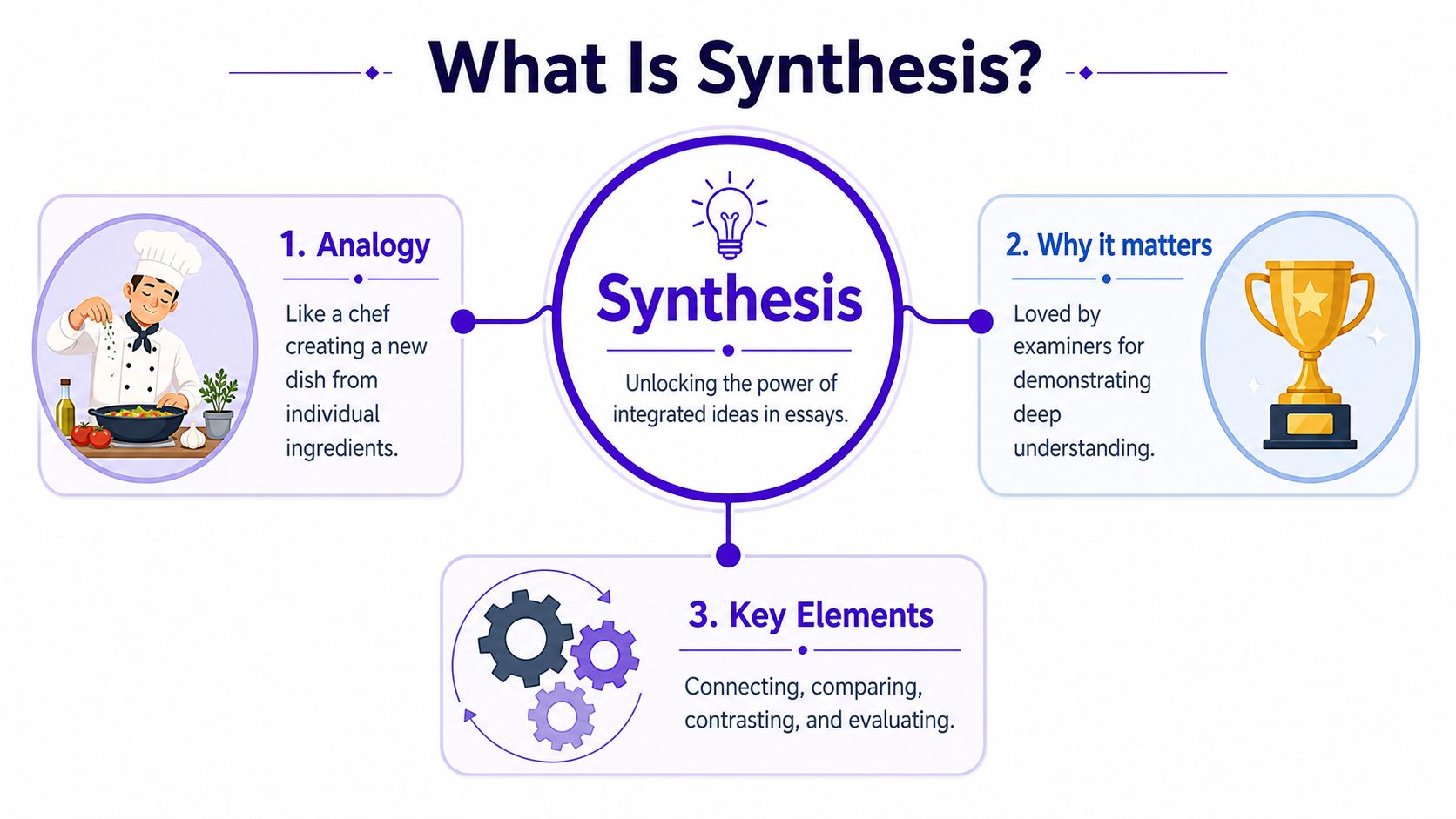
A chef doesn't impress anyone by placing flour, eggs, butter, and sugar on a plate. The skill is in combining them to make something new. That's synthesis. In writing, your ingredients are quotes, facts, methods, critics, context, examples, and counterarguments. Your job is to turn them into one clear judgement.
The simple definition that actually helps
Synthesis in essays means linking pieces of evidence so they support one argument together.
That link can take different forms:
- Connecting a method to a meaning
- Comparing one interpretation with another
- Contrasting context with a character's actions
- Evaluating which idea is stronger and why
The key word is together. A quote on its own isn't synthesis. Context on its own isn't synthesis. A critic bolted on at the end of a paragraph definitely isn't synthesis. It becomes synthesis when each part changes or sharpens the meaning of the others.
What examiners are actually rewarding
The limitations of generic essay advice become clear. A lot of online guidance still follows a US-style formula, usually a rigid five-paragraph setup. UK boards such as AQA, Edexcel, and OCR don't really care whether your paragraph count looks tidy. They care whether your thinking is integrated.
In A-Level English Literature, the 40-mark essay demands that students combine literary criticism, historical context, and textual evidence into a coherent thesis. Examiner reporting highlighted in this discussion of synthesis essay expectations identifies this as the most common reason for failure in the top mark band. It states that 62% of students failed to move beyond simple summarisation, producing a median score of 48% instead of the 60% needed for an A grade.
That's why synthesis matters so much. It isn't a decorative extra. It's often the hidden difference between a capable script and a top-band one.
What this looks like in marking terms
Open any set of exam mark schemes and the language changes slightly by subject, but the pattern is familiar. Top responses don't just “identify” or “mention”. They analyse, evaluate, develop, and integrate.
Here's the examiner mindset in plain English:
| Weak move | Strong move |
|---|---|
| Adds a quote | Uses a quote to prove a wider point |
| Mentions context | Shows how context changes interpretation |
| Names a critic | Weighs the critic against the text |
| Gives two ideas | Shows the relationship between them |
Examiners trust synthesis because it proves the student is in control of the material, not trapped underneath it.
If you remember one thing from this section, make it this. Synthesis is not adding more. It's joining better.
From Summary to Synthesis 3 Core Techniques
Most students don't need more “be analytical” advice. They need actual moves they can use in a sentence.
These three techniques are the ones I return to most because they work across subjects. English, History, Economics, even science essays all improve when students learn how to connect ideas with intention.
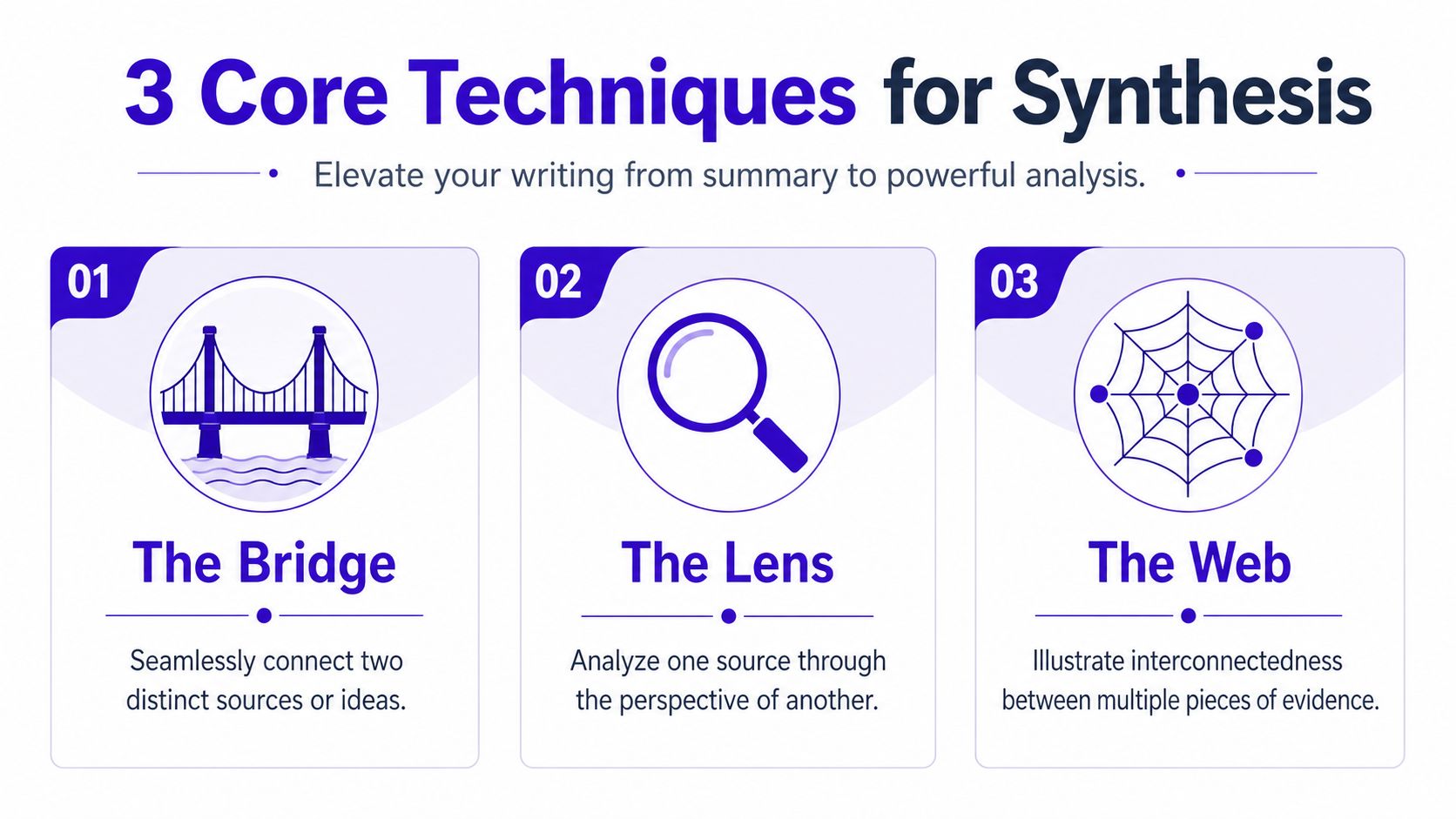
The Bridge
Use this when you have two relevant points and need to show the relationship between them.
A weak writer places the points in separate sentences and hopes the examiner does the connecting. A stronger writer builds the bridge for them.
Before
Shakespeare presents Macbeth as ambitious. This reflects Jacobean concerns about kingship.
After
Shakespeare presents Macbeth's ambition as politically dangerous, so the character's private desire becomes a warning shaped by Jacobean anxieties about kingship.
That one sentence now does more than list. It joins character and context into one argument.
Useful sentence starters:
- This matters because...
- Read together, these suggest...
- The second idea sharpens the first by...
- This turns a simple description into...
The Lens
Use one idea to interpret another. This is especially useful with critics, alternative views, or concepts.
Think of a camera lens. The object stays the same, but the focus changes. In essays, one source or idea can help you see another more clearly.
Before
A critic argues that Lady Macbeth challenges gender roles. She tells Macbeth to be a man.
After
If we read Lady Macbeth through the critic's view of gender rebellion, her attack on Macbeth's masculinity looks less like a personal insult and more like a deliberate attempt to weaponise the values of her society.
The quote hasn't changed. The lens has.
A good shortcut is to ask: What does this second idea help me notice?
That same move works beyond English. In History, a political speech can be read through the lens of wartime fear. In Economics, inflation data can be read through the lens of short-run versus long-run effects.
If you revise with video content, it can help to create YouTube video summaries before you write. That forces you to separate the raw explanation from the argument you want to build from it, which is exactly the jump from summary to synthesis.
A quick explainer can help if you want to hear these moves broken down aloud:
The Web
The Bridge joins two ideas. The Web links several pieces of evidence to one central claim.
Better essays begin to feel confident. Instead of hopping from point to point, the paragraph keeps returning to a core thread.
Your paragraph should feel like a spider web, not a stepping stone path. Every strand should pull back to the centre.
Try this structure:
- Make one clear claim
- Add one piece of evidence
- Link it to a second piece from a different angle
- Show what both pieces prove together
Before
The poem uses nature imagery. It also uses violent language. The speaker seems conflicted.
After
The speaker's conflict becomes sharper because the nature imagery and violent language pull in opposite directions. The natural imagery suggests order and renewal, but the violent diction interrupts that pattern, so the poem presents inner struggle as something that disturbs even the world around the speaker.
A quick test for each technique
Use this checklist while drafting:
- Bridge test: Have I explained the connection between idea A and idea B?
- Lens test: Has one perspective changed how I read the evidence?
- Web test: Do all my examples feed the same central claim?
Students often think synthesis is an advanced extra for the very top. It isn't. It's a practical writing habit. Once you learn these moves, your paragraphs stop sounding like notes and start sounding like judgement.
See It in Action Annotated Essay Paragraphs
It's easier to spot synthesis when you see it working inside a full paragraph. The examples below aren't magic. They keep the argument moving while evidence, interpretation, and evaluation stay tied together.
English Literature example
Question: How does Priestley present responsibility in An Inspector Calls?
Priestley presents responsibility as a moral duty that exposes the limits of selfish individualism, because the Inspector's language forces each family member's private actions into a wider social framework. When the Inspector insists that “we are members of one body”, the shift from individual guilt to collective obligation reframes Eva Smith's death as more than a single tragedy. It becomes evidence of a broken social attitude. This idea gains force when set against Mr Birling's earlier confidence in personal success and business logic, because Priestley turns Birling's self-satisfaction into the very mindset the play condemns. Read through the play's post-war context, that contrast matters even more. The Inspector's message does not merely challenge one man, but an entire view of society based on separation rather than duty. Priestley therefore uses the clash between character, message, and context to argue that responsibility isn't optional. It is the basis of a humane society.
Why this works:
- The paragraph has one governing claim. Responsibility is presented as a moral duty.
- The quote is integrated. It isn't dropped in and left alone.
- Two ideas are bridged. The Inspector's statement is connected to Birling's worldview.
- Context acts as interpretation, not wallpaper. It sharpens the argument instead of sitting in a spare sentence at the end.
The best context feels stitched into the paragraph. If you can cut the context sentence without changing the argument, it probably wasn't integrated well enough.
Economics example
In UK Economics 25-mark essays, top-band synthesis is defined by integrating AO2 application and AO4 evaluation throughout the answer rather than treating them as separate sections. Examiners require at least two distinct AO1-AO4 blocks, each containing a Point, Evidence, and Evaluation or Analysis, to show the range needed for nuanced judgement, as explained in this guide to A-Level Economics essay structure.
Here's what that can look like in practice.
Question: Evaluate whether a rise in interest rates is the best way to reduce inflation.
A rise in interest rates can reduce inflation by weakening consumer spending and borrowing, so in the short run it may lower demand-pull pressure across the economy. This is more convincing where inflation is being driven by strong consumption, because households and firms become less willing to spend when borrowing costs rise. However, that argument is less secure if inflation comes mainly from supply-side shocks such as higher energy or import costs, since tighter monetary policy does little to fix shortages directly. In that case, the same policy may reduce demand without addressing the underlying cause of price rises. The strength of the policy therefore depends on the source of inflation, which means interest rates can be effective, but not automatically the best response in every context.
Why this works:
| Sentence move | What it does |
|---|---|
| Opening claim | Applies knowledge to the question |
| Context condition | Narrows the point to a specific case |
| Evaluation turn | Challenges the first point |
| Judgement | Weighs effectiveness instead of declaring it blindly |
This is synthesis because the paragraph doesn't split into “point section” and “evaluation section”. The evaluation grows out of the application.
If you want feedback on whether your own paragraphs are doing this, automated exam marking is useful only when it shows where your AO gains and losses happen sentence by sentence. That's the level where synthesis either exists or doesn't.
What both examples share
Different subject. Same principle.
- They don't collect evidence. They organise it.
- They don't bolt on evaluation. They build it into the point.
- They don't wander. Every sentence feeds the paragraph's main claim.
That's the hidden pattern across UK essays. Whether you're analysing a play or judging an economic policy, synthesis is what turns knowledge into argument.
Common Synthesis Mistakes That Cap Your Grade
Most weak essays don't fail because the student knows nothing. They fail because the thinking never joins up.

One of the clearest warnings comes from A-Level English Literature. The Joint Council for Qualifications 2024 reporting highlighted in this explanation of synthesising sources states that 58% of candidates who fail to synthesise sources are capped at Grade C, even when their textual knowledge is secure, because the analysis and evaluation objective requires a genuine synthesis of ideas.
The quote sandwich
This happens when students introduce a point, insert a quote, then repeat the point in slightly different words.
It looks safe. It feels structured. It rarely scores highly.
Why it loses marks: the quote stays isolated. The paragraph proves that you found evidence, not that you interpreted it in relation to anything else.
A better question is: What does this quote change, complicate, or support?
Topic hopping
Some essays move constantly. Method, context, theme, critic, another quote, another theme. Everything may be relevant, but the paragraph has no centre.
That creates the impression of effort without control. Examiners can't reward a thread they can't follow.
A paragraph should answer one problem well, not five problems badly.
Patch-writing from notes
This is common in revision-heavy essays. Students memorise smart phrases from class, model answers, videos, or online resources and then stitch them together. The result sounds polished for a sentence or two, then oddly flat.
Why? Because the writing carries information, but not ownership.
If you've noticed that in your own work, resources on overcoming author challenges can help you notice when you're leaning on borrowed phrasing instead of building your own line of thought.
The last-minute critic drop
Teachers know this one immediately. The paragraph is nearly over, and suddenly a critic appears in the final sentence as if added for decoration.
That isn't synthesis. That's name-dropping.
Use this quick comparison:
- Weak use: “A critic also says the character is trapped.”
- Stronger use: “That reading becomes more persuasive when viewed alongside the critic's argument that the character is trapped, because both the imagery and the structural isolation point in the same direction.”
The critic must do work. If it doesn't affect your interpretation, it doesn't deserve space.
Your Synthesis Toolkit Practice Prompts and Checklist
A lot of advice on synthesis in essays still defaults to the US AP Language five-paragraph model. That's one reason students get confused. UK essays usually need thematic synthesis, where you weave ideas together in response to a command word rather than force everything into a rigid paragraph count, as discussed in this overview of the limits of generic synthesis essay advice.
A checklist you can use before handing in
Read your paragraph and ask:
- Main argument: Does every paragraph clearly support my overall judgement?
- Connection: Have I linked ideas together, or just placed them next to each other?
- Evidence use: Does each quote, example, or statistic get interpreted?
- Comparison or tension: Have I shown agreement, contrast, or development between ideas?
- Evaluation: Have I explained which view is stronger, weaker, limited, or conditional?
- Relevance: Does every sentence answer the actual question?
If you can't answer “yes” to most of those, the paragraph probably needs more synthesis, not more content.
Practice prompts
Try these in your next revision session:
- English Literature: Synthesize two critical views on Frankenstein and decide which one better explains Victor's responsibility.
- History: Use two sources on the causes of the First World War and build one argument that weighs both.
- Economics: Evaluate whether taxation or interest rates is the better response to a specific inflation scenario.
- Biology essay practice: Link at least four specification topics to one title and make sure each link is explicit, not implied.
A final habit worth keeping
After each paragraph, write one sentence in the margin: “This paragraph proves that…”
If that sentence is vague, your paragraph probably is too.
And when you want fresh material to test these skills on, working through A-Level Past papers is one of the quickest ways to see whether your synthesis holds up against real command words, not just class notes.
If you want revision that matches the unwritten rules behind UK mark schemes, MasteryMind is built for that. It gives GCSE and A-Level students board-aligned practice across AQA, Edexcel, OCR, and WJEC, with examiner-style feedback that breaks answers down by assessment objective. That means you can practise the exact skill this article has focused on: turning knowledge into connected, high-mark argument.
Ready to master this topic?
Practise with quizzes, blurt exercises and exam questions on MasteryMind.
7 days Premium · Then free forever · No card, no charge