Triple Science GCSE Explained: Biology, Chemistry, Physics
Year 9 options night has a way of making everything feel urgent. One minute you're staring at a form with boxes for science, the next you're trying to work out whether Triple Science GCSE is the brave choice, the sensible choice, or just a lot more homework.
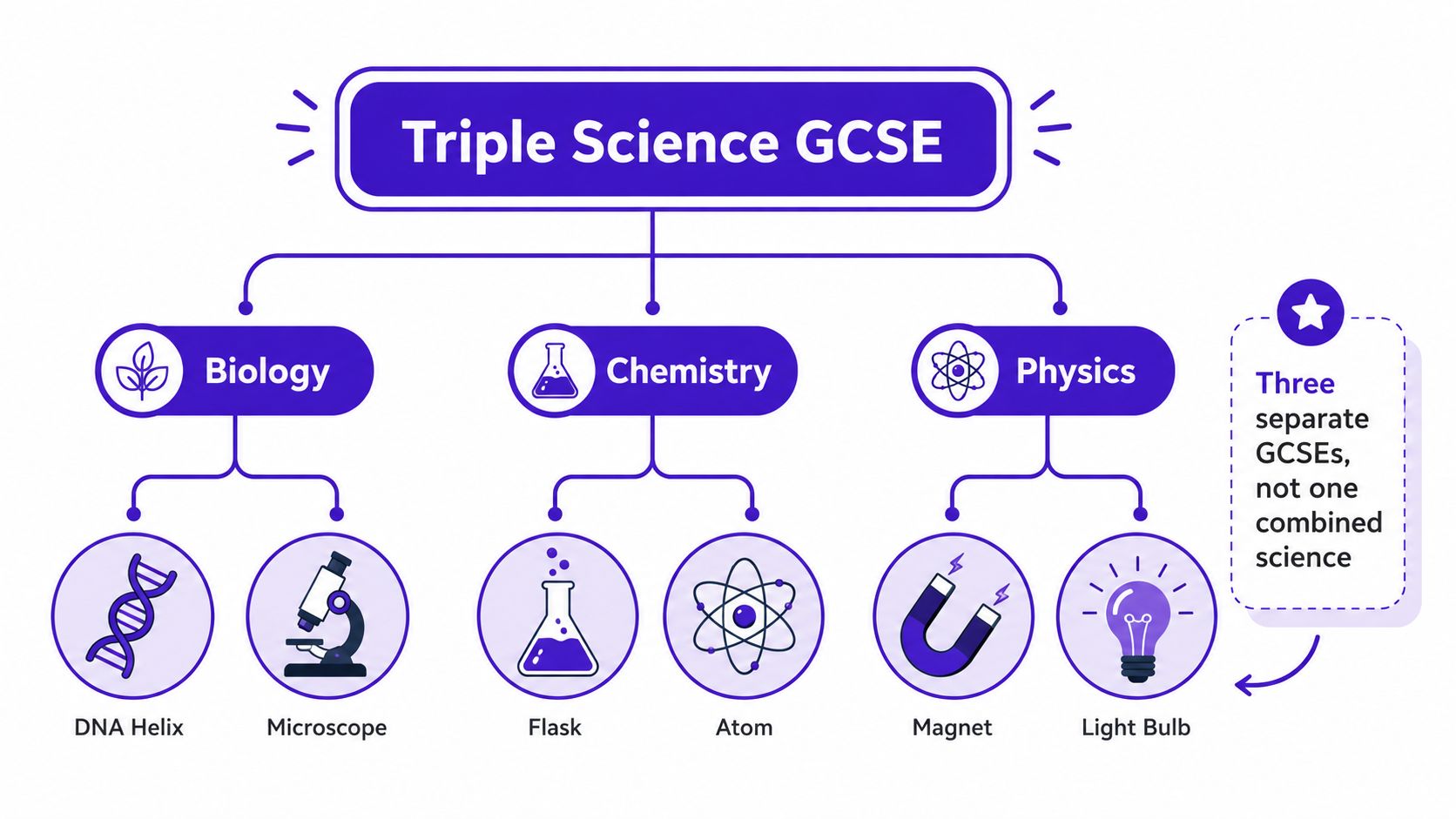
If that's you, or you're a parent or teacher trying to decode the same question, start with the simple version. Triple science means three separate GCSEs, one each in Biology, Chemistry and Physics, rather than one combined science award, and AQA planning materials describe it as the fullest coverage of those three subjects at key stage 4 official AQA planning guidance.
see covered subjects for UK exams
What Triple Science GCSE Actually Means
A student can hear “triple” and assume it means one harder science paper with a fancier label. It doesn't. It means the school enters you for three separate GCSEs, so on results day you get three science grades instead of one combined grade.
Think of a Year 9 student called Sam. If Sam takes combined science, the result usually looks like a pair of linked science grades. If Sam takes triple science, the results page splits the sciences out, so Biology, Chemistry and Physics each stand on their own. That matters because the route doesn't just change what appears on the certificate, it changes how schools organise teaching time, revision, and exam entry.
Why schools offer it at all
The route exists because some pupils want, or need, deeper coverage of each science before post-16 study. That's why schools often sell it as the path for students who already know they like science, or who are keeping doors open for further study later on.
A helpful way to explain it to a confused student is this, one combined course gives you breadth, triple science gives you separation and depth. Neither automatically makes you “better” at science. They are different ways of organising the same subject family, with different levels of subject splitting and workload.
Practical rule: if the label is confusing, ignore it for a moment and ask, “Will I be learning one science course or three separate ones?”
The phrase triple science GCSE sounds technical, but the idea is plain once you strip away the jargon. It is a separate science route, and that's the part that drives almost everything else, from paper structure to revision planning.
Triple vs Combined Science at a Glance
The first question most families ask is not “What's in it?” but “What changes if I choose it?” The cleanest answer is that Triple Science gives you three GCSEs, while Combined Science gives you two GCSEs. That difference sounds small on paper and huge in practice, because it changes how much content sits behind each grade.
AQA's combined science specification still tests application and analysis heavily, with assessment objectives at roughly 40% AO1, 40% AO2 and 20% AO3 AQA Combined Science specification. So combined science isn't the “easy” option. It's just a different way of packaging science into fewer qualifications.
| Feature | Triple Science | Combined Science (Trilogy) |
|---|---|---|
| Qualification outcome | Three GCSEs, one each in Biology, Chemistry and Physics | Two GCSEs covering all three sciences |
| Content shape | Separate subjects with deeper coverage | Linked science content in a combined route |
| Assessment style | More papers because each subject is assessed separately | Fewer overall papers than triple |
| Revision focus | Three subject areas to keep active | Combined science topics across the shared course |
| Best fit | Students aiming to keep science open at post-16 | Students who want a full science base alongside more room for other GCSEs |
The trade-off is simple. Triple science gives you more subject detail, but it also asks you to manage more separate material. Combined science keeps the load lighter at GCSE level, while still staying firmly in full GCSE territory.
For students, that means the question is not “Which one is harder?” It's “Which structure fits the rest of my subject choices, my confidence in science, and the route I want after Year 11?”
How the Exams Are Actually Structured
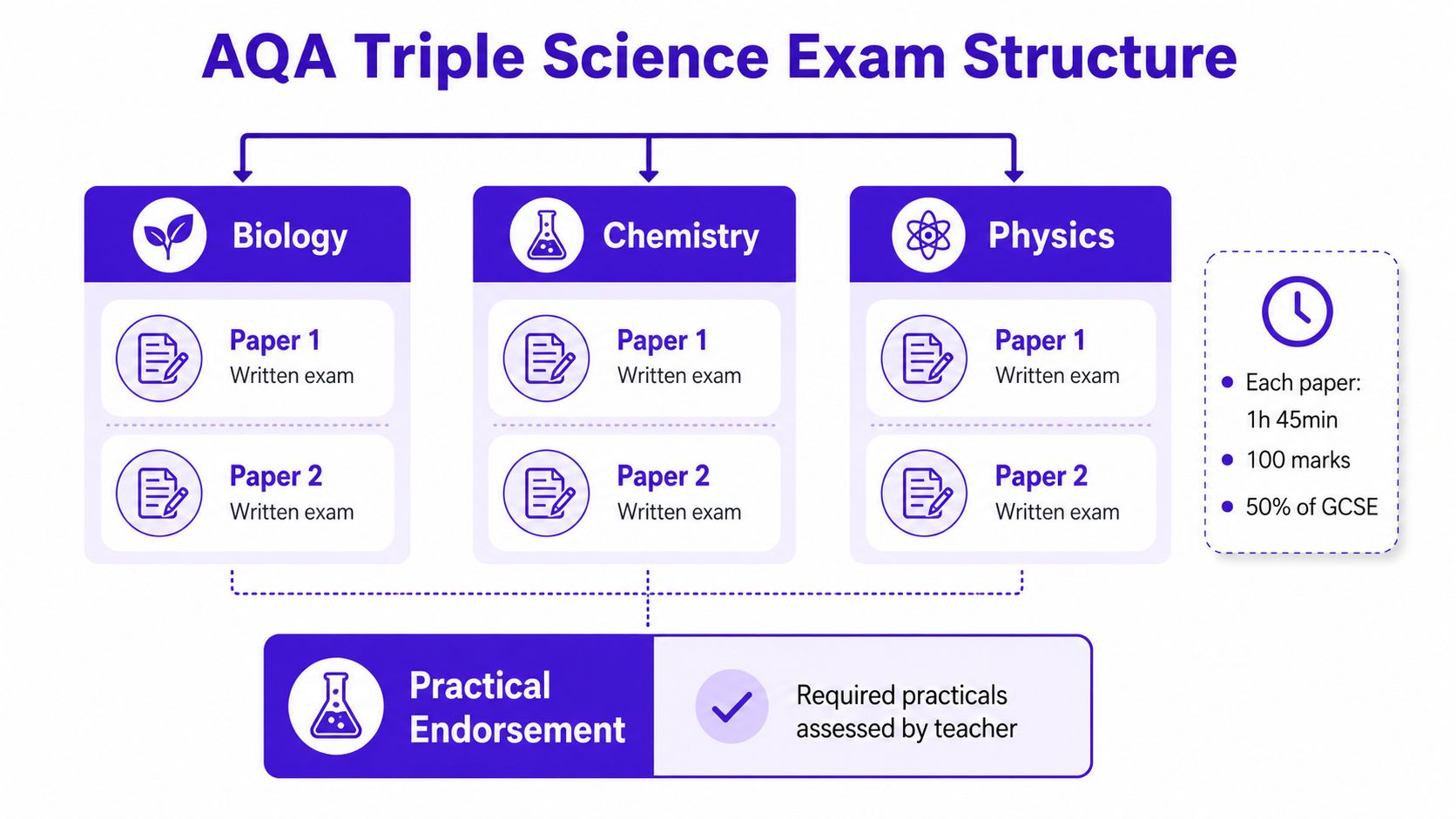
AQA is a good worked example because the paper structure is clear and widely used. The qualification codes are 8461 Biology, 8462 Chemistry and 8463 Physics, and each subject is split into two papers, with each paper worth 50% of that GCSE AQA triple science course guide.
What that means on a timetable
A student doing triple science is not sitting one giant science exam. They're sitting six separate written papers across the three subjects, then revising each subject as its own course. That's why the workload can feel spread thin if revision is left until late.
A school guidance sheet also says there is no coursework, and practical work is assessed through exam questions, with around 15% of exam questions directly related to practical work school guidance video transcript. That makes lab work important, but not in the old “hand in a coursework folder” sense many parents still remember.
Because the subjects are separate GCSEs, students can take different tiers in Biology, Chemistry and Physics. That's useful for schools that want to match entry to confidence in each subject rather than forcing one decision across all three.
Teacher shorthand: if a pupil is strong in Chemistry but less secure in Physics, triple science can let the school make that call subject by subject.
The topic blocks are also distinct. Biology includes areas like Cell Biology, Organisation, Infection and Response, Bioenergetics, Homeostasis and Response, Inheritance, Variation and Evolution, and Ecology. Chemistry and Physics each have their own named blocks too, which is why organised revision matters so much in Year 11.
For extra practice, GCSE Past Papers are the obvious next stop once class notes are sorted.
What Triple Science Sets You Up for Next
The big question is not “How many pages are in the textbook?” It's whether triple science changes what happens after GCSEs. That's where the progression data is useful, because it shows a clear pattern without pretending to be a guarantee.
FFT Education Datalab found that among pupils completing Key Stage 4 in 2017, those who took triple science were 4.4 times more likely to take A-Level chemistry, 3.6 times more likely to take A-Level biology and 2.9 times more likely to take A-Level physics than similar pupils who took double science FFT Education Datalab progression research. That doesn't mean triple science causes those choices on its own. It does suggest the route sits naturally alongside later science study.
When the route really matters
Triple science makes the most sense when a student already leans towards an A-Level science pathway, a STEM degree, or a technical route where science knowledge stays relevant. In those cases, the extra depth can make the jump to post-16 content feel less abrupt.
Geography and school type still shape access. FFT Education Datalab found that in the South East, 10% of schools entered 75% or more of their pupils for triple science in 2019, compared with 5% nationally, and selective schools, schools with sixth forms, and schools with lower disadvantage were more likely to offer it at scale FFT Education Datalab progression research. That's a reminder that choice isn't always equal across the country.
For students, the takeaway is pretty grounded. If you're aiming at science beyond GCSE, triple can line up nicely with that plan. If you're undecided, the route is still a choice, not a life sentence, and the label matters less than the direction you're trying to take.
When Combined Science Is the Smarter Pick
There's a lot of pressure around triple science, as if taking it is the only way to look serious about science. That's not how most pupils experience GCSEs in real life. Triple science has stayed a minority option in England, with FFT Education Datalab reporting 22.4% of pupils studying it nationally, which means most students still take combined science and do well with it FFT Education Datalab headline data.
Combined science can be the smarter choice when a student wants a broader GCSE mix, wants to protect time for subjects they love more, or knows that science beyond GCSE isn't their main route. It also suits pupils who'd rather secure a strong combined result than stretch themselves across three separate sciences and lose ground elsewhere.
A few situations come up again and again.
- You want more subject space: combined science keeps room open for languages, humanities, creative subjects, or vocational options.
- You're not aiming for science post-16: if your likely route is non-STEM, the deeper triple content may not repay the extra workload.
- You need steadier confidence: some pupils perform better with a single science block rather than three parallel ones.
- You'd rather revise with consistency than chase breadth: that's a perfectly valid reason to choose the combined route.
The main mistake is treating combined science like a fallback. It isn't. It's a proper GCSE pathway, and for a lot of pupils it's the better fit because it gives them a strong science base without swallowing the rest of the timetable.
A Revision System That Actually Works
Science revision goes wrong when students revise the way they feel they're learning, instead of the way the exam rewards marks. The marks usually come from recall, application, and explaining ideas in exam language, so the revision system has to hit all three.
Start with named topic blocks
AQA's triple science papers cover clear content blocks, including Biology topics such as Cell Biology, Organisation, Bioenergetics and Ecology, Chemistry topics such as Atomic Structure, Quantitative Chemistry and Organic Chemistry, and Physics topics such as Energy, Electricity, Forces and Atomic Structure AQA triple science topic overview. That means students can audit their weaknesses topic by topic instead of revising “science” in the abstract.
A simple system works best:
- Retrieval first. Close the book and write or say what you remember.
- Then check. Fill the gaps in another colour.
- Then test again. Move the same content into a different question style.
- Then time it. Use past-paper questions under exam timing, not just untimed notes.
Don't ignore command words
The highest-value science revision isn't just remembering facts. It's learning how to answer words like describe, explain, compare, evaluate, and calculate without drifting off-task. That matters because AO2 and AO3 carry a big chunk of the marks in science, and students often lose easy marks by writing too much of the wrong kind of answer.
What works in practice: short, repeated question practice beats one giant revision session the night before.
Practical questions need a separate routine too. Students should revisit required practicals, the equipment used, and the reason each step matters, because those exam questions often ask for method, variables, or evaluation. That's the bit where lots of clever students slip, not because they don't know the science, but because they don't know how examiners phrase it.
If you want structured, exam-aligned practice in one place, Exam Practice for GCSE is the kind of tool that can sit alongside flashcards, class notes and past papers.
Choosing, Planning and Frequently Asked Questions
The easiest way to choose is to ask four honest questions. Do you expect to keep science on after GCSE, do your current grades suggest you can handle the extra depth, can you revise three sciences without your other subjects collapsing, and does your school support the route properly? If one of those is a shaky “no”, combined science may be the calmer choice.
A few quick answers help too. Universities don't usually care about the route label as much as the grades and later qualifications, but the path can still matter because it shapes what you're ready to study next. If a student changes their mind in Year 10, schools can sometimes adjust entries, but that depends on timetable, tier, and teaching capacity. Parents can help most by keeping revision organised, checking that the student is practising questions rather than just rereading notes, and making sure the workload stays realistic.
If you want a practical way to support a student at home without turning every evening into a science lecture, ShortGenius AI video ad maker is useful as a quick reminder that good learning tools should save time, not add noise. And if you want a more structured place to keep everything together, Online Revision for GCSE gives students a central revision space that fits around school, homework and mocks.
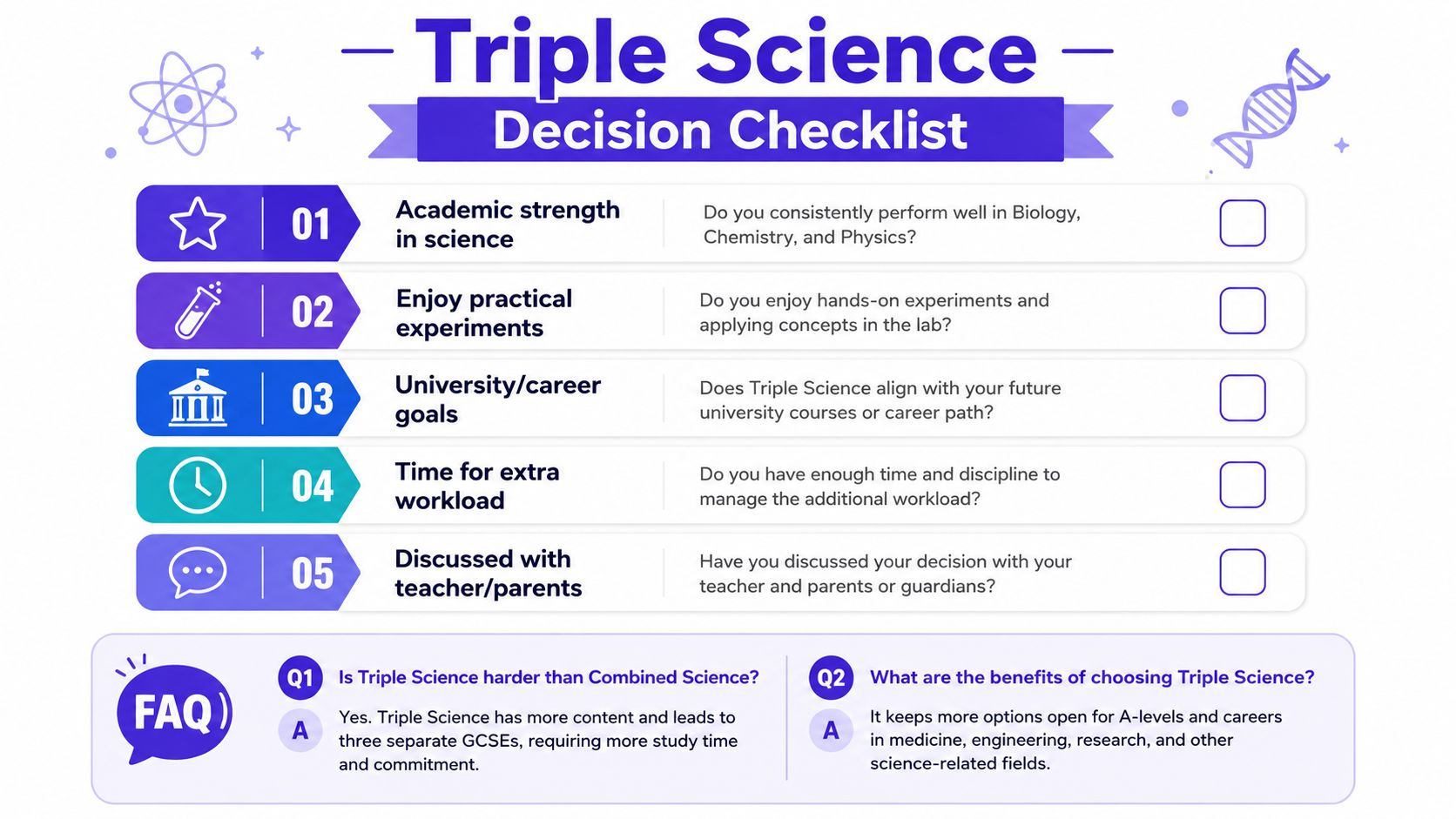
The best choice is the one a student can sustain. If triple science matches their route and workload, go for it with a plan. If combined science gives them a stronger, steadier GCSE set, that's a smart decision too.
MasteryMind gives GCSE students science practice that lines up with the exam board they're sitting, including Biology, Chemistry and Physics. If you're deciding between Triple and Combined Science, or trying to revise three subjects without burning out, visit MasteryMind and try a revision workflow built around real questions, command words and instant feedback.
Ready to master this topic?
Practise with quizzes, blurt exercises and exam questions on MasteryMind.
7 days Premium · Then free forever · No card, no charge