What Is BIDMAS: Master Order of Operations
BIDMAS is the rules of the road for maths calculations. It stands for Brackets, Indices, Division, Multiplication, Addition and Subtraction, and in England it's a statutory part of primary maths by the end of Year 6.
A student once told me, “I only lose marks on the easy bits.” Then we looked at their working and found the problem straight away. They knew the maths. They just weren't following the order of operations consistently.
If you've ever searched what is BIDMAS, that's usually the main issue. Not whether you've seen the acronym before, but whether you know how to use it properly when the question gets messy, especially when division and multiplication appear together.
Why That Viral Maths Problem Is So Confusing
You've seen the kind of question. It turns up on TikTok, Facebook or in a group chat:
8 ÷ 2 × 4 = ?
Half the comments say one answer. The other half say another. Everyone sounds confident, and suddenly a basic calculation turns into a full argument.
That's exactly why BIDMAS exists. Maths needs one agreed rule so that every person reading the same expression gets the same answer. Without that rule, expressions with several operations would be ambiguous.
Why adults get this wrong too
This isn't just a school problem. A persistent misconception that division always comes before multiplication, and addition always comes before subtraction, caused 74% of general public users on Facebook to fail a basic order-of-operations quiz, as discussed in Prof Pete's analysis of that viral BIDMAS confusion.
That matters because many students assume, “If loads of adults disagree, maybe there isn't really one right method.” There is. The confusion comes from people reading the acronym as a strict letter-by-letter ranking rather than understanding how equal-priority operations work.
Maths isn't being awkward here. It's being precise. BIDMAS stops arguments because it gives one reliable method.
The moment the mistake happens
Take 8 ÷ 2 × 4.
Some people spot the D in BIDMAS and think division must happen before multiplication in a special way. Others were taught something closer to PEMDAS and think multiplication must win. Both approaches miss the key idea.
The expression has no brackets and no indices, so you're looking at division and multiplication together. Those two sit on the same level. That means you work left to right.
- First step: 8 ÷ 2 = 4
- Second step: 4 × 4 = 16
So the answer is 16.
If you want more help building fluency before exam season kicks in, MasteryMind Mathematics resources give students a clear place to practise the basics properly instead of relying on random social media examples.
Breaking Down The BIDMAS Acronym
BIDMAS works like a recipe. If you bake a cake by throwing everything in at random, you might still produce something edible, but you probably won't get the result you wanted. Maths is less forgiving.
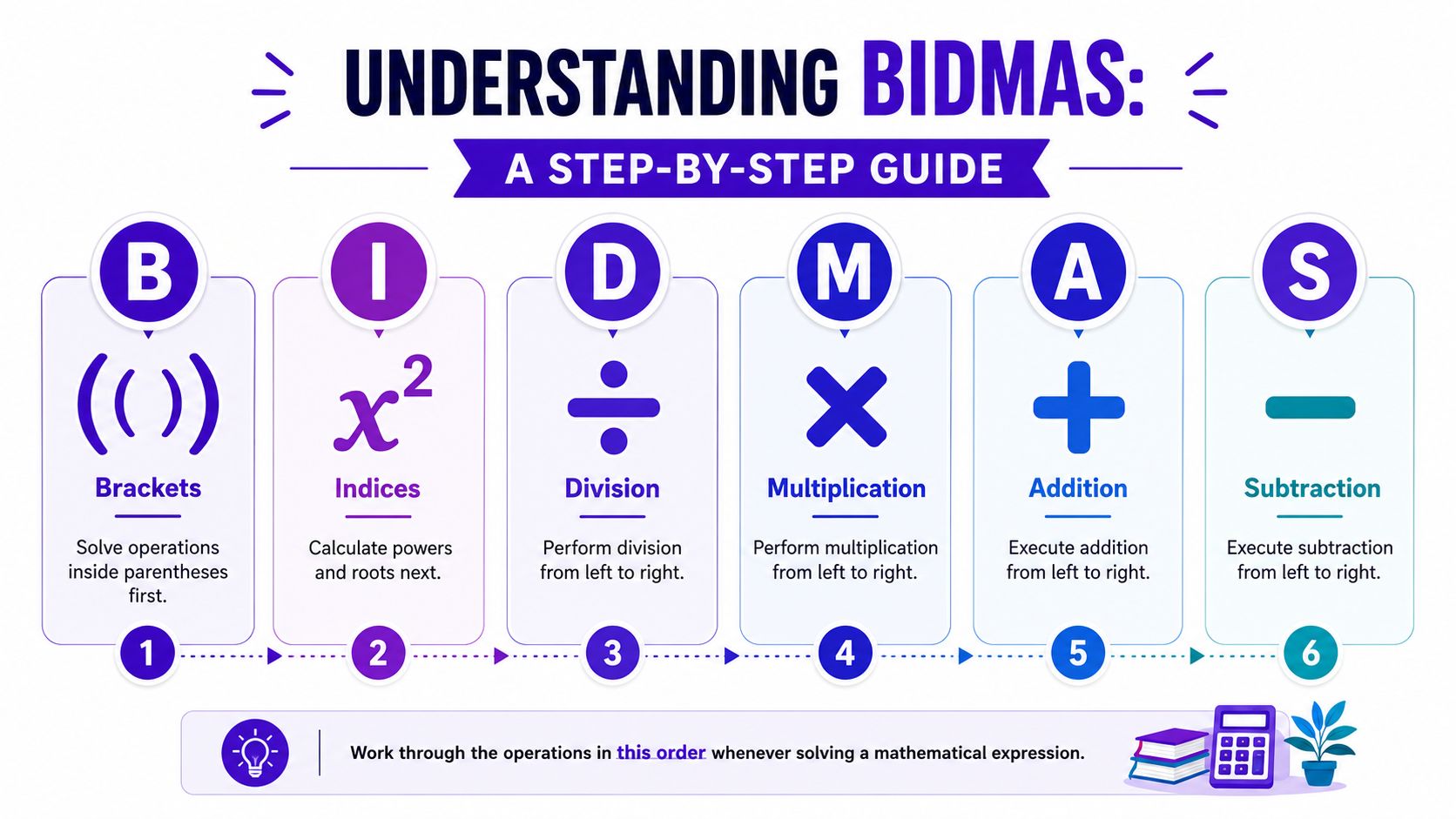
In England, this isn't a niche trick or a tutor-only shortcut. BIDMAS is mandated in England's National Curriculum for mathematics. By the end of Year 6, students must be fluent in using the order of operations, a statutory requirement for Key Stage 2. The 2014 curriculum update officially replaced “Orders” with “Indices” to align with modern algebraic notation, as set out in the National Curriculum for England mathematics programmes of study.
What each letter means
Here's the acronym in plain English.
| Letter | Meaning | What it tells you to do | Simple example |
|---|---|---|---|
| B | Brackets | Work out anything inside brackets first | (3 + 2) = 5 |
| I | Indices | Deal with powers and roots next | 3² = 9 |
| D | Division | Divide when it's your turn in the order | 12 ÷ 3 = 4 |
| M | Multiplication | Multiply when it's your turn in the order | 4 × 5 = 20 |
| A | Addition | Add near the end | 7 + 2 = 9 |
| S | Subtraction | Subtract near the end | 9 - 4 = 5 |
The meanings students usually muddle up
A few parts of BIDMAS cause more trouble than others.
- Brackets: These create a little maths bubble. Whatever is inside has to be sorted before you move on.
- Indices: This means powers such as 2³ or 5². It doesn't mean “multiply by the small number”. For example, 3² means 3 × 3, not 3 × 2.
- Division and multiplication: These often appear together, which is where students start rushing.
- Addition and subtraction: Same issue. They don't behave like separate floors of a building.
Practical rule: Think of BIDMAS as levels, not six unrelated commands.
A simple full example
Try this:
5 + 2 × 3
You do not add first just because it appears first on the page.
- Multiplication comes before addition.
- So calculate 2 × 3 = 6
- Then do 5 + 6 = 11
That's the whole purpose of BIDMAS. It gives the expression one fixed meaning.
For students, that means fewer silly slips. For teachers, it means a shared language that starts in primary school and carries right through to GCSE.
The Critical Left-to-Right Rule Everyone Forgets
This is the part that costs marks.
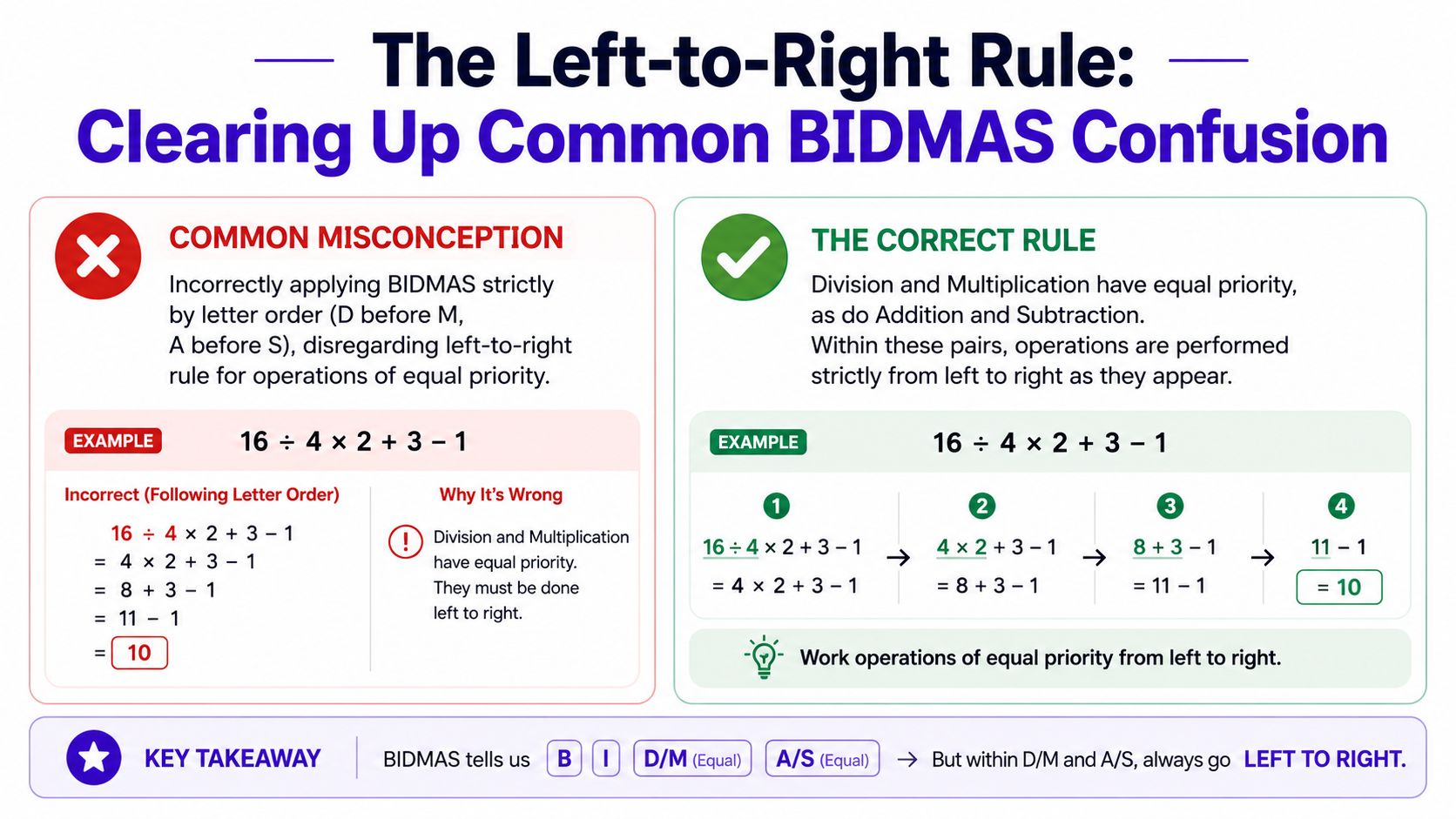
A lot of students learn BIDMAS as though it means: first brackets, then indices, then division, then multiplication, then addition, then subtraction. That sounds tidy. It's also where a major misconception starts.
Division and multiplication are equal partners
In real use, division and multiplication have equal priority. The same is true of addition and subtraction. So if both appear at the same level, you don't pick the one whose letter comes first in the acronym. You work from left to right.
That sounds small, but it isn't. Failure to apply left-to-right evaluation for equal-priority operations like division and multiplication causes a 34% error rate in student calculations on questions requiring 3-step order-of-operations evaluation, according to a UK Department for Education analysis referenced by Twinkl's BIDMAS guide.
The example that exposes the mistake
Look at this:
12 ÷ 4 × 3
If someone wrongly thinks multiplication must happen before division, they'll try to force the 4 × 3 first. That breaks the structure of the expression.
Do it properly:
- Start on the left.
- 12 ÷ 4 = 3
- Then 3 × 3 = 9
So the answer is 9.
Now look at addition and subtraction:
10 - 2 + 5
Again, you work left to right.
- 10 - 2 = 8
- 8 + 5 = 13
If you tried to add first, you'd change the expression into something it isn't.
The acronym helps you remember the levels. The left-to-right rule tells you what to do within a level.
A quick way to spot whether left-to-right matters
Ask yourself one question:
Am I looking at two operations from the same BIDMAS level?
If yes, move left to right.
- ÷ and × together: left to right
- + and - together: left to right
That's the version of BIDMAS students need in exams. Not the oversimplified chant, but the correct rule.
BIDMAS in Action Step-by-Step Worked Examples
Knowing the rule is one thing. Using it under pressure is another. The fix is to write one clean step at a time and resist the urge to do bits in your head.
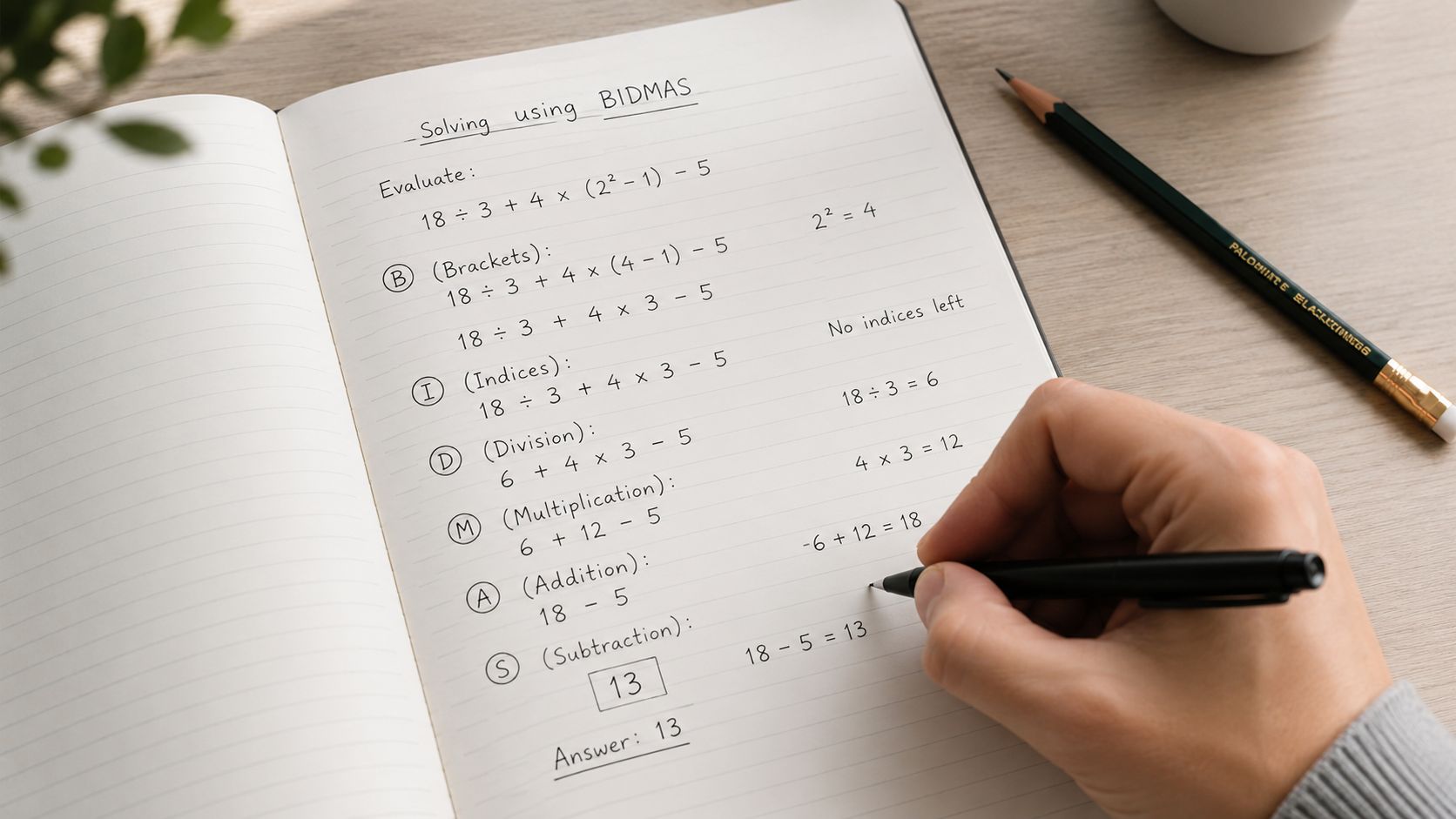
If you want to train that habit properly, MasteryMind's quiz system is useful because quick repeated questions force you to spot the operation level before you calculate.
Example one with brackets and multiplication
7 + (6 - 2) × 3
Start with the brackets.
- (6 - 2) = 4
- The expression becomes 7 + 4 × 3
- Multiplication before addition: 4 × 3 = 12
- Then 7 + 12 = 19
Answer: 19
Example two with indices
20 - 3² + 5
The index comes before addition and subtraction.
- 3² = 9
- The expression becomes 20 - 9 + 5
- Work left to right: 20 - 9 = 11
- Then 11 + 5 = 16
Answer: 16
A lot of students slip here because they either ignore the square or they don't use left-to-right once they reach subtraction and addition.
Example three with nested brackets
2 × (3 + (4 - 1))
Work from the inside out.
- Inner brackets: (4 - 1) = 3
- Now the expression is 2 × (3 + 3)
- Brackets again: 3 + 3 = 6
- Then 2 × 6 = 12
Answer: 12
That “inside-out” approach is the safest one every time nested brackets appear.
Here's a short walkthrough if you want to see the process in a different format.
Example four with a negative number
18 - (2 × 5)
- Brackets first, but inside the brackets multiplication happens first anyway: 2 × 5 = 10
- Now calculate 18 - 10
- Answer: 8
This looks simple, but in exams students often copy down the next line incorrectly. The method is fine. The arithmetic line gets rushed.
Write each new line as a full expression, not just the part you've changed. That makes sign errors much easier to catch.
Example five with a fraction bar
A fraction bar acts like a bracket because it groups the top and bottom.
(8 + 4) ÷ 3
- Brackets first: 8 + 4 = 12
- Then divide: 12 ÷ 3 = 4
Answer: 4
Example six with algebra
BIDMAS still matters when letters appear.
3x + 2(x + 4) when x = 2
Substitute first:
- 3(2) + 2(2 + 4)
- Brackets: 2 + 4 = 6
- Multiplication: 3 × 2 = 6 and 2 × 6 = 12
- Then addition: 6 + 12 = 18
Answer: 18
That's why BIDMAS isn't just a primary-school rule. It sits underneath algebra, substitution and plenty of GCSE number work.
BIDMAS vs BODMAS vs PEMDAS What is the Difference
Students get mixed messages about this all the time. One teacher says BIDMAS. A parent says BODMAS. A YouTube video from the US says PEMDAS. It can look like three different systems, but the actual maths underneath is the same.
The names are different. The rule is the same.
In the UK, you'll usually see BIDMAS. Older materials and plenty of adults still say BODMAS. In the US, the common acronym is PEMDAS.
Here's the basic comparison:
| Acronym | Common use | Key wording difference |
|---|---|---|
| BIDMAS | UK | I means Indices |
| BODMAS | Older UK usage | O means Orders |
| PEMDAS | US | P means Parentheses, E means Exponents |
According to BBC Bitesize's explanation of BIDMAS and PEMDAS, while the UK uses BIDMAS, the US uses PEMDAS, both systems enforce identical logic where Division and Multiplication have equal priority and are performed left-to-right, as are Addition and Subtraction. The term “BODMAS” was dominant in UK schools until the 2014 National Curriculum reform officially adopted “BIDMAS”.
Why England shifted from BODMAS to BIDMAS
The change from Orders to Indices helps match the language students meet later in algebra. If a GCSE question talks about indices, powers or standard form, the terminology fits more neatly with BIDMAS than with the older version.
That doesn't mean BODMAS is “wrong”. It just means the official wording changed.
The trap with all three acronyms
The trap is exactly the same whatever acronym you use.
- BIDMAS trap: thinking D must beat M
- BODMAS trap: same problem
- PEMDAS trap: thinking M must beat D
None of those interpretations is correct. The letter order is a memory aid, not a ranking system inside each pair.
If you understand that, you can read maths from UK revision guides, old worksheets or American videos without getting thrown off.
Common BIDMAS Mistakes That Lose You Marks in Exams
Teachers spot these errors quickly because they happen again and again. Examiners spot them too. The frustrating part is that many of the students making them do know the content. They just apply it badly under pressure.
The biggest GCSE trap
According to Third Space Learning's summary of AQA's 2024 GCSE Maths examiner report, misapplying BIDMAS is the primary cause of lost marks in complex numerical questions. 68% of students failed questions where multiplication appeared before division, such as 12 ÷ 4 × 3, because they incorrectly prioritised multiplication over the correct left-to-right evaluation.
That lines up perfectly with what many teachers see in class. Students don't usually forget brackets. They misread equal-priority operations.
If you're practising under timed conditions, Exam Practice for GCSE can help you spot whether you only make this mistake when the pressure goes up.
Mistakes that look small but cost real marks
Here are the ones I'd watch for first:
- Forcing the acronym letter by letter: Students see division and multiplication together and treat the letters as strict instructions. That changes the value of the whole expression.
- Ignoring an index until later: A square or cube gets left behind while the student jumps to addition or subtraction.
- Dropping a negative sign: This happens after brackets are resolved and the next line is copied down too fast.
- Doing several steps mentally: That's where hidden errors creep in, especially in non-calculator work.
In GCSE maths, neat working isn't just presentation. It protects marks.
What teachers and strong students do differently
They slow the first line down.
Not the whole paper. Just the first line of any BIDMAS expression. They identify the operation level, choose the correct first step, and rewrite the full line after each change. That habit is boring, but it's also the difference between a clean method and a careless drop in marks.
A good check at the end is simple:
- Did I clear brackets first?
- Did I deal with any indices before moving down?
- When operations were tied, did I move left to right?
If the answer to all three is yes, the method is likely sound.
How to Practise and Master BIDMAS for Your Exams
You won't master BIDMAS by reading about it once. You master it by seeing the same patterns often enough that your brain stops hesitating.
Four quick questions
Try these before looking at the answers.
- 6 + 2 × 5
- (14 - 8) ÷ 2
- 18 ÷ 3 × 2
- 16 - 2² + 1

Answers
- 1: 16
- 2: 3
- 3: 12
- 4: 13
If you got question 3 wrong, that's the left-to-right issue again. That's the one worth drilling until it feels automatic.
Revision habits that actually help
- Write one operation per line: It feels slower, but it cuts avoidable errors.
- Mix easy and awkward examples: Don't only practise tidy textbook questions. Include expressions where division and multiplication appear together.
- Say the rule out loud: “Same level, left to right” is a useful self-check.
- Use past-paper style practice: Real exam phrasing matters, especially once arithmetic is wrapped inside a worded problem.
For students revising seriously, GCSE Past Papers are where BIDMAS starts to feel real, because that's where the rule appears in mixed-topic questions rather than neat standalone exercises.
If you want one final tip, it's this:
Don't treat BIDMAS as a chant to memorise. Treat it as a decision-making process.
MasteryMind gives UK learners a smarter way to practise maths for GCSEs and A Levels, with examiner-aligned questions, adaptive revision, instant feedback, and topic-by-topic tracking. If you want to turn BIDMAS from “something I sort of know” into marks you can rely on, try MasteryMind.
Ready to master this topic?
Practise with quizzes, blurt exercises and exam questions on MasteryMind.
7 days Premium · Then free forever · No card, no charge