What Is Energy Transfer: A 2026 GCSE Guide
Energy transfer is energy moving between stores or from one system to another, and in GCSE physics it's always measured in joules (J). If you can remember that, you're already ahead of the students who keep saying “energy changes form” and then lose marks because that's too vague for an exam answer.
You're probably revising with one eye on the clock, trying to make sense of a topic that sounds simple until the question gets specific. That's normal. The exam wants you to name the pathway, track the stores, and explain the direction of transfer, not just say energy “happens” somewhere.
Energy Transfer in Plain English
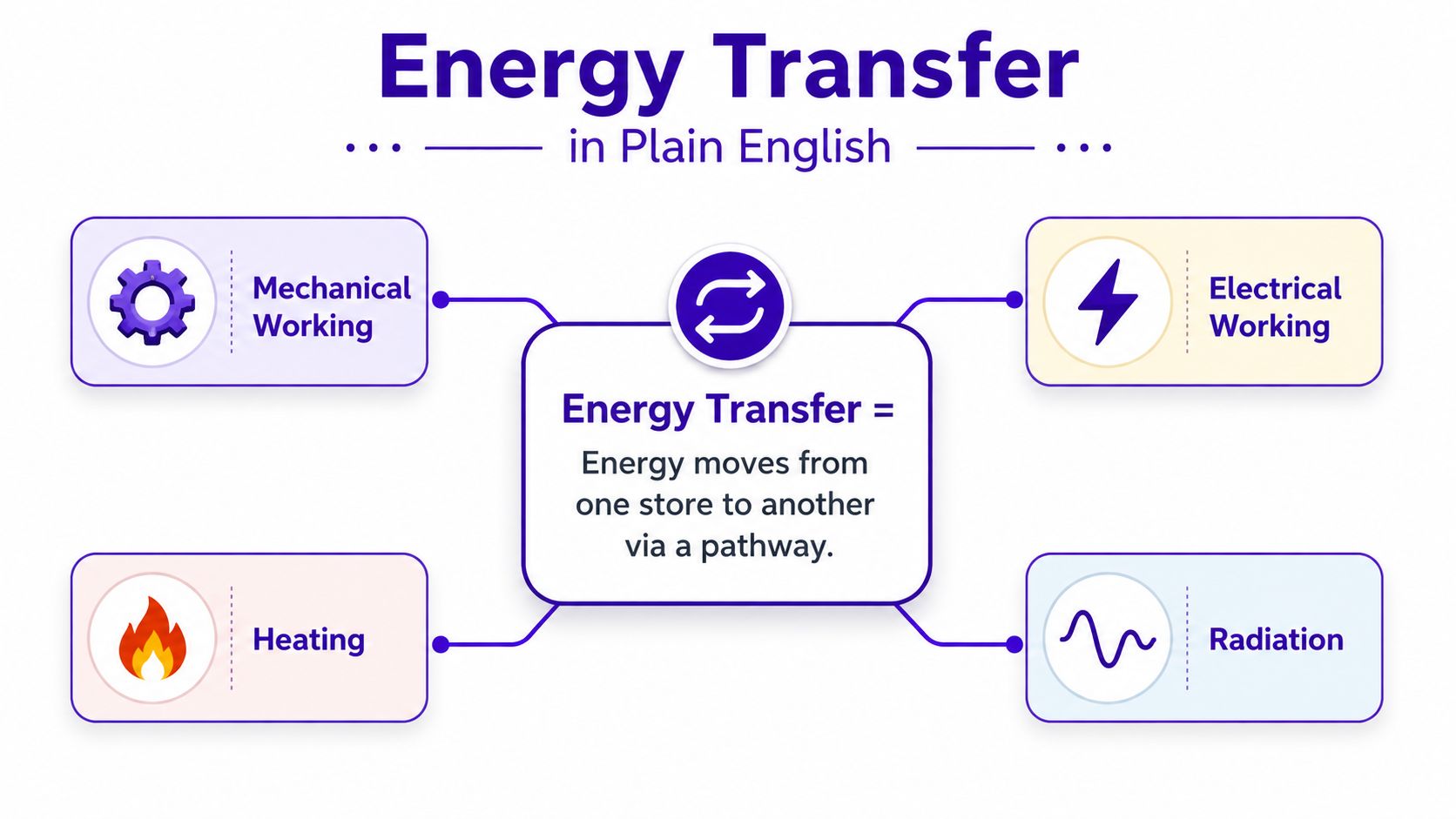
When teachers ask what is energy transfer, they usually want a clean physics sentence, not a slogan. The safest working definition is this, energy is moved between stores within a system, or from one system to another, and the amount transferred is measured in joules. That matters because it keeps your answer tied to the language examiners use, especially when the question is asking for a process rather than just a label.
A useful way to think about it is to picture energy as something that can leave one place and arrive somewhere else. It does not vanish, and it does not need to be “used up” in the casual sense students often mean. The system view is what keeps the idea precise, because you can say where the energy starts, where it ends up, and what changed in between.
The sentence examiners want
If a kettle heats water, say that energy is transferred by heating from the kettle to the water. If a moving object slows because of friction, say energy is transferred out of the motion and into thermal stores. That kind of wording sounds simple, but it's exactly what separates a strong explanation from a half-right one.
Practical rule: if you can point to a before and after, and say where the energy went, you're usually on the right track.
For quick revision across different subjects, the MasteryMind revision subjects page is a tidy place to organise topics without jumping between random tabs.
The Four Pathways Energy Travels Along
GCSE questions usually want one of four named pathways, mechanical working, electrical working, heating, or radiation. Once you know those names, you can sort most examples quickly instead of guessing. The trick is not to memorise them as isolated words, but to match each one to the physical action happening in the question.
Mechanical working is energy transferred when a force acts through a distance. A trolley pushed along a floor is the everyday version, and friction between surfaces is the physics version because the force is doing work over a distance. The same idea appears in muscles contracting, lifting, dragging, and braking.
Electrical working is the transfer linked to moving charges in a circuit. Charging a phone is the ordinary example, while current through a motor is the physics example. If electricity is doing something useful, examiners usually want you to identify the electrical pathway rather than just saying “the battery powers it”.
Heating covers energy transfer caused by a temperature difference. Boiling water on a stove fits neatly here, and so does thermal conduction through a rod. A kettle, a filament lamp, and a boiling flask can all count as heating transfers when energy is passed into a hotter or cooler object in a way that increases thermal store.
Radiation is transfer by electromagnetic waves, including infrared. A microwave oven cooking food is an everyday example, and infrared from a heater is the physics one. Students often forget that radiation doesn't need contact, which is why it shows up in questions about heat loss and insulation.
The key calculation for mechanical working is work done = force × distance, measured in joules. So a force of 50 N applied over 3 m transfers 150 J of energy, and that calculation is useful because it gives you a quantitative way to describe how much energy moved. In longer questions, that same idea helps you connect force, distance, and efficiency without drifting away from the physics.
Exam habit: name the pathway first, then choose the equation. Don't do it the other way round.
Why Thinking in Systems Gets You More Marks
A lot of weaker answers stay at the level of “energy changes form”. That sounds reasonable, but markers often need more than that. The stronger approach is to identify the system, say what changed inside it, and state whether energy moved into it or out of it.
Take a kettle. If the heating element warms the water, the useful answer is not just “energy transferred”. A better answer says energy is transferred into the water system, increasing the water's thermal store, while some energy is also transferred to the surroundings. That tells the examiner you understand the boundary of the system, not just the topic word.
That same structure scales up cleanly. In a power station, you can still talk about one system handing energy to another, with some energy becoming useful output and some being dissipated. The exact details change, but the logic stays the same, and that's why systems thinking works so well in extended responses.
A simple template helps:
- Name the system. Say what you are talking about, the kettle, the motor, the car, the circuit.
- Name the store before and after. For example, electrical store to thermal store, or gravitational store to kinetic store.
- State the direction. Energy moves into the object, out of the system, or between two systems.
- Add the pathway. Mechanical, electrical, heating, or radiation.
EBSCO's definition of energy transfer as energy crossing out of one system and into another matches the conservation wording students use in science teaching, which is why the system boundary matters so much. The moment you make that boundary explicit, your answer stops sounding like guesswork and starts sounding like physics.
Energy Transfer in Physics and Biology
Physics and biology use the same core idea, even when the contexts look different. In physics, a falling apple transfers energy from gravitational stores into kinetic stores, and then some of that energy can go into the thermal store of the surroundings through air resistance or impact. A moving car does the same kind of bookkeeping, with kinetic energy turning into thermal energy through resistance and braking.
A resistor gives you another clean example. Electrical energy is transferred through the circuit, and some ends up in thermal stores because the resistor warms up as charges move through it. That's why the same language works whether you're talking about a circuit diagram or a car slowing down.
Biology uses the same conservation logic, just with different stores and pathways. Sunlight is transferred by radiation into plants, where photosynthesis stores energy chemically in glucose. Later, respiration releases that energy for useful work, while some is transferred to thermal stores as unavoidable waste heat.
That cross-subject overlap is exactly why this topic is worth nailing properly. Students who keep physics and biology separate often learn two half-models instead of one solid one. Once you see that energy is always being tracked between stores, the subject boundary matters less than the physics beneath it.
If you like seeing ideas in a practical simulator rather than only on paper, interactive physics in Unity VR is a useful way to think about forces and motion in a more visual setting.
Worked Exam Questions You Can Copy
A good exam answer usually follows the same rhythm, identify the pathway, choose the equation, substitute values, check units, then write the conclusion in words. That sounds basic, but students lose marks when they skip one of those steps or write the maths without a sentence at the end.
Question 1, mechanical working with friction
A force of 50 N pushes a box 3 m across the floor. How much energy is transferred?
Use work done = force × distance.
Work done = 50 × 3 = 150 J
So the energy transferred is 150 J.
The sentence the examiner wants could be, 150 J of energy is transferred by mechanical working. If the question mentions friction, add that some of the energy is transferred into thermal stores because of the resistive force. That second sentence shows you understand why the motion is not perfectly efficient.
A common trap is writing the answer in newtons or metres because you copied the numbers but ignored the unit. Don't do that. The equation gives you joules, and the unit has to match the quantity being transferred.
Question 2, efficiency in a kettle or motor
If a device takes in energy and only some of it becomes useful output, efficiency is about how much of the input ends up where you want it to. In a kettle, the useful part is heating the water. In a motor, the useful part is motion.
For a maths-style question, the marker usually wants you to identify the useful energy transferred, compare it with the total input, and present the result clearly. If the question gives the values in kJ, convert them to J before you calculate, because the final answer may need to be in joules.
If you're drilling this kind of question, the GCSE Past Papers page is the obvious place to get more exam-style practice without wasting time on unrelated questions.
Marker-minded habit: write the unit check in your working. It catches most careless mistakes before they cost marks.
Common Mistakes That Cost Easy Marks
The most expensive mistakes are usually not the hard ones. They're the phrases that sound nearly right but miss the physics.
The three slips markers see again and again
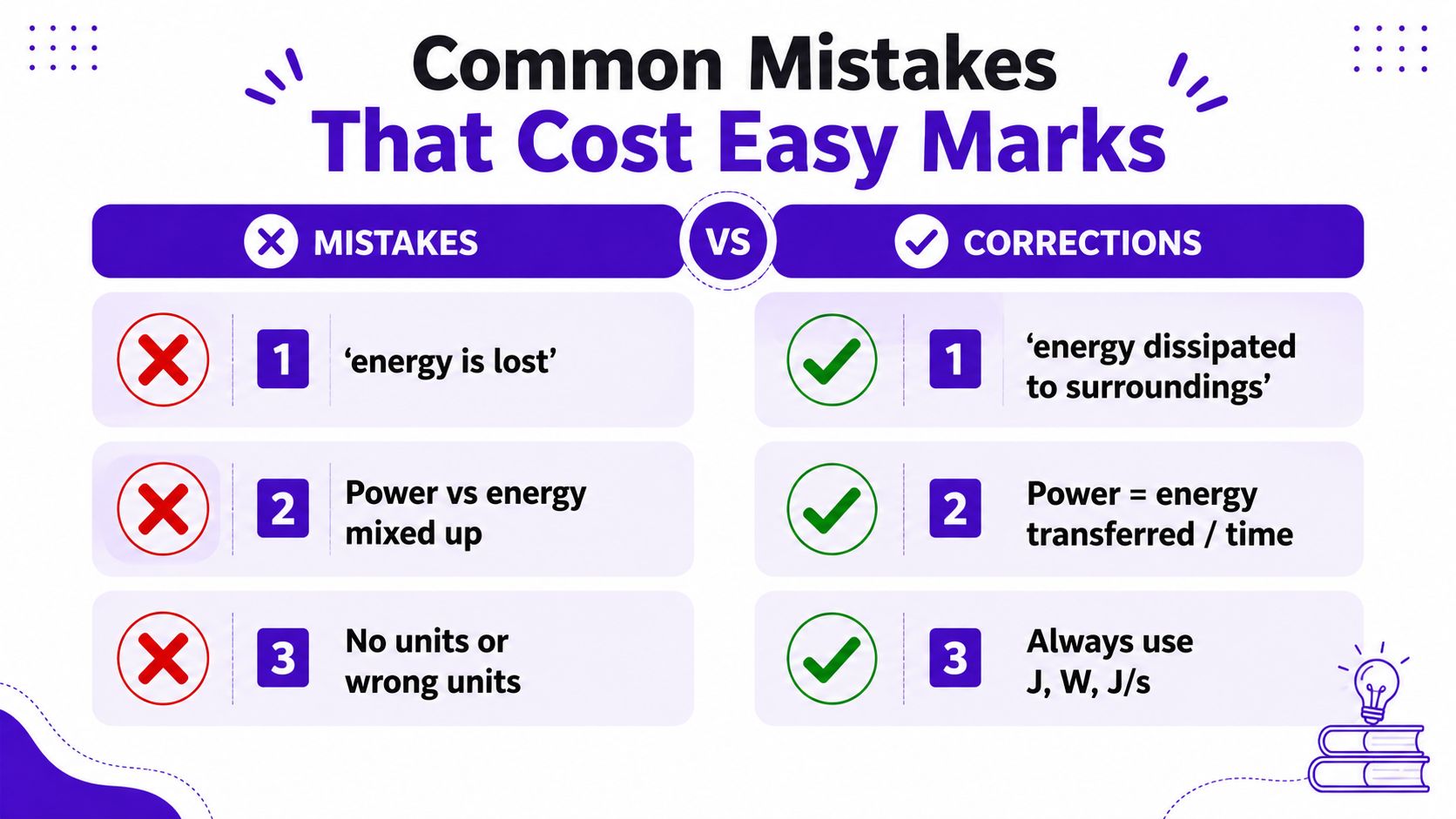
Wrong phrase: “energy is lost”.
Right phrase: “energy is dissipated to thermal stores of the surroundings”.
Why it works, because energy doesn't disappear, it moves into a less useful store.Wrong phrase: mixing up power and energy.
Right phrase: power = energy transferred / time.
Why it works, because power is a rate, not the energy itself.Wrong phrase: no units, or the wrong ones.
Right phrase: always use J, W, or J/s where appropriate.
Why it works, because the unit tells the examiner what quantity you've calculated.
The A-Level trap is a bit deeper. Students sometimes write as if a system creates energy for itself, but conservation still applies, energy can be transferred and stored, not invented. That's the point to keep in mind when the wording gets more technical and the marks get tighter.
For structured practice with feedback on question types, Exam Practice for GCSE fits well with this topic because it keeps you in exam conditions instead of just rereading notes.
Two Quick Demonstrations You Can Run Today
A metal spoon in hot water is a simple home demo, but it teaches the idea properly if you watch it carefully. Put the spoon in the water and feel how the handle warms up over time. What you're seeing is energy transferred by heating into the spoon's thermal store, then along the spoon as the material warms.
Record which end warms first and how quickly you notice the change. That tells you the transfer isn't magic, it depends on the material and the temperature difference. The point is not just “it gets hot”, it's that energy has moved from the water system into the spoon system.
A falling ball and a ball of clay make a good classroom comparison. Drop the ball first and notice the rebound, then repeat with the clay and notice how the bounce is far smaller. The energy from motion is still conserved, but much more of it ends up in thermal stores and sound during the inelastic impact with the clay.
What to write down is simple, the height change, the rebound difference, and the idea that impact transfers energy into less obvious stores. That's the kind of observation that turns a demo into revision, rather than just a neat trick.
Revision Checklist and Next Steps
Before the exam, make sure you can do these five things without hesitation:
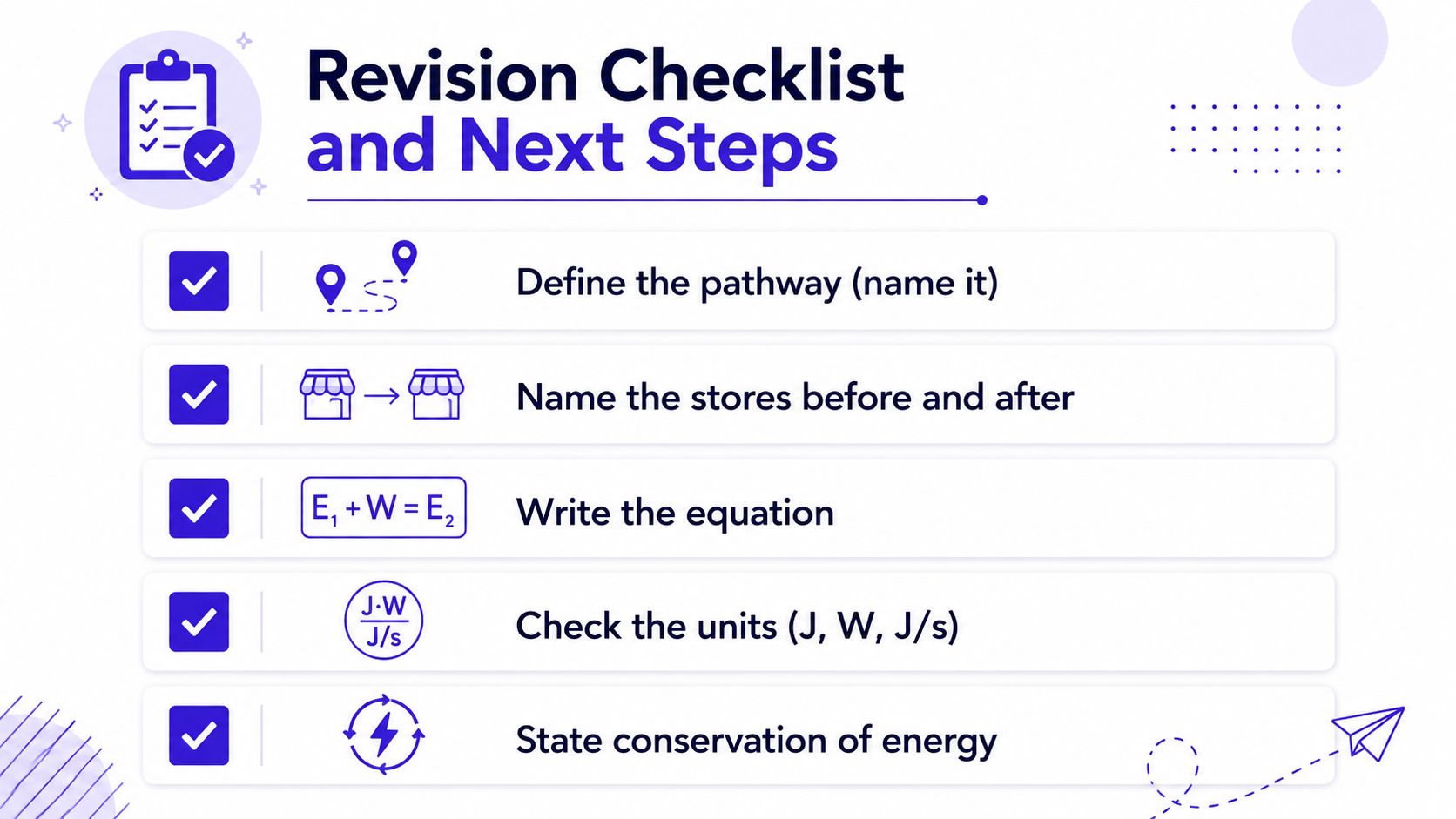
- Define the pathway.
- Name the stores before and after.
- Write the equation.
- Check the units.
- State conservation of energy.
If you want more topic-matched practice that follows UK specifications, Online Revision for GCSE gives you a straightforward way to mix recall, calculation, and exam wording in one place. Use it to tighten the exact phrases you'd write under pressure, not just to recognise them when you're relaxed.
MasteryMind helps UK learners practise energy transfer in the same style they'll meet in GCSE and A-Level papers, with questions aligned to exam-board language and mark schemes. If you want revision that keeps the physics precise and the wording exam-ready, visit MasteryMind and use it alongside your notes and past papers.
Ready to master this topic?
Practise with quizzes, blurt exercises and exam questions on MasteryMind.
7 days Premium · Then free forever · No card, no charge