What Is Unseen Poetry? Your Complete Exam Guide 2026
Unseen poetry is an exam task where you analyse a poem you've never studied before, testing close reading and comparison rather than memorised knowledge. In AQA GCSE English Literature, the unseen section is worth 32 marks, split between a 24-mark response and an 8-mark comparison.
You're probably here because an exam is getting close, your notes feel incomplete, or you're aiming to turn a decent answer into a strong one. Perhaps you've opened an unseen poem before and thought, “I don't know what this means, so how am I supposed to write about it?” That reaction is common, but it doesn't mean you can't succeed.
I've marked enough poetry responses to know that students rarely lose marks because they missed one obscure technique. They lose marks because they retell the poem, name methods without explaining effects, ignore structure, or leave the comparison until there's hardly any time left. The good news is that unseen poetry rewards a repeatable process. Once you understand your exam board, the assessment objectives, and the shape of an effective paragraph, the task becomes much more manageable.
The Unfamiliar Poem in Front of You
You turn the page and find a poem you have never studied. You do not know the poet, the publication history, or the interpretation your teacher might normally provide. The first response may be uncertainty. Read the opening again, then identify the situation before judging whether you understand every line.
The poem could show a child leaving home, a speaker remembering someone who has died, or a person watching an ordinary scene become unsettling. Recognition is not the test. Your task is to observe what the words do, select precise evidence, and connect those choices to the question.
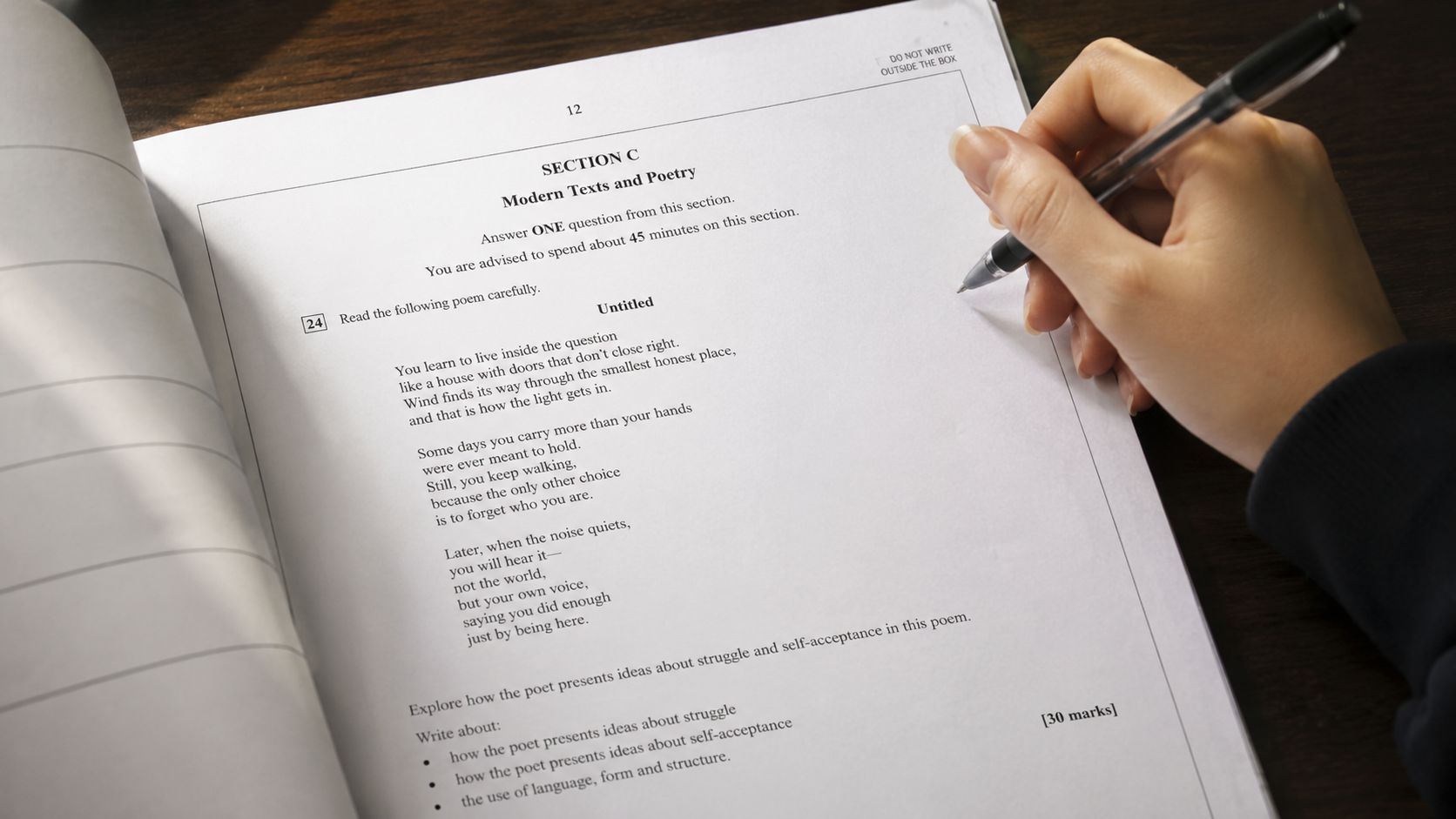
A skills test, not a memory test
Unseen poetry gives you a poem you have not studied and asks you to analyse it. The examiner is testing whether you can:
- Understand meaning: Identify what happens and what the speaker appears to feel.
- Select evidence: Choose short, relevant words or phrases.
- Analyse methods: Explain how language, form, and structure create meaning and effects.
- Interpret thoughtfully: Build an argument that the poem supports.
- Compare where required: Explain significant similarities and differences between two poems.
AQA's GCSE specification expects students to compare content, theme, structure, and language when analysing unseen poems. It also emphasises reading a wide range of poetry as preparation for unfamiliar texts. The Poetry Society's GCSE unseen-poetry resources support this skills-based practice through commissioned poems and poet-led material, helping students respond without relying on memorised interpretations.
Start with questions you can answer from the page: What is the speaker's situation? Which words stand out? Does the mood shift? Does the ending alter your understanding? Starting with those questions gives you a clear entry point into even the most unfamiliar poem.
Practical rule: You do not need the “correct” interpretation before writing. You need a plausible interpretation that you can prove through precise references and analysis.
How Unseen Poetry Looks Across Exam Boards
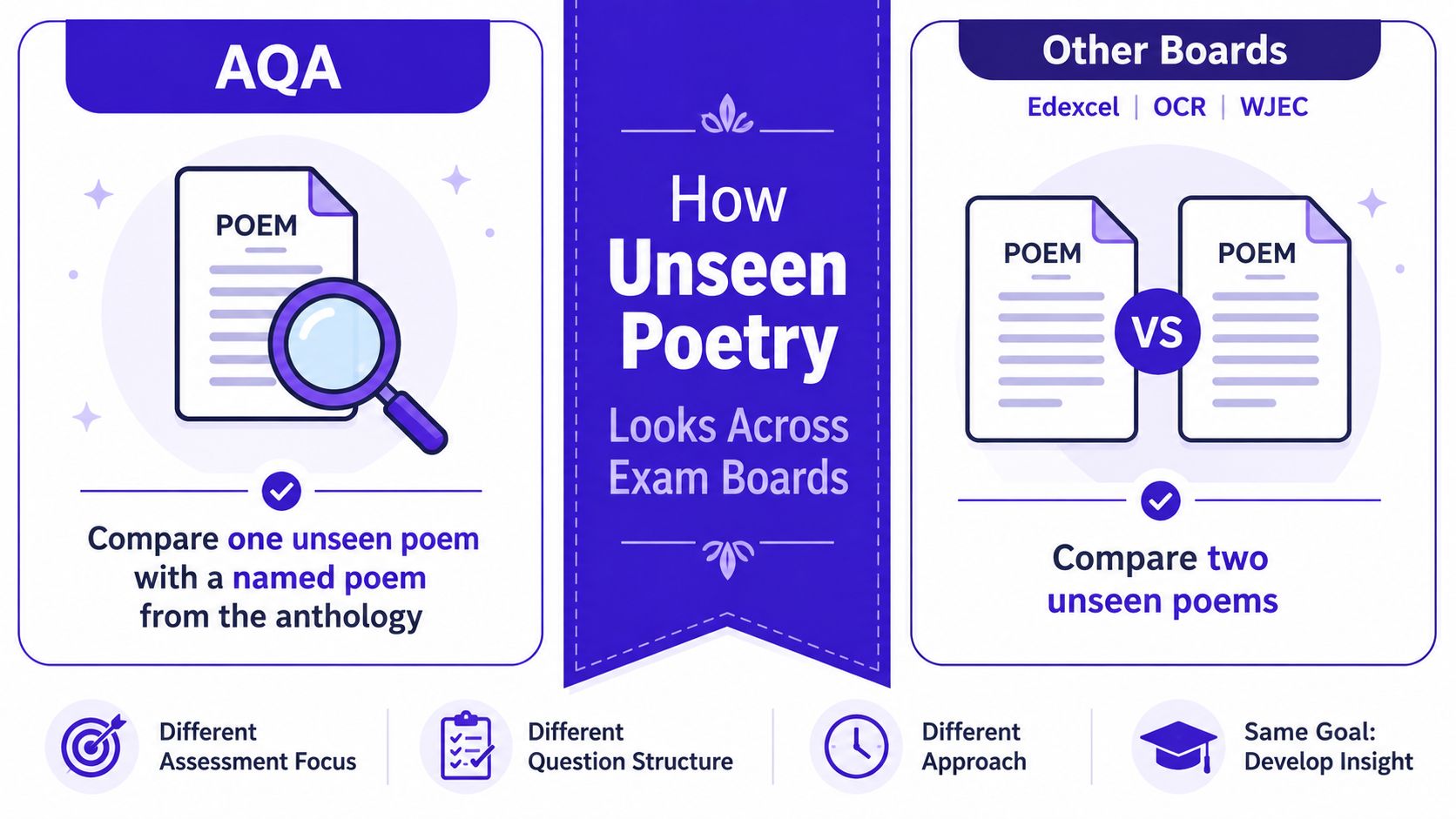
You open the exam paper and see a poem you have never studied. Before analysing its imagery, check the route your exam board has set: the paper may use a different structure, mark allocation, or comparison task. Your revision strategy should match that format, so check your specification and practise with papers from your own board.
For AQA GCSE English Literature in England, unseen poetry appears in Paper 2, Section C, worth 32 marks in total. Question 1 asks for an analysis of one unseen poem and carries 24 marks. Question 2 asks you to compare it with a second unseen poem and carries 8 marks. That split matters: spend most of your time building a developed response to the first poem, then write a concise comparison that connects methods and meaning.
WJEC presents unseen poetry as a one-hour Unit One exam task comparing two contemporary poems that students have not been given in advance. The same core prompt is used for both higher and foundation tiers. This differs from AQA GCSE, where the longer response focuses on one poem before the shorter comparison.
At AQA A-level English Literature A, unseen poetry is a compulsory 25-mark essay on two unseen poems in Paper 1. The exam allocates approximately 45 minutes to this section. Your argument needs to examine how the poets create meaning through form, structure, and language. This AQA A-level unseen poetry guide summarises the comparative emphasis on AO1 and AO2.
| Route | Unseen poetry format | What you need to prioritise |
|---|---|---|
| AQA GCSE | 24-mark analysis of one poem, followed by an 8-mark comparison | Focused analysis first, then concise method-based comparison |
| WJEC GCSE | One-hour comparison of two unfamiliar contemporary poems | Sustained comparison across both poems |
| AQA A-level | 25-mark essay on two unseen poems, with approximately 45 minutes allocated | A developed comparative argument about form, structure, and language |
| Edexcel GCSE | Section B unseen poetry totals 40 marks, split equally into 20 marks for part (a) and 20 marks for part (b), as outlined in Edexcel unseen poetry guidance | Check the exact wording and balance of the two parts |
Use GCSE Past Papers to practise the timing and question style you will face. OCR and Eduqas organise poetry assessment differently, so students should verify that every strategy matches their specific exam board format.
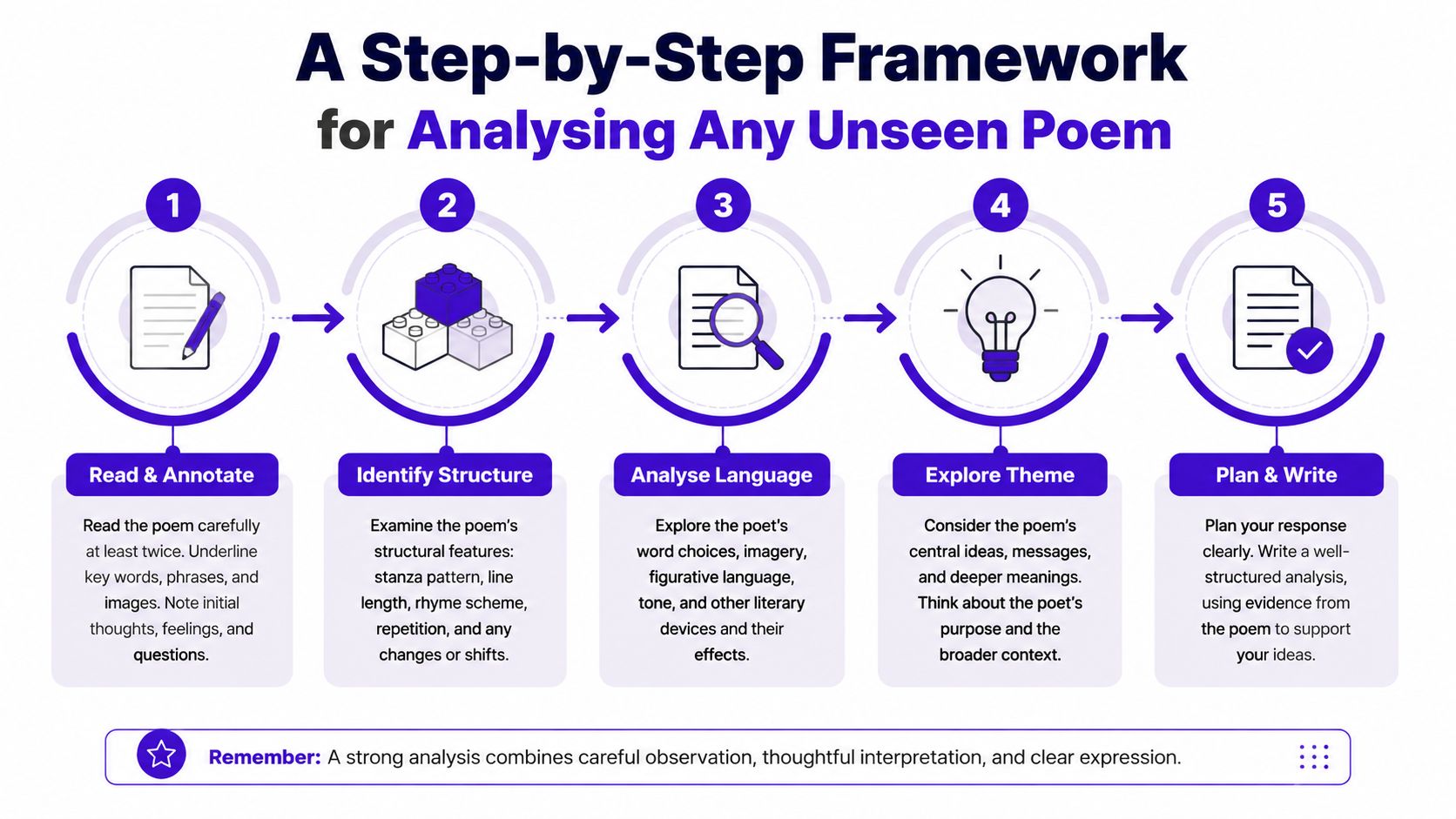
A Step-by-Step Framework for Analysing Any Unseen Poem
A reliable process stops panic from controlling your response. You can adapt the details to your board, but the underlying movement is simple: read, annotate, plan, and write.
Phase one, read for the whole picture
Read the poem carefully before hunting for techniques. On the first reading, ask what situation the poem presents, what mood you notice, and who seems to be speaking. On the second reading, look for changes, repetitions, striking images, and unusual choices.
Suppose the poem describes an old photograph. On the first read, you might understand that the speaker is remembering a relationship. On the second, you might notice that the poem begins with warm visual imagery but ends with a colder, more distant image. That movement could become the centre of your response.
AQA's teaching guidance tells students to read both poems carefully and think about the connection between them. Its unseen poetry teaching guide is especially useful for understanding why the second poem matters in the comparison question.
Phase two, annotate what earns attention
Don't cover the page in random underlining. Mark features that help answer the question:
- Language: Connotations, imagery, verbs, adjectives, sound patterns, repetition and contrast.
- Form: Dramatic monologue, sonnet-like features, free verse, regular rhyme, or a particular voice.
- Structure: Stanza changes, line breaks, enjambment, a turning point, opening and ending.
- Meaning: Emotions, relationships, conflicts, attitudes and changes in viewpoint.
Use brief notes. “Memory becomes painful” is more useful than a paragraph of unfinished thoughts.
Phase three, plan a route through the response
Choose a small number of main ideas rather than trying to mention everything. A straightforward plan might move from the speaker's feelings, to an important image, to a structural change that complicates the poem's ending.
Each paragraph should have a purpose. If your point is just “the poem uses a metaphor”, it isn't ready. Turn it into an argument: “The metaphor makes the memory seem physically difficult to escape, suggesting that the speaker's past still controls the present.”
Phase four, write analysis, not a feature list
A useful paragraph often follows this movement:
- Make a clear point that answers the question.
- Embed a short quotation.
- Identify the relevant method.
- Explore a word, image, structural choice, or sound.
- Explain the effect and connect it to the poem's wider meaning.
The Exam Practice for GCSE page can help you practise this process under exam-style conditions. If you're studying outside the UK system as well, read about AP English prep on ClassLecture for a broader comparison of analytical exam preparation.
Here's a visual reminder of the process:
You can also use this short video as a revision prompt before attempting a practice poem:
What Examiners Actually Mark
Mark schemes become much less intimidating when you separate what you say from how you analyse it.
For AQA GCSE, the 24-mark question assesses AO1 and AO2. AO1 concerns your argument and your use of textual references. AO2 concerns your analysis of language, form and structure, including the effects created by the poet's choices. A strong response doesn't merely identify a theme, and it doesn't pile up terminology. It explains how the writing creates the meaning you're discussing.
The AQA comparison guidance confirms that the 8-mark comparison is AO2 only. That means your marks come from comparing language, form and structure, as well as the effects created by those methods. You aren't being asked for a full context essay or a catalogue of everything you know about poetry.
AO1 and AO2 in practice
Consider this weak comment:
The poet uses a metaphor to show that the speaker is sad.
It identifies a method, but the explanation is thin. A stronger version would explain what the metaphor compares, why that comparison matters, and how it shapes the reader's understanding of the speaker's sadness.
For example:
The image of grief as “a locked room” presents sadness as a physical place rather than a passing emotion. The adjective “locked” suggests that the speaker feels trapped inside the memory, while the room image creates a private, enclosed atmosphere. The poem therefore presents mourning as isolation, not simply pain.
This paragraph demonstrates both objectives. The writer makes an argument about grief, which supports AO1, then examines the image and the connotations of “locked”, which supports AO2.
At the top of the AQA levels, responses are described as critical and insightful. Lower levels move through thoughtful, clear, and simple analysis. The difference isn't usually one rare technique. It's the precision of the explanation and the strength of the connection between evidence and interpretation.
Ask yourself after every quotation: What does this choice suggest, and why has the poet presented it this way?
Writing a High-Scoring Comparison Paragraph
You reach the 8-mark comparison after the longer response, with less time and concentration. Treat it as a short, focused task, not a reduced full essay. Your aim is to make a clear judgement about how both poets present the connection named in the question.
For AQA, compare the methods used in both poems. Focus on how the poets use language, form and structure to present the shared idea or contrast. Context and memorised anthology knowledge are not required because the question tests the poems in front of you.
A practical timing plan is roughly two to three minutes annotating the second poem and about twelve minutes writing, following school-facing guidance such as this GCSE English Literature exam overview. Adjust this to your full paper, but protect time for both stages. A rushed comparison can lose marks even when the first answer is detailed.
A paragraph shape that works
Build the paragraph in this order:
- Shared idea: State a similarity or contrast that answers the question.
- Poem one: Use a short quotation and examine a method.
- Poem two: Use a short quotation and examine a method.
- Comparative judgement: Explain what the similarity or difference reveals.
For example:
Both poets explore loss, but the first poem uses fragmented imagery and enjambment to mirror emotional dislocation, while the second relies on softer metaphor and a steady rhyme scheme to suggest that grief has settled into acceptance. The broken movement of the first poem makes loss feel immediate and unstable, whereas the controlled pattern in the second presents sorrow as something the speaker has learned to live with.
The comparison works because the poems remain connected throughout. Do not write a full paragraph on poem one, then attach a final sentence about poem two. Link each method to the other poem and explain why the contrast matters.
A quick comparison checklist
Before moving on, check that you have:
- Answered the connection: Have you compared the idea named in the question?
- Used both poems: Is the second poem analysed, rather than merely mentioned?
- Discussed methods: Have you included language, form, or structure?
- Explained effects: Have you shown what each choice makes the reader understand?
- Made a judgement: Have you explained how the poets approach the idea similarly or differently?
A paragraph that moves between poems using this sequence can be adapted for any command word that asks for comparison. Practise the same comparative shape across different GCSE and A-Level subjects, including prose, drama, and non-fiction, where you must weigh two texts against each other.
Common Pitfalls That Cost Marks
Students often ask whether they need to spot unusual forms or identify every technique. You don't. A precise comment on an ordinary verb can be more valuable than an incorrect label attached to a complicated device.
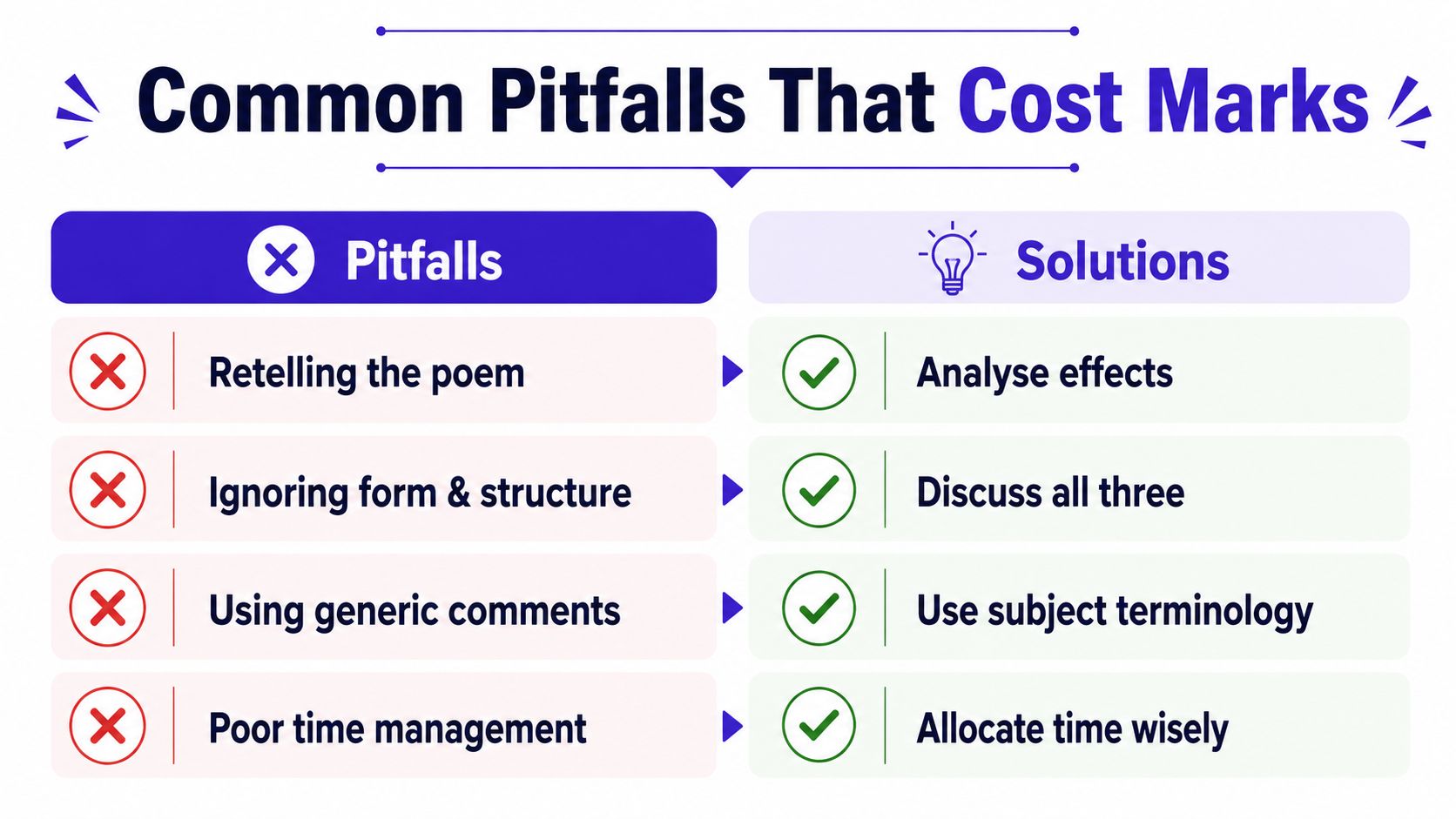
Four habits to remove
- Retelling the poem: A sentence such as “The speaker walks home, sees the house, and remembers their mother” summarises events. Add analysis by explaining how the poem's imagery or viewpoint makes that memory feel threatening, comforting, or uncertain.
- Naming without explaining: “There's a simile” isn't analysis. Explain what is being compared, what the comparison suggests, and how it affects the poem's meaning.
- Ignoring form and structure: Look at stanza organisation, line length, enjambment, rhyme, repetition, shifts in tone, and the ending. You don't need to mention all of them, but you should consider whether the poem's organisation supports your argument.
- Mismanaging time: A detailed first answer doesn't compensate for a rushed comparison. The marks should influence your decisions. Keep the longer response focused and protect time for the shorter question.
The most damaging assumption is that high marks come from exhaustive technique-spotting. They usually come from disciplined paragraphing, well-selected evidence, and clear effects. If you spot only one structural feature but explain its significance convincingly, that can be stronger than listing five devices with no interpretation.
A good answer notices. A great answer explains why the poet's choice matters.
Building a Revision Routine That Works
Unseen poetry improves through exposure and practice. You can't memorise the exact poem that will appear, but you can train yourself to respond calmly to unfamiliar language, changing moods, and difficult endings.
Start with the Poetry Society's GCSE unseen-poem collection, which uses commissioned poems and poet-led videos for exam preparation. The collection includes four videos, each based on a newly commissioned poem and designed to practise unseen-poetry techniques, as described in the GCSE unseen-poems revision resource. AQA's specification, listed there as last updated on 2026-08-22, continues to direct students towards content, theme, structure and language.
A practical routine
Read widely. Choose poems you haven't studied and read them without immediately searching for an explanation. Write a short note about the speaker, mood, and central idea. Your first response doesn't need to be complex. It needs to be yours.
Practise annotation separately. Set yourself a short, focused session. Mark one language choice, one structural feature, one shift, and one possible theme. This builds the speed you need without exhausting yourself by writing a full essay every time.
Complete timed responses. Use your board's past papers and mark schemes. After writing, highlight where you identify a method, where you explain an effect, and where you develop an interpretation. If one of those is missing repeatedly, that's the skill to practise next.
Use feedback intelligently. An AI Powered Revision platform such as MasteryMind can provide board-aligned unseen poetry practice, adaptive questions, and examiner-style feedback with assessment-objective breakdowns. It can sit alongside teacher feedback, not replace it, especially when you need another opportunity to practise a paragraph before the next lesson.
For students recovering exams, begin with short annotations and one carefully developed paragraph. For students aiming for the highest grades, challenge yourself to make every paragraph connect language, structure, and interpretation rather than treating them as separate boxes. Teachers can use the same routine for modelling, guided annotation, independent writing, and feedback.
You don't need to love every poem. You need a process that helps you find meaning, select evidence, and explain the poet's choices under pressure.
MasteryMind gives UK GCSE and A-Level students exam-aligned practice across AQA, Edexcel, OCR, and WJEC, including unseen poetry questions and AO-focused feedback. Visit MasteryMind to practise analysing unfamiliar poems, compare methods, and build confidence before your next exam.
Ready to master this topic?
Practise with quizzes, blurt exercises and exam questions on MasteryMind.
7 days Premium · Then free forever · No card, no charge