What's Emotive Language? A GCSE & A-Level Exam Guide
You’re probably here because you’ve seen a question like “How does the writer use language to influence the reader?” and thought, “I know there are techniques in there somewhere, but what am I supposed to say?”
That’s where what's emotive language stops being a vague classroom phrase and starts becoming useful. If you can spot it, explain it, and link it to the writer’s purpose, you move out of the danger zone of saying “this makes the reader feel something” and into the kind of analysis examiners reward.
Teachers know this too. Students often recognise obviously emotional words, but they miss the more subtle choices that carry tone, judgement, and pressure. That gap matters in both GCSE and A-Level English.
Stuck on Analysing Language in Exams? Let's Fix It
A lot of students freeze when they see a language question. They underline a few words, write “the writer uses emotive language”, and then run out of road. The problem usually isn’t effort. It’s that nobody has made the technique feel concrete enough.
If that’s you, don’t panic. Emotive language is one of the easiest ways to improve your analysis fast, because once you understand how it works, you start seeing it everywhere. In speeches, articles, fiction, charity adverts, even your own creative writing.
What usually goes wrong
Students often do one of these:
- Spot the feature only. “The writer uses emotive language.”
- Use vague effects. “It makes the reader feel sad.”
- Miss the purpose. They explain the feeling, but not why the writer wants that reaction.
Teachers will recognise this pattern straight away. Students know a device is present, but they haven’t translated that into AO2-style analysis.
Practical rule: Don’t just name the method. Explain the exact word, the feeling it creates, and why that helps the writer.
If you’re rebuilding your revision from scratch, it also helps to pair language analysis with a proper routine. This guide on how to revise for GCSE English is useful because it turns a broad subject into manageable revision habits. For extra subject-specific practice, students often use Online Revision for GCSE.
What examiners want from you
They don’t want random spotting. They want controlled explanation.
That means you need to show:
- Which word or phrase matters
- What it suggests or connotes
- How it shapes the reader’s response
- What that helps the writer achieve
Once you get that chain clear in your head, language questions stop feeling so slippery.
Decoding Emotive Language Beyond a Simple Definition
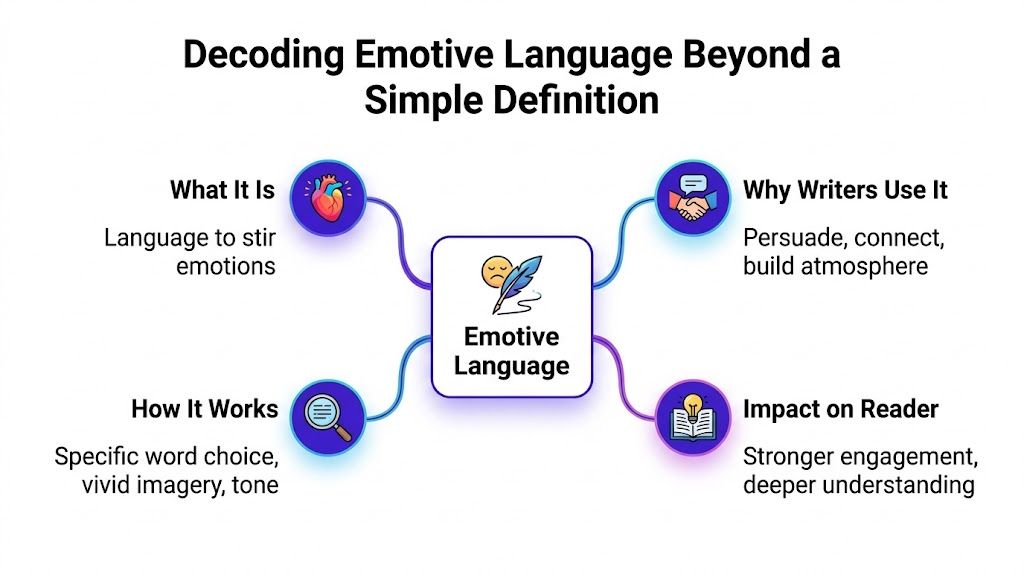
Emotive language is language chosen to stir a feeling in the reader. Not just to describe something, but to make you react to it. A writer might want sympathy, anger, fear, admiration, guilt, hope, or disgust.
That’s why a plain definition isn’t enough. You need to think of emotive language as a deliberate choice.
The key idea is connotation
A word has a literal meaning, but it also carries associations. That extra layer is what matters.
Take these three versions:
- The man walked away.
- The man stumbled away.
- The man fled away.
All three describe movement. But they don’t feel the same. Stumbled suggests weakness or shock. Fled suggests fear, urgency, maybe guilt. The denotation is similar. The connotation changes everything.
In UK GCSE English Language specifications, emotive language is treated as the strategic use of connotative words to shape audience response. According to Twinkl’s summary of exam-linked guidance, 68% of top-band scripts in AQA’s 2023 Paper 2 examiner reports explicitly linked emotive words such as “devastating” to changes in reader sympathy, with AO2 achievement rising by an average of 25 to 30%.
It isn’t just adjectives
Students often think emotive language means dramatic adjectives only. It doesn’t.
It can appear in:
- Adjectives like cruel, joyful, pathetic
- Verbs like snatched, abandoned, slammed
- Nouns like tragedy, nightmare, victim
- Adverbs like brutally, desperately, tenderly
Here’s the easiest way to remember it.
Emotive language is like a volume dial for feeling. Neutral wording keeps the volume low. Loaded wording turns it up.
Neutral and emotive aren’t the same thing
Compare these:
| Version | Effect |
|---|---|
| The council cut services. | Neutral, factual |
| The council cruelly stripped families of vital support. | Emotive, judgemental |
The second version doesn’t just report. It pushes the reader towards outrage. Words like cruelly, stripped, and vital guide the emotion.
That’s what you need to notice in exam texts. Ask yourself: is the writer informing me, or are they steering me?
Finding and Highlighting Emotive Language in Texts
Once you know the idea, the next step is training your eye. Start with the words that feel loaded. Then ask what emotion they try to trigger.
Start with the obvious example
“Hundreds of innocent children were abandoned in freezing conditions, left to suffer while the world looked away.”
This is packed with emotive language.
- innocent pushes us towards sympathy
- abandoned suggests neglect and betrayal
- freezing sharpens the physical suffering
- suffer makes the pain direct
- looked away hints at guilt and moral failure
This kind of writing appears in charity campaigns and opinion pieces because the writer wants more than attention. They want a response.
Then look for context
At A-Level, what counts as emotive can depend on where the word appears and what surrounds it. The OCR A-Level English Language specification highlights this context-sensitivity, and Translations.co.uk’s discussion of emotive language notes that candidates who could unpack the psycholinguistic impact of high-valence lexis such as “barbaric betrayal” averaged 18/25 in 2022 WJEC examiner insights on media text analysis.
That matters because a word isn’t automatically emotive in every setting.
“The minister described the proposal as a reckless attack on ordinary families.”
Here, reckless and attack are emotionally loaded. But their effect depends on the political context. In a speech or newspaper article, they can frame a policy disagreement as something dangerous and personal.
Finally, notice subtle examples
In literature, emotive language is often quieter.
“She stood in the doorway of the empty house, clutching the last letter he had sent.”
Nothing here is shouting. But empty and clutching do a lot of work. Empty suggests loss. Clutching implies desperation, attachment, maybe grief.
That’s where students sometimes miss marks. They wait for words like heartbreaking and terrifying, and overlook the softer choices.
A quick method for annotation
When you read a passage, try this:
- Circle loaded words. Anything that feels judgemental, painful, affectionate, or harsh.
- Group them by feeling. Sympathy, anger, fear, hope.
- Ask why that feeling helps. Does it support an argument, shape a character, or build mood?
Don’t hunt for “emotive language” as a label. Hunt for words that make the reader lean emotionally in one direction.
That shift in thinking makes your annotations sharper straight away.
How to Analyse Emotive Language Like a Grade 9 Student
Spotting the word is only the start. The important marks come from what you do next.

A lot of weaker answers stop here:
The writer uses the emotive word “helpless”.
That’s identification, not analysis.
The problem with feature-spotting
On language analysis questions, weak responses often stay vague. That matters because StudioBinder’s overview of emotive language is linked in the verified data to a key exam issue: 28% of GCSE English students in 2025 achieved grade 4 or below on language analysis questions, and Ofqual’s 2025 report notes that vague comments such as “sad words” were common in 42% of Grade 5 scripts.
Examiners penalise that kind of blur because it shows recognition without understanding.
A better structure
Use this simple pattern:
- Point. What choice has the writer made?
- Evidence. Quote the precise word or phrase.
- Analyse. Explain its connotations, effect, and purpose.
Here’s the difference.
Weak version
The writer uses the emotive word “helpless” which makes the reader feel sad.
Stronger version
The adjective “helpless” presents the victims as completely powerless, which encourages the reader to feel sympathy and perhaps guilt. It also supports the writer’s wider aim of making the situation seem urgent and morally serious.
See the difference? The second one explains the shade of meaning and links it to intention.
What to say after “this makes the reader feel”
Most students need one extra sentence. That sentence usually begins with one of these:
- This suggests...
- This implies...
- This positions the reader to...
- This helps the writer...
Try this mini formula:
| Step | Question |
|---|---|
| Quote | Which exact word matters most? |
| Connotation | What does that word suggest? |
| Reader effect | What are we pushed to feel? |
| Writer’s purpose | Why is that useful for the writer? |
Exam habit: Zoom in on one word before you zoom out to the whole message.
If you want targeted examples of how this works in OCR-style tasks, this guide on analysing language in OCR GCSE English Language is a helpful model.
A worked example
Take this sentence:
“The exhausted mother dragged her children through the merciless rain.”
You could analyse it like this:
- exhausted suggests complete physical and emotional depletion
- dragged implies struggle, heaviness, and effort
- merciless personifies the weather as cruel and unforgiving
Together, these choices create sympathy for the mother and make the scene feel punishing. The writer wants the reader to see her not as passive, but as someone enduring hardship.
A useful walkthrough can help you hear how strong analysis is phrased in real time:
One final upgrade
For top marks, avoid broad emotional words when a more precise one fits.
Don’t say:
- sad
- bad
- nice
- angry
Try:
- sorrowful
- threatening
- reassuring
- resentful
Precise vocabulary helps you sound like someone who’s analysing language, not just reacting to it.
Emotive Language Compared to Figurative Language
Students mix these up all the time. That’s normal, because the two often overlap. But they are not the same thing.
Emotive language aims mainly to trigger feeling. Figurative language aims mainly to create comparison, imagery, or layered meaning. Sometimes one piece of writing does both.
The clean distinction
If a writer says “the brutal decision ruined lives”, that’s emotive because brutal and ruined push us towards judgement and feeling.
If a writer says “grief sat on his chest like stone”, that’s figurative because the simile creates an image through comparison. It may also be emotive, but the key method is comparison.
Emotive vs figurative language
| Device | Primary Purpose | Example | Can it be Emotive? |
|---|---|---|---|
| Emotive language | To shape the reader’s feelings | “The innocent child was abandoned” | Yes |
| Simile | To compare using like or as | “Her fear spread like fire” | Yes |
| Metaphor | To describe one thing as another | “The city was a battlefield” | Yes |
Why this distinction matters in essays
If you call everything “emotive language”, your analysis gets blurry. If you call a metaphor a metaphor and then explain that it also creates fear or sympathy, your analysis gets more precise.
That precision matters even more at A-Level, where overblown writing can cost marks. According to Grammar Monster’s page on emotive language, 22% of Grade A scripts in AQA A-Level English Literature examiner reports lost AO5 marks for “unsubstantiated emotive assertions”, and Edexcel moderation data showed a 31% penalty rate for conclusions that were emotionally charged but lacked nuance.
A strong essay doesn’t sound dramatic for the sake of it. It sounds controlled.
If you want a broader refresher on different rhetorical devices, that can help you separate emotive wording from techniques like metaphor, repetition, and rhetorical questions.
A quick test you can use
Ask:
- Is the writer mainly making me feel something?
- Or are they mainly making me picture something?
If it’s feeling first, you’re probably looking at emotive language.
If it’s image or comparison first, you’re probably looking at figurative language.
If it does both, say both.
Put It Into Practice with Exam-Style Prompts
The best way to lock this in is to practise with short extracts and mark your own response truthfully.
Prompt one
“The forgotten veterans sat in silence, carrying wounds that the nation had chosen to ignore.”
Question
Analyse how the writer uses emotive language to create sympathy.
What to notice:
- forgotten suggests neglect and disrespect
- wounds can imply both physical and emotional damage
- chosen to ignore adds blame
Prompt two
“The playground, once alive with laughter, now lay desolate beneath broken glass and ash.”
Question
How does the writer use language to create a powerful emotional response?
What to notice:
- contrast between alive with laughter and desolate
- broken glass and ash creates harsh, bleak imagery
- the emotional effect comes from loss
Prompt three
“He called the plan a savage assault on ordinary people, not a reform.”
Question
How does the writer use emotive language to influence the reader’s view of the plan?
What to notice:
- savage assault frames policy as violence
- ordinary people encourages identification
- not a reform rejects a neutral interpretation
Mark your own checklist
Before you finish an answer, check these:
- Have I quoted a specific word or short phrase?
- Have I explained the connotations of that word?
- Have I described the effect on the reader precisely?
- Have I linked that effect to the writer’s purpose?
- Have I avoided vague comments like “this is emotional”?
For timed practice, it helps to train under pressure as well as in notes. Students who want more structured Exam Practice for GCSE often find that useful because it forces you to turn ideas into full answers, not just highlights on a page.
If you want to turn language analysis from guesswork into a repeatable exam skill, MasteryMind gives you GCSE and A-Level practice built around UK exam boards, with feedback that helps you move from spotting techniques to explaining them clearly and accurately.
Ready to master this topic?
Practise with quizzes, blurt exercises and exam questions on MasteryMind.
7 days Premium · Then free forever · No card, no charge