OCR · GCSE · English Language
Analyzing language
This guide focuses on the crucial skill of analyzing language and structure for OCR GCSE English Language. It provides a deep dive into the techniques required to excel in AO2-focused questions, helping candidates move beyond simple feature-spotting to develop insightful, mark-scoring analysis.
- 8 min read
- 3 worked examples
- 5 practice questions
Study Notes
Overview
Welcome to your guide for mastering language and structure analysis in OCR GCSE English Language. This skill, primarily assessed in Paper 1, Question 3, is fundamental to achieving high marks. It requires you to explore how writers use linguistic and structural choices to create meaning and effects. Examiners are looking for candidates who can move beyond simply identifying techniques and instead offer a developed analysis of why a writer has made certain choices and how these choices shape the reader's experience. This guide will equip you with the terminology, frameworks, and exam strategies to do just that.
Reading Skills
Identifying Information & Ideas
To analyze a text, you first need to understand it. This involves locating both explicit information (what is directly stated) and implicit information (what is suggested or implied). For unseen texts, start by reading through once to get the gist, then a second time to highlight key phrases and potential areas for analysis. Ask yourself: What is the overall mood? What is the writer's perspective? What key events or descriptions stand out?
Analysing Language
Language analysis is the bread and butter of this skill. It involves zooming in on specific word choices and literary devices. Credit is given for using precise terminology and explaining the specific effect of the language used.
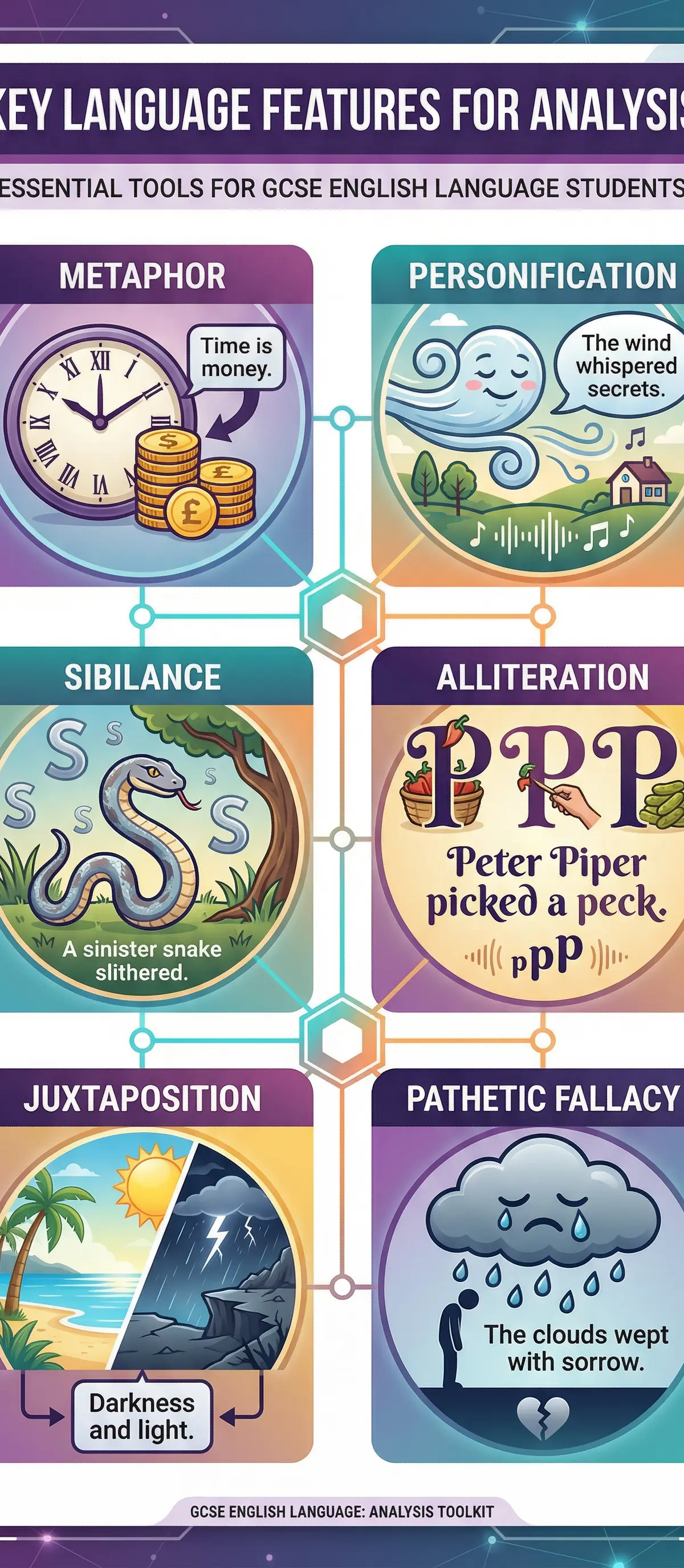
Key Language Features to Identify
| Feature | Definition | Effect on Reader | Example |
|---|---|---|---|
| Metaphor | A figure of speech in which a word or phrase is applied to an object or action to which it is not literally applicable. | Creates a powerful image, making an abstract concept more concrete or drawing a strong comparison. | The classroom was a zoo. |
| Simile | A figure of speech involving the comparison of one thing with another thing of a different kind, used to make a description more emphatic or vivid (e.g., as brave as a lion). | Makes a comparison easier to understand and more memorable. | He was as strong as an ox. |
| Personification | The attribution of a personal nature or human characteristics to something non-human. | Creates a specific mood or helps the reader relate to the object being described. | The wind whispered through the trees. |
| Pathetic Fallacy | The attribution of human feelings and responses to inanimate things or animals, especially in art and literature. | The weather or setting reflects the mood of a character or the scene, creating atmosphere. | The clouds wept with sorrow. |
| Alliteration | The occurrence of the same letter or sound at the beginning of adjacent or closely connected words. | Can create a specific sound effect (e.g., harsh, soft), draw attention to key words, or create a sense of pace. | The sweet smell of success. |
| Sibilance | A figure of speech in which a hissing sound is created within a group of words through the repetition of 's' sounds. | Often used to create a sinister, soft, or menacing tone. | The snake slithered silently. |
| Juxtaposition | The fact of two things being seen or placed close together with contrasting effect. | Highlights the differences between two things, creating a sense of conflict, irony, or drama. | The juxtaposition of wealth and poverty. |
| Semantic Field | A group of words that are related in meaning. | Builds a specific atmosphere or reinforces a key theme or idea. | A semantic field of war: 'battle', 'conflict', 'weapon', 'soldier'. |
Analysing Structure
Structure refers to how a text is organized and put together. OCR questions will ask you to consider this alongside language. Think about the bigger picture: the journey the writer takes the reader on.
- Openings: How does the writer begin the text? Does it hook the reader immediately? Establish a setting? Introduce a character?
- Shifts in Focus: Where does the writer change the focus of the text? Is there a shift in time, place, or perspective? Why?
- Narrative Perspective: Who is telling the story? First-person (I, we) creates a personal, subjective feel. Third-person (he, she, they) can be limited (following one character) or omniscient (all-knowing).
- Sentence Length Variation: Short, simple sentences can create tension, pace, or a sense of finality. Long, complex sentences can be descriptive, reflective, or build a sense of overwhelming detail.
- Paragraph Structure: Look at the length of paragraphs and how they are connected. A series of short paragraphs can speed up the pace, while a long, dense paragraph can slow it down.
- Cyclical Structure: Does the text end where it began? This can suggest that nothing has changed or that a cycle is repeating.
- Flashback/Foreshadowing: Does the writer move back in time (flashback) or hint at future events (foreshadowing)? This can provide context or build suspense.
Evaluating Critically
Evaluation questions ask for your informed opinion on how effectively a writer has achieved their purpose. You need to make a judgment and support it with evidence from the text. A good structure is:
- Statement: Make a clear point that answers the question (e.g., "To a large extent, the writer successfully creates a sense of mystery.").
- Evidence: Select a short, relevant quotation.
- Analysis: Explain how the language and/or structure in your evidence supports your statement.
- Link: Link back to the question and your overall judgment.
Comparing Writers' Viewpoints
For comparison questions, you need to identify the similarities and differences between two texts. Focus on comparing the writers' methods and viewpoints. A good framework is:
- Identify Viewpoints: What is the main message or perspective of each writer?
- Compare Methods: How do they use language and structure to convey their viewpoints? Compare their choices of words, imagery, tone, and structural features.
- Evaluate Effectiveness: Which writer do you think is more successful in conveying their message and why?
Writing Skills
Creative Writing
Creative writing tasks (narrative or descriptive) test your ability to use language and structure to engage a reader. Examiners reward ambition and control.
- Show, Don't Tell: Instead of telling the reader a character is nervous, show it: "His heart hammered against his ribs, and a bead of sweat trickled down his temple."
- Sensory Description: Appeal to all five senses (sight, sound, smell, touch, taste) to create a vivid and immersive world.
- Varied Sentence Structures: Mix simple, compound, and complex sentences to control pace and rhythm.
- Engaging Openings: Start with action, dialogue, or a mystery to hook the reader.
- Satisfying Endings: Endings should feel deliberate. A cyclical structure, a twist, or a moment of reflection can be effective.
- One-Scene Rule: For narrative tasks, focus on a single, well-developed scene rather than trying to tell a whole life story. This allows for more depth and detail.
Transactional/Non-Fiction Writing
Transactional writing requires you to write for a specific purpose, audience, and form (e.g., letter, article, speech, leaflet). The key is to adopt a convincing and appropriate tone.
- Purpose-Form-Audience (PFA): Always consider: What is the purpose of this text? What is the required format? Who is the intended audience?
- AFOREST: Use this acronym to remember persuasive techniques: Alliteration, Facts, Opinions, Rhetorical questions, Emotive language, Statistics, Three (rule of).
- Structure: Plan your structure. A letter needs an address and salutation. An article needs a headline and subheadings. A speech needs a clear introduction, body, and conclusion.
Technical Accuracy (SPaG)
Spelling, punctuation, and grammar (SPaG) are crucial. They account for a significant portion of the marks in writing tasks. Poor SPaG can obscure your meaning and suggest a lack of care.
- Ambitious Punctuation: Move beyond full stops and commas. Correctly using semicolons (to link two closely related independent clauses), colons (to introduce a list or explanation), dashes (for emphasis or interruption), and parenthetical commas (to add extra information) will impress examiners.
- Paragraph Cohesion: Use discourse markers (e.g., "Furthermore", "In contrast", "Consequently") to link your paragraphs and create a logical flow of ideas.
Worked Examples
3 worked examples — open one to explore the question and available guidance.
Practice Questions
Test your understanding — click to reveal model answers
Identify three language features in the following sentence: 'The ancient oak, a gnarled old man, stood stubbornly against the howling wind.'
Hint: Look for comparisons, human qualities, and sound effects.
Explore how the writer uses language to present the city as a dangerous place: 'The alleyways were veins of darkness, and the city’s breath was a cold whisper of exhaust fumes and decay.'
Hint: Use the What-How-Why framework. Focus on the metaphors and personification.
Write a single paragraph describing a storm, focusing on using pathetic fallacy and varied sentence structures.
Hint: Make the weather reflect an emotion (e.g., anger, sadness). Use a mix of long, descriptive sentences and short, punchy ones.
Analyse how the writer uses structural features to build tension in a short narrative extract.
Hint: Look for shifts in focus, sentence length, repetition, and the use of a single-sentence paragraph.
Write the opening to a speech arguing that mobile phones should be banned in schools. (Approx. 150 words)
Hint: Use the PFA framework. Hook the audience with a rhetorical question or a startling statistic. Use AFOREST techniques.
Test your understanding of Analyzing language
Active recall beats re-reading. Take an instant quiz now to test what you’ve learned and lock it into long-term memory.
7 days Premium · Then free forever · No card, no charge