Year 11 Revision Timetable: Build Your Plan in One Weekend

You've got nine subjects' worth of notes, a phone buzzing beside you, and no idea which book deserves your attention first. You keep telling yourself you'll start after dinner, then after one more video, then tomorrow with a “proper plan”. That isn't laziness. It's what happens when revision has no clear starting point.
A useful Year 11 revision timetable must do more than fill boxes with subject names. It needs to tell you which task to complete, when to revisit it, how exam dates change your priorities, and where recovery fits. You can build that plan in one weekend, even if you feel behind.
The GCSE season usually sits in the late-spring window. One UK school guide lists exams starting on 5 May 2026, while another places the start of the GCSE exam season on 20 June 2025, so you should use your own school's official timetable rather than rely on a generic calendar. Hampton Gardens' Year 11 revision information gives useful context for why dates need checking carefully.
Revision is a design problem, not a willpower contest. Get the design right and starting becomes much less painful.
The Moment Every Year 11 Student Eventually Hits
Three months before the GCSEs, you're sitting on the floor with biology flashcards under one knee, a half-finished English essay beside you and maths worksheets scattered across the carpet. Notes from nine subjects are somewhere in the mess. Your phone keeps lighting up with messages, but the phone is not the problem.
The problem is the question in your head: which book do I open first?
That uncertainty eats the evening. You spend twenty minutes sorting notes, another ten hunting for a topic list, then choose an easy subject because it feels productive. By bedtime, you have worked hard without touching the topic you were avoiding.
The enemy isn't effort. It's unplanned effort aimed at the wrong thing.
A downloaded seven-day grid will not solve that. It may label Monday “maths” and Tuesday “science”, but it cannot identify whether maths needs trigonometric identities, algebraic manipulation or exam timing. It cannot account for the order of your papers or the quotation memory you keep dodging in English Literature.
Your timetable must show what each study block contains, not merely which subject gets the hour. Build it around your subjects, your tier, your exam dates and your actual confidence. One hour might contain retrieval questions, another might contain mixed exam practice, and a third might be a timed response followed by marking. That detail is what turns a calendar into a revision plan.
Build the priority grid tonight
Set aside roughly half an hour with a pen, a notebook and your phone. List every GCSE subject you will sit this summer, including whether each paper is Foundation or Higher.
Find the official exam dates on your exam board website and your school's published information. Do not rely on memory or rumours from a group chat. Put the dates in one list, with the earliest exam first. Those dates will later decide when you switch from learning content to timed papers and final recall.
Now grade your confidence from A to D:
- A: You could teach the topic to someone else.
- B: You understand it but make occasional mistakes.
- C: You recognise the material but struggle to apply it.
- D: You avoid it, forget it or have no reliable method yet.
Write one specific gap beside every subject. “Bad at science” gives you nothing useful to schedule. “Electricity paper 2”, “quotation memory” and “trig identities” tell you exactly what the next session should contain.
| Subject | Tier | Exam Date | Confidence (A–D) | Biggest Gap |
|---|---|---|---|---|
| Mathematics | Higher | Add official date | D | Trigonometric identities |
| Biology | Higher | Add official date | C | Required practicals |
| English Literature | Add tier if relevant | Add official date | C | Quotation memory |
| Geography | Add tier if relevant | Add official date | A | Timed case-study answers |
| Subject five | Add tier | Add official date | B | Specific topic |
| Subject six | Add tier | Add official date | C | Specific topic |
| Subject seven | Add tier | Add official date | B | Specific topic |
| Subject eight | Add tier | Add official date | A | Specific topic |
| Subject nine | Add tier | Add official date | C | Specific topic |
Do not give favourite subjects the biggest share just because they feel comfortable. Easy revision can leave you feeling busy while weak areas continue costing marks. Weight your plan towards low-confidence topics and close exams, then keep stronger subjects active through shorter maintenance sessions.
The modern GCSE system replaced O-levels and CSEs in England, Wales and Northern Ireland in 1986, and England later introduced the 9–1 grading scale in 2017. That history matters less than the practical consequence: you are revising for particular papers, command words and mark schemes, not “science” in the abstract.
For structured digital practice alongside your paper plan, Online Revision for GCSE offers specification-aligned questions and spaced review. Use it to practise a chosen gap, then record what you got wrong. Do not let another resource become an excuse to avoid deciding what needs work.
Time-Blocking and Weighting Your Weekly Hours
Start with the time you have, not the timetable you'd like to have. Your available revision hours come from school evenings after 4pm, minus commuting, dinner, clubs, family responsibilities, one proper rest hour and the ordinary faff of being human.
For many Year 11 students, that leaves roughly 12 to 18 hours weekly, depending on their commitments. Treat that as a planning range, not a target you must force every week.
Give weak and urgent subjects more space
Use the confidence grades and exam-date list from your priority grid. A weak Higher maths paper coming soon deserves more attention than a strong geography subject with plenty of time before its exam.
A worked example might look like this:
- Higher maths, confidence D: 4 hours.
- Biology, confidence C: 2.5 hours.
- Strong geography with an early exam: 1 hour for maintenance.
- The remaining six subjects: share the remaining time according to confidence, paper demands and exam proximity.
This is weighting, not neglect. Every subject appears regularly, but not every subject receives identical treatment. A subject with essay-heavy papers may need timed writing and feedback, while maths may need short retrieval followed by targeted exam questions.
Make each block executable
Use 50 minutes of focused work followed by 10 minutes away from the desk. Put two subjects in an evening rather than attempting one enormous stretch. Keep weekends for past papers, mock conditions and reviewing mistakes.
A blank block labelled “biology” creates another decision. A block labelled “retrieve cell biology from memory, then mark six exam questions” tells you exactly what to do.
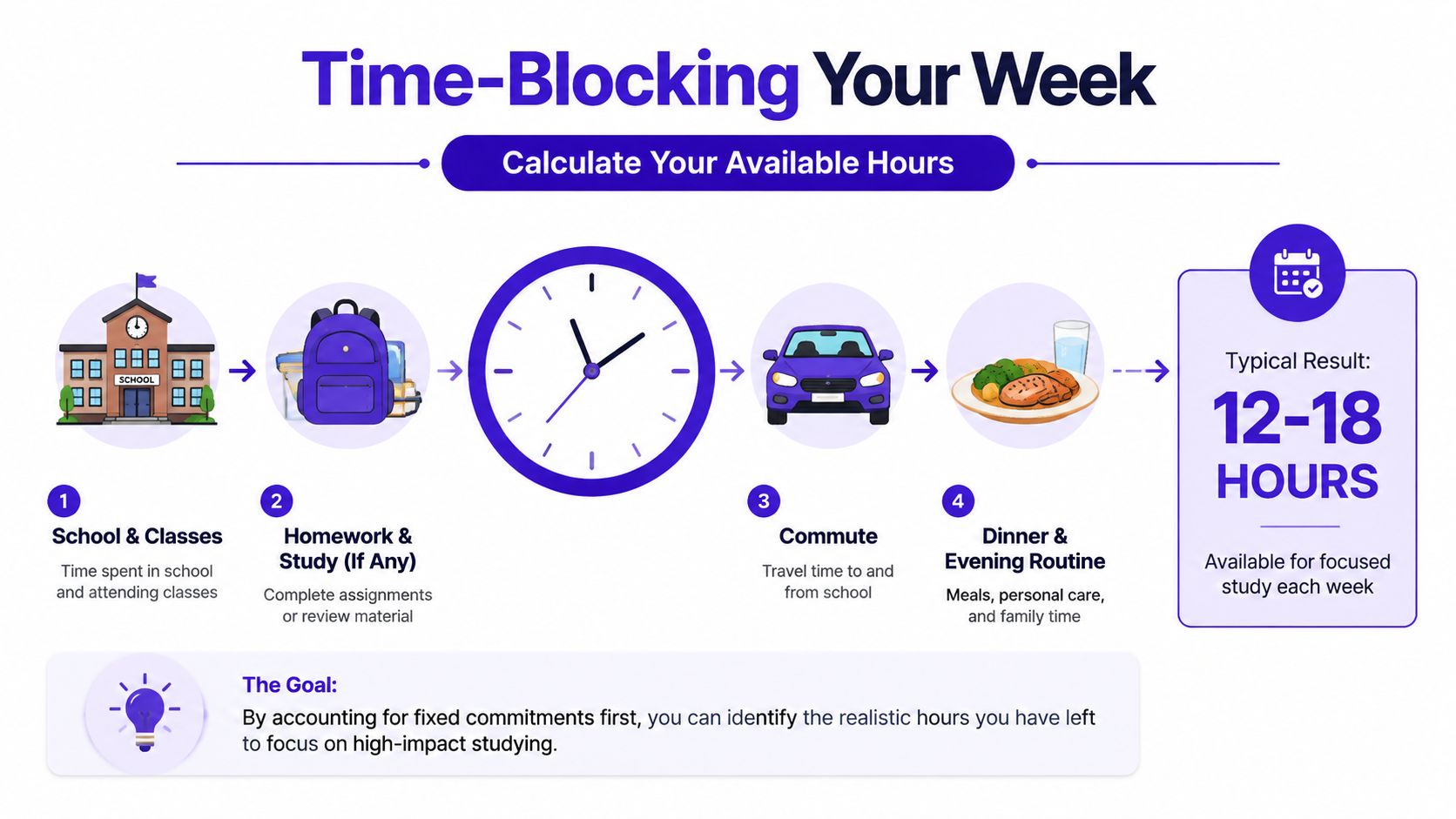
Useful student scheduling strategies can help you account for fixed commitments before you promise yourself heroic study hours. Honesty wins here. A timetable you follow through Friday beats a perfect-looking plan abandoned on Wednesday.
Spacing, Mixed Practice and Why Your Brain Needs Both
Reading a chapter repeatedly gives you a familiar feeling, but familiarity isn't the same as recall. A better timetable returns to a topic after a gap, asks you to retrieve it without notes, then checks what you missed.
Use a simple rhythm: review a difficult idea the next day, revisit it again after a few days, then return to it the following week. If an assessment is a week away, the KAA handout recommends reviewing daily. If it's a month away, it recommends reviewing about once a week. The KAA spacing and timing guide turns spacing into a practical calendar decision.
Put retrieval before explanation
Start sessions with a short retrieval slot. Close the book and write everything you remember about a process, formula or theme. Then compare your answer with the specification, notes or mark scheme. The gaps you uncover decide what happens next.
Mixed practice adds productive difficulty. Instead of spending an entire evening on one comfortable topic, rotate between related tasks or subjects. A maths block might move from algebra to graphs, while a science session might combine required practicals with calculation questions. That rotation exposes weak links before the exam exposes them for you.
One UK school guide recommends 25-minute focus blocks with five-minute breaks, while another advises keeping each session to no more than an hour and labelling every block with a specific topic. The Helena Romanes revision guide supports the practical point: shorter, named tasks are easier to start and measure.
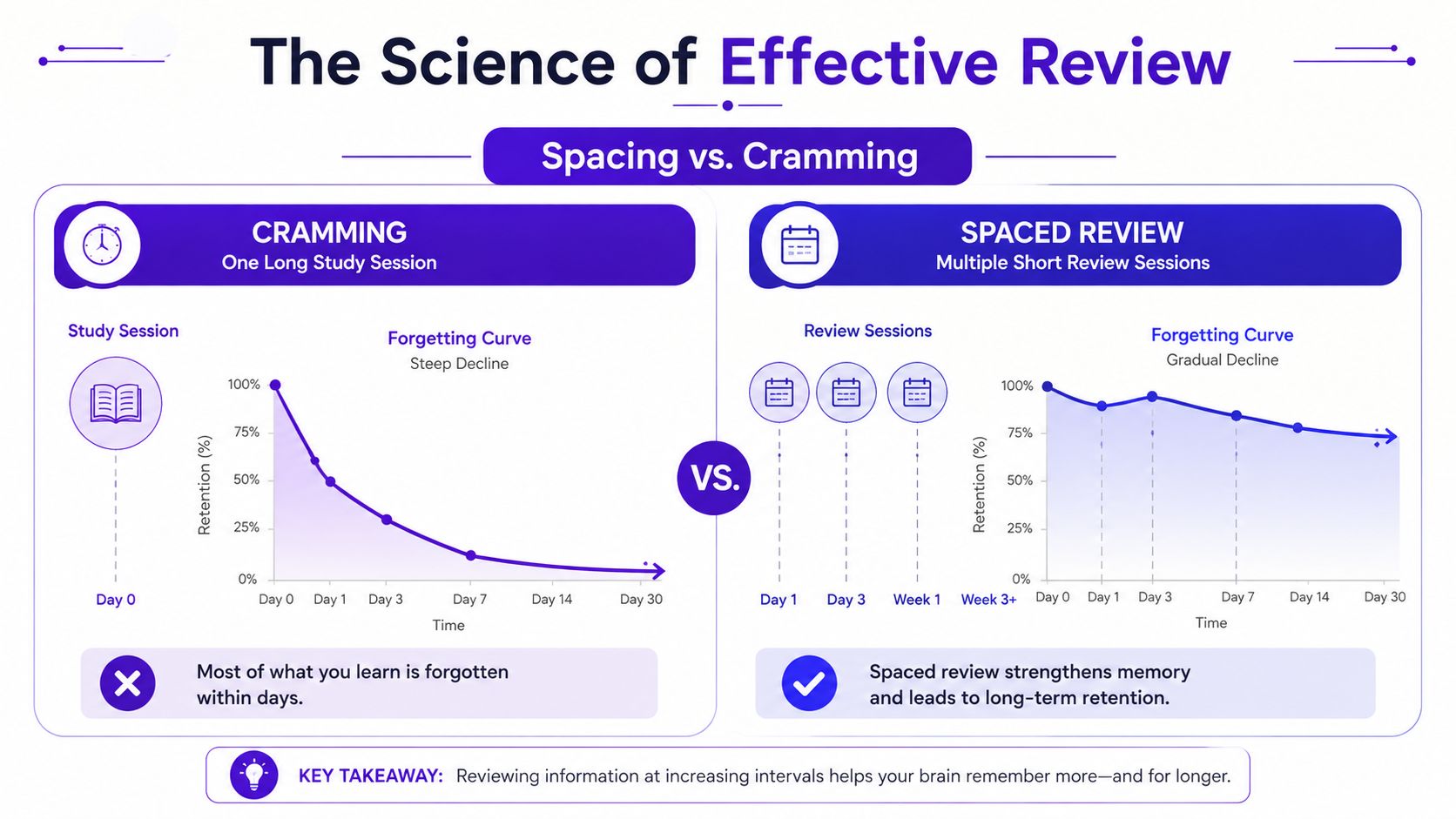
A blocked week might contain five hours of one subject followed by a panicked switch to another. A spaced, mixed week distributes recall, questions and feedback so you meet material repeatedly. Evidence-based revision strategies can help you turn those returns into scheduled review rather than relying on memory to remind you.
Two Sample Revision Timetables You Can Steal
These grids show the shape of a workable plan for a student taking nine GCSEs and committing 15 hours each week. Change the subjects, timings and task types to match your life. Don't copy the labels blindly.
The normal-term version includes morning school slots, four weekday evenings and a Saturday morning. Sunday remains a planning and recovery day rather than another heavy study day.
| Day/Block | Normal Week | Pre-Mocks Week |
|---|---|---|
| Monday morning | 20-minute maths retrieval | 20-minute maths formula retrieval |
| Monday evening | English Literature quotation recall, then biology exam questions | Full English Literature paper under timed conditions |
| Tuesday morning | Geography case-study flashcards | Biology definitions and required-practical recall |
| Tuesday evening | Higher maths mixed questions, then French vocabulary retrieval | Biology timed paper, then mark-scheme review |
| Wednesday morning | Chemistry equation retrieval | Chemistry calculation drill |
| Wednesday evening | History essay plan, then English Language structure practice | History timed section, then feedback triage |
| Thursday morning | Biology process recall | English Language timing drill |
| Thursday evening | Physics calculations, then geography retrieval quiz | Physics paper under timed conditions |
| Friday morning | French vocabulary and listening practice | Weak-topic rescue slot |
| Friday evening | Light flashcards and homework catch-up | Light error-log review, hard stop |
| Saturday morning | Maths past paper, mark it, then review errors | Full mixed mock or two timed papers with feedback |
| Saturday afternoon | Rest, friends, sport or hobbies | Rest and recovery |
| Sunday | Full day off, then short planning ritual | Full day off, then plan the next feedback cycle |
Keep the task visible. “English” is vague. “Recall five quotations, write one paragraph from memory and compare it with the mark scheme” is usable.
If you need a more visual way to organise routines around school, travel or additional support needs, an autism daily schedule template can offer a useful layout to adapt. For exam preparation, GCSE Past Papers give you the raw material for timed practice, marking and error tracking.
The pre-mocks grid deliberately reduces new content. It replaces passive coverage with full papers, timed conditions and feedback triage. Every wrong answer becomes a future topic slot, not a reason to panic.
Building Your Timetable Around Mock Exams
Mocks shouldn't smash your timetable apart. They should be the load-bearing wall holding it together.
Suppose your mocks begin in week six. Work backwards from that date. In the earlier phase, build knowledge and repair obvious gaps. Then give each subject a proper timed-paper slot, followed by a feedback period where mistakes become the next fortnight's revision list.
Label blocks with a countdown:
- T-minus 4: Learn and retrieve high-priority content.
- T-minus 3: Complete targeted exam questions and mark them.
- T-minus 2: Run timed papers and identify recurring errors.
- T-minus 1: Review weak spots, practise timing and protect sleep.
- Mock week: Use short recall sessions and avoid frantic new-topic collecting.
A mock result is diagnostic information. If you lose marks through missing content, schedule retrieval. If you know the material but fail to answer the command word, schedule question analysis. If you run out of time, schedule timed sections rather than rereading another chapter.
After results, expect an energy dip. Don't respond by deleting every rest period and writing a punishing new plan. Spend one session sorting errors into categories, then re-weight the priority grid. A low mark in one paper doesn't define your ability, but repeated errors do deserve a timetable response.

Use Exam Practice for GCSE when you need a focused environment for timed questions and exam-style work.
The roadmap below shows how the phases fit together.
Your mock plan should answer one question after every paper: what exactly changes in next week's timetable? If the answer is “nothing”, you've collected a score rather than used the mock.
Wellbeing Rules That Make Revision Work
A timetable can contain the right topics and still fail if it leaves you wrecked. Exhaustion makes retrieval, answer-checking and calm decision-making harder, so sleep and rest belong inside the plan, not after it.
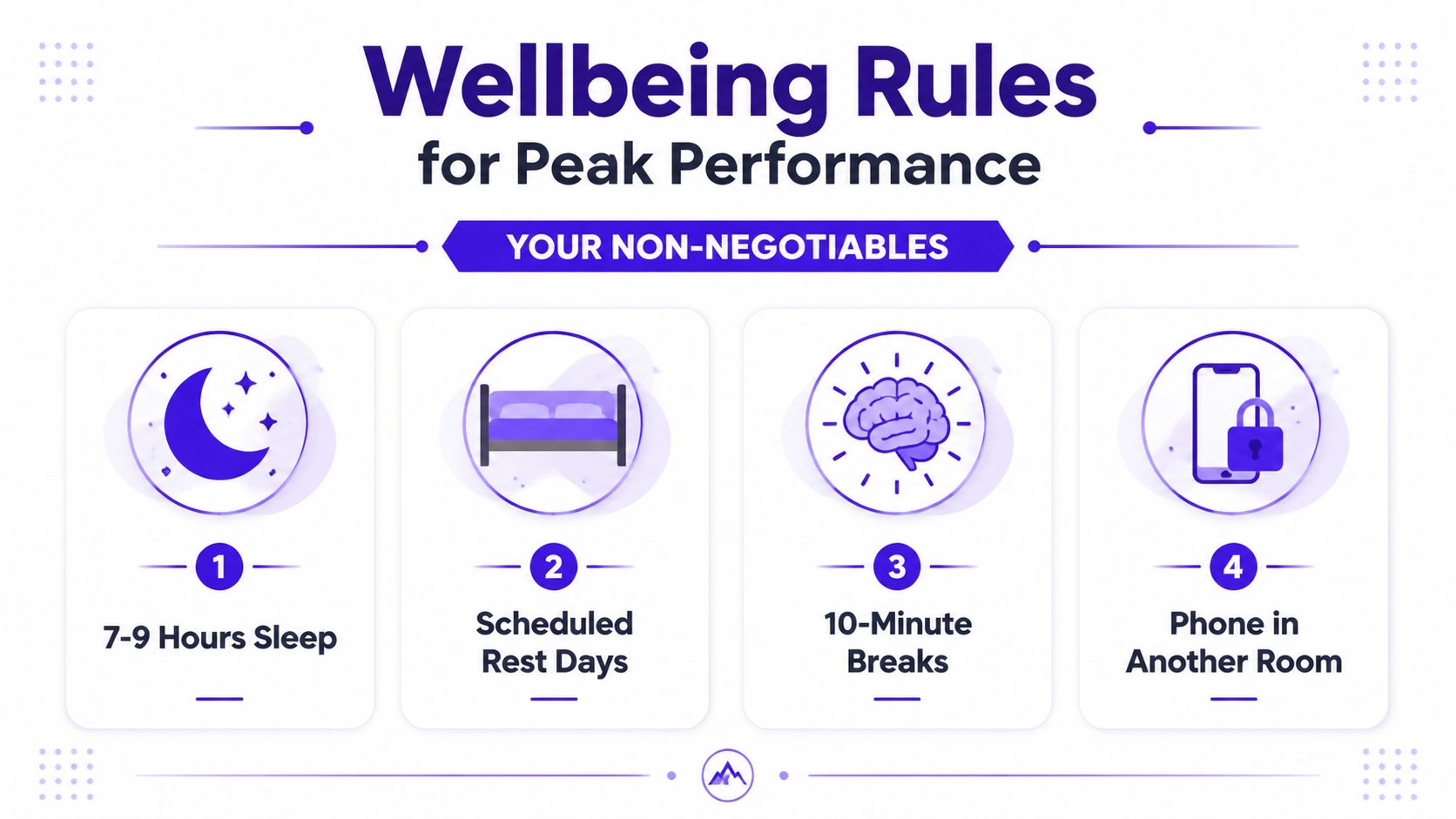
Protect 7 to 9 hours of sleep, a figure included in UK study guidance from Contour Education. Set an evening cut-off and keep it. The hour you spend half-awake rereading notes is usually worse than the sleep you sacrificed.
Build the rules into the grid
- Phone elsewhere: Leave it in another room during focused blocks. A phone beside your workbook still takes attention, even when the screen is off.
- Take real breaks: Use a 10-minute break after a long block. Stand up, drink water or walk outside. Avoid turning that pause into an accidental scrolling session.
- Keep one full rest day: Take a complete day away from revision each week. You will return with more patience and clearer concentration.
- Get daylight before screens: Start with outdoor light or a short walk before settling into online notes.
- Set a stopping time: Choose when work ends before you begin. Without a finish line, one task expands and bedtime disappears.
A Gloucestershire County Council study-plan resource recommends rotating core subjects in 45 to 60-minute homework blocks, taking a 10-minute break, then using a lighter 20 to 30-minute task. It also advises switching devices off between 8:30 and 10:15 pm to support sleep. Read the Gloucestershire Year 11 study-plan ideas and adapt the principle to your household.
Missed a session? Restart at the next block. Do not scrap the whole week or punish yourself with an impossible replacement plan. A timetable that includes food, movement, sleep and rest gives every study hour a better chance of doing its job.
Your First Evening With This Plan
Give yourself one focused hour tonight. Don't spend it making a beautiful spreadsheet with colour-coded tabs and no actual tasks. Build the minimum useful version.
The 60-minute setup
First, gather the exam information. Find your school or exam-board timetable and note every paper date, including possible clashes or multiple papers close together.
Next, rate your subjects. Use the A to D confidence scale and write one specific gap beside each subject. If you can't name the gap, spend a short retrieval attempt finding it. Your mistakes are more useful than your mood.
Then, block next week. Put realistic 90-minute windows on your calendar, split into focused tasks and breaks. Include school commitments, travel, meals, clubs, rest and your hard stop before placing revision into the remaining spaces.
Finally, choose three micro-goals for tomorrow. Make them observable: complete a set of algebra questions, retrieve a biology process from memory, or write one timed English paragraph and mark it. “Revise science” isn't a goal. It's a fog machine.
A paper wall planner works well because you see it without opening another app. Keep a simple spreadsheet beside it with columns for topic, confidence and next review date. That gives you a record of what needs returning to, rather than a diary of hours spent sitting near a textbook.
The plan only works if you use it. Before closing this page, write tomorrow's first task on paper and put the required book on your desk. Starting is the win you need tonight.
MasteryMind offers UK exam-board-aligned practice across GCSE subjects, with adaptive questions, examiner-style feedback, spaced review and mixed-topic practice. Visit MasteryMind to turn the priorities in your Year 11 revision timetable into specific questions and feedback-led study sessions.
Ready to master this topic?
Practise with quizzes, blurt exercises and exam questions on MasteryMind.
7 days Premium · Then free forever · No card, no charge