AQA · A-Level · Biology
Course version: 7402 · Version from Sept 2016
Division of the cytoplasm (cytokinesis) usually occurs, producing two new…
Full specification wording
All cells arise from other cells: Division of the cytoplasm (cytokinesis) usually occurs, producing two new cells.
Cytokinesis is division of the cytoplasm, and it follows telophase rather than forming part of nuclear division itself.
Checked against the AQA 7402 specification (opens in a new tab) on .
- Point 7 of 14
- 4 key terms
Study notes
From the checked teaching notes for this specification point.
The idea
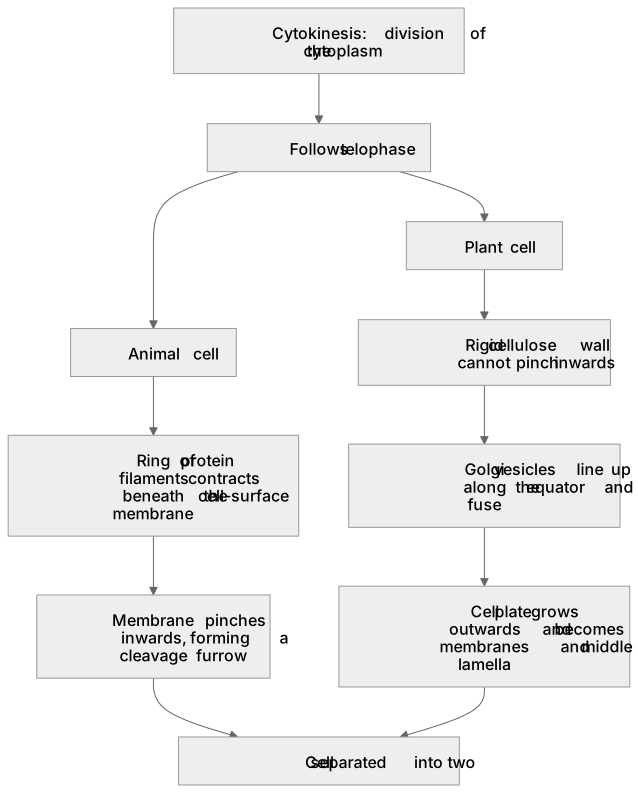
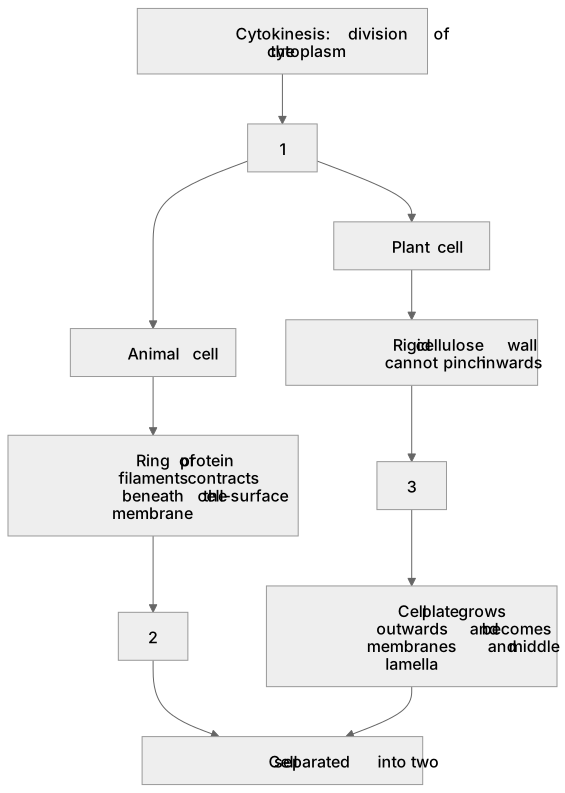
Cytokinesis is division of the cytoplasm, and it follows telophase rather than forming part of nuclear division itself. In an animal cell a ring of protein filaments just beneath the cell-surface membrane contracts, pinching the membrane inwards to form a cleavage furrow that deepens until the cell is separated into two. A plant cell cannot pinch inwards because of its rigid cellulose wall, so vesicles from the Golgi apparatus line up along the equator and fuse, forming a cell plate that grows outwards until it meets the existing wall and becomes the new cell-surface membranes and middle lamella. Organelles such as mitochondria are shared out roughly rather than exactly. The word usually in the specification matters: mitosis can occur without cytokinesis, and the result is one cell containing two or more nuclei.
What earns the marks
- Cytokinesis being division of the cytoplasm, after telophase, producing two separate cells.
- The animal cell mechanism: the cell-surface membrane constricts or pinches inwards to form a cleavage furrow.
- The plant cell mechanism: vesicles fuse along the equator to form a cell plate, because the cellulose wall cannot pinch inwards.
- Recognising that if cytokinesis is prevented the cell is left with two nuclei, appearing to be stopped at telophase.
- Identifying that the block is on cytoplasm or new membrane formation, not on nuclear division.
Common mistakes and how to put them right
Listing cytokinesis as a fifth stage of mitosis instead of a separate division of the cytoplasm.
Describing a cell plate forming in an animal cell, or a cleavage furrow in a plant cell.
Saying a drug that blocks cytokinesis stops DNA replication or prevents mitosis, when nuclear division has already finished.
Assuming organelles are divided in exactly equal numbers between the daughter cells.
Omitting the observable evidence, two nuclei in one cell, when asked what a cytokinesis inhibitor would produce.
Exam tips
- When a stem says a substance stimulates cytokinesis, the predicted effect of inhibiting it is binucleate cells, not fewer mitoses.
- Use the cellulose cell wall as the reason for the difference between plant and animal cytokinesis; it is the explanation that carries the mark.
- Say cytoplasm divides, not the cell splits, so it is clear which part of division you mean.
Try the lesson
The start of the All cells arise from other cells: Division of the cytoplasm (cytokinesis) usually occurs, producing two new cells. lesson, made from checked teaching notes for this specification point.
Have a go first
What name is given to the division of the cytoplasm that usually produces two new cells?
Listen
Cytokinesis is division of the cytoplasm, and it follows telophase rather than forming part of nuclear division itself. In an animal cell a ring of protein filaments just beneath the cell-surface membrane contracts, pinching the membrane inwards to form a cleavage furrow that deepens until the cell is separated into two. A plant cell cannot pinch inwards because of its rigid cellulose wall, so vesicles from the Golgi apparatus line up along the equator and fuse, forming a cell plate that grows outwards until it meets the existing wall and becomes the new cell-surface membranes and middle lamella. Organelles such as mitochondria are shared out roughly rather than exactly. The word usually in the specification matters: mitosis can occur without cytokinesis, and the result is one cell containing two or more nuclei. A strong answer earns marks for these points. cytokinesis being division of the cytoplasm, after telophase, producing two separate cells. the animal cell mechanism: the cell-surface membrane constricts or pinches inwards to form a cleavage furrow. the plant cell mechanism: vesicles fuse along the equator to form a cell plate, because the cellulose wall cannot pinch inwards. recognising that if cytokinesis is prevented the cell is left with two nuclei, appearing to be stopped at telophase. Exam tip: When a stem says a substance stimulates cytokinesis, the predicted effect of inhibiting it is binucleate cells, not fewer mitoses.
See it
Key words
Say what each word means before you turn the card.
division of the cytoplasm
Try answering aloud or in your head before turning the card.
cleavage furrow
Try answering aloud or in your head before turning the card.
cell plate and Golgi vesicles
Try answering aloud or in your head before turning the card.
binucleate cells
Try answering aloud or in your head before turning the card.
See every definition
- division of the cytoplasm
- Usually occurs after telophase, producing two new cells, and is not part of nuclear division itself.
- cleavage furrow
- In an animal cell, a ring of protein filaments just beneath the cell-surface membrane contracts, pinching the membrane inwards to form this, which deepens until the cell is separated into two.
- cell plate and Golgi vesicles
- In a plant cell, vesicles from the Golgi apparatus line up along the equator and fuse, forming this, which grows outwards until it meets the existing wall.
- binucleate cells
- If cytokinesis is prevented, mitosis can occur without it, and the result is one cell containing two or more nuclei.
Label the diagram
Some boxes have lost their names. Pick the right name for each number.
1Box 1
2Box 2
3Box 3
There is more to this lesson
The full lesson goes on to check your understanding and help you earn the marks. Create a free account to carry on, with your progress saved.
A week of Premium from your first lesson · Then the free plan continues · No card, no charge
Test your understanding of All cells arise from other cells: Division of the cytoplasm (cytokinesis) usually occurs, producing two new cells.
Active recall beats re-reading. Take an instant quiz now to test what you’ve learned and lock it into long-term memory.
A week of Premium from your first lesson · Then the free plan continues · No card, no charge