AQA · A-Level · Biology
Course version: 7402 · Version from Sept 2016
Meiosis is covered in section 3.4.3 Students should be able to: recognise…
Full specification wording
All cells arise from other cells: Meiosis is covered in section 3.4.3 Students should be able to: recognise the stages of the cell cycle: interphase, prophase, metaphase, anaphase and telophase (including cytokinesis) explain the appearance of cells in each stage of mitosis.
Recognition questions give you a photomicrograph or a drawing and ask for the stage plus a reason taken from what is visible.
Checked against the AQA 7402 specification (opens in a new tab) on .
- Point 8 of 14
- 4 key terms
Study notes
From the checked teaching notes for this specification point.
The idea
Recognition questions give you a photomicrograph or a drawing and ask for the stage plus a reason taken from what is visible. Interphase: no individual chromosomes visible, a distinct nucleus with a nucleolus. Prophase: chromosomes visible as dark thickened threads scattered through the cell, with the nuclear envelope disappearing. Metaphase: chromosomes arranged in a single line across the middle of the cell. Anaphase: two separate groups of V shaped chromatids moving towards opposite poles with a clear gap between them. Telophase: two dense groups of chromosomes at the poles, beginning to uncoil, with a new nuclear envelope forming and a cleavage furrow or cell plate appearing. The explanation must give the cause of the appearance, not restate it: anaphase, because the chromatids have been pulled to opposite poles by the shortening spindle fibres.
What earns the marks
- Naming the stage shown, using the mitotic name and not a meiotic one.
- The visible evidence, for example chromosomes aligned along the equator, or two groups of chromatids at opposite poles.
- Explaining the appearance by the underlying event, such as spindle fibres shortening and pulling chromatids apart.
- Identifying a cell containing two nuclei as one in which cytokinesis has been prevented after telophase.
- Recognising interphase from an intact nucleus with no visible individual chromosomes.
Common mistakes and how to put them right
Giving a meiotic name such as anaphase I for a mitotic figure, which mark schemes reject.
Explaining the appearance by restating it, for example anaphase because it looks like anaphase.
Calling the separating structures homologous chromosomes instead of chromatids.
Confusing metaphase with anaphase when the chromatids have only just begun to move apart.
Describing the whole of mitosis when the question asks only for the stage shown and why.
Exam tips
- Answer in two parts, stage then cause, because the two halves usually carry a mark each.
- Check the stem for the word mitosis before writing any stage name, and never add a Roman numeral.
- Use the number of visible groups of chromosomes as your first clue: none, scattered, one line, two moving groups, two settled groups.
Try the lesson
The start of the All cells arise from other cells: Meiosis is covered in section 3.4.3 Students should be able to: recognise the stages of the cell cycle: interphase, prophase, metaphase, anaphase and telophase (including cytokinesis) explain the appearance of cells in each stage of mitosis. lesson, made from checked teaching notes for this specification point.
Have a go first
Which stage of the cell cycle is the period of growth and DNA replication before mitosis?
Listen
Recognition questions give you a photomicrograph or a drawing and ask for the stage plus a reason taken from what is visible. Interphase: no individual chromosomes visible, a distinct nucleus with a nucleolus. Prophase: chromosomes visible as dark thickened threads scattered through the cell, with the nuclear envelope disappearing. Metaphase: chromosomes arranged in a single line across the middle of the cell. Anaphase: two separate groups of V shaped chromatids moving towards opposite poles with a clear gap between them. Telophase: two dense groups of chromosomes at the poles, beginning to uncoil, with a new nuclear envelope forming and a cleavage furrow or cell plate appearing. The explanation must give the cause of the appearance, not restate it: anaphase, because the chromatids have been pulled to opposite poles by the shortening spindle fibres. A strong answer earns marks for these points. naming the stage shown, using the mitotic name and not a meiotic one. the visible evidence, for example chromosomes aligned along the equator, or two groups of chromatids at opposite poles. explaining the appearance by the underlying event, such as spindle fibres shortening and pulling chromatids apart. identifying a cell containing two nuclei as one in which cytokinesis has been prevented after telophase. Exam tip: Answer in two parts, stage then cause, because the two halves usually carry a mark each.
See it
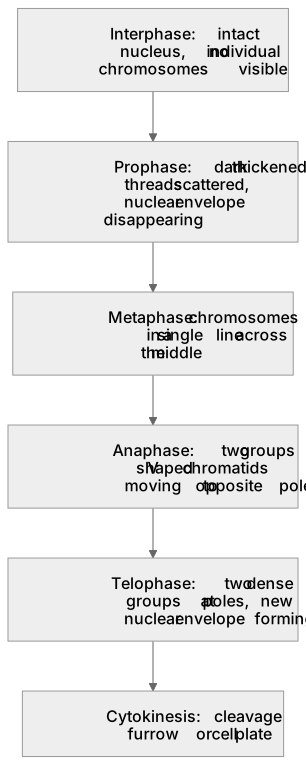
Put it in order
Put these steps in the order they happen.
- 1. Metaphase: chromosomes in a single line across the middle
- 2. Prophase: dark thickened threads scattered, nuclear envelope disappearing
- 3. Interphase: intact nucleus, no individual chromosomes visible
- 4. Cytokinesis: cleavage furrow or cell plate
- 5. Telophase: two dense groups at poles, new nuclear envelope forming
- 6. Anaphase: two groups of V shaped chromatids moving to opposite poles
Key words
Say what each word means before you turn the card.
interphase
Try answering aloud or in your head before turning the card.
anaphase
Try answering aloud or in your head before turning the card.
telophase
Try answering aloud or in your head before turning the card.
metaphase
Try answering aloud or in your head before turning the card.
See every definition
- interphase
- A stage with no individual chromosomes visible and a distinct nucleus with a nucleolus.
- anaphase
- Two separate groups of V shaped chromatids moving towards opposite poles with a clear gap between them.
- telophase
- Two dense groups of chromosomes at the poles, beginning to uncoil, with a new nuclear envelope forming and a cleavage furrow or cell plate appearing.
- metaphase
- Chromosomes arranged in a single line across the middle of the cell.
Label the diagram
Some boxes have lost their names. Pick the right name for each number.
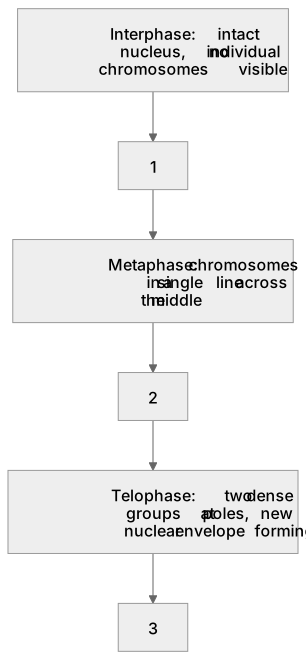
1Box 1
2Box 2
3Box 3
There is more to this lesson
The full lesson goes on to check your understanding and help you earn the marks. Create a free account to carry on, with your progress saved.
A week of Premium from your first lesson · Then the free plan continues · No card, no charge
Test your understanding of All cells arise from other cells: Meiosis is covered in section 3.4.3 Students should be able to: recognise the stages of the cell cycle: interphase, prophase, metaphase, anaphase and telophase (including cytokinesis) explain the appearance of cells in each stage of mitosis.
Active recall beats re-reading. Take an instant quiz now to test what you’ve learned and lock it into long-term memory.
A week of Premium from your first lesson · Then the free plan continues · No card, no charge