AQA · A-Level · Biology
Course version: 7402 · Version from Sept 2016
The inorganic phosphate released during the hydrolysis of ATP can be used…
Full specification wording
ATP: The inorganic phosphate released during the hydrolysis of ATP can be used to phosphorylate other compounds, often making them more reactive.
When ATP is hydrolysed the inorganic phosphate released is not waste.
Checked against the AQA 7402 specification (opens in a new tab) on .
- Point 3 of 3
Study notes
From the checked teaching notes for this specification point.
The idea
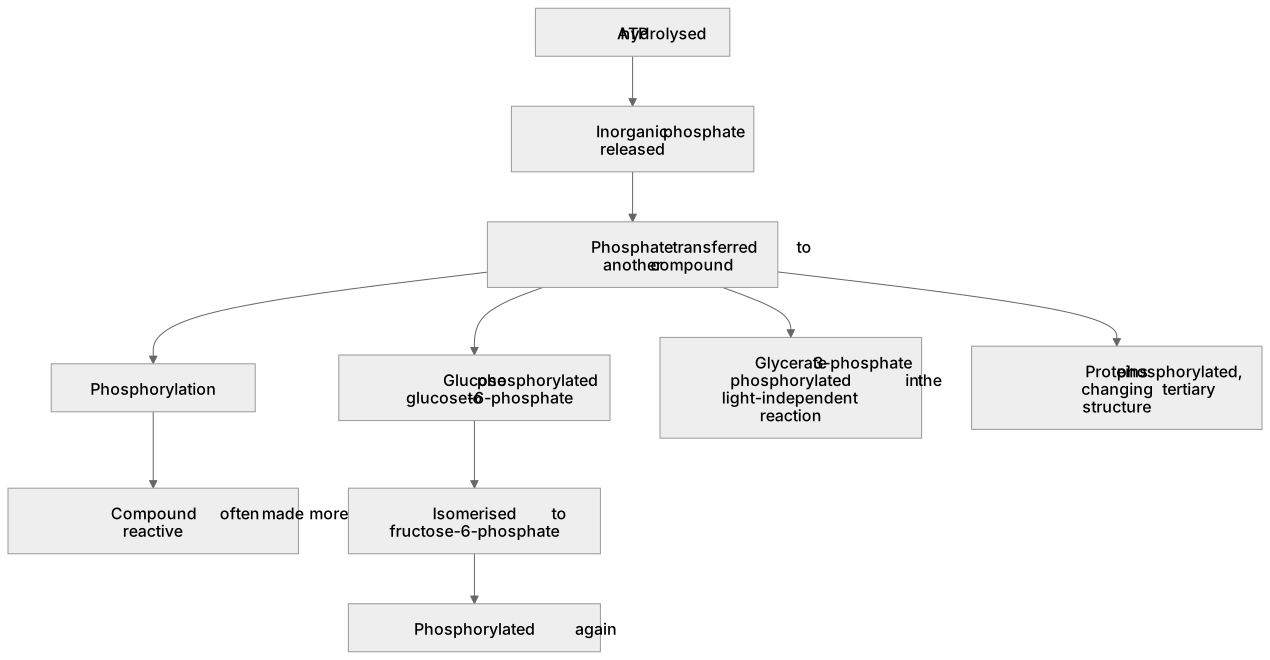
When ATP is hydrolysed the inorganic phosphate released is not waste. It can be transferred onto another molecule, a process called phosphorylation, and that often makes the molecule more reactive. For example, glucose is phosphorylated to glucose-6-phosphate at the start of glycolysis; this is later isomerised to fructose-6-phosphate, which is phosphorylated again. Both steps destabilise the sugar so it can be split and trap it inside the cell. Glycerate 3-phosphate is phosphorylated in the light-independent reaction before it is reduced to triose phosphate. Proteins are phosphorylated too, which changes their tertiary structure and so switches them on or off: carrier proteins change shape during active transport, and in the second messenger model a kinase phosphorylates enzymes that catalyse glycogenolysis. Phosphorylation is therefore a general chemical switch.
What earns the marks
- The phosphate released being transferred to another compound, that is phosphorylation.
- Phosphorylation often making that compound more reactive.
- A named example, such as the phosphorylation of glucose to glucose-6-phosphate in glycolysis or of glycerate 3-phosphate in the light-independent reaction.
- ATP releasing a relatively small amount of energy, so little is lost as heat.
- ATP being rapidly resynthesised and not being lost from the cell.
Common mistakes and how to put them right
Saying the phosphate is released as waste or excreted.
Writing that phosphorylation 'gives the molecule energy' without saying that it makes it more reactive.
Confusing phosphorylation of another compound with the phosphorylation of ADP that forms ATP.
Answering that ATP is useful because it releases a large amount of energy, when the advantage is a small usable amount.
Giving ADP alone as the product of hydrolysis and omitting the inorganic phosphate.
Stating that glucose is phosphorylated to fructose-6-phosphate.
Put it right by noting that glucose is phosphorylated to glucose-6-phosphate, which is later isomerised to fructose-6-phosphate.
Exam tips
- 'Give two ways in which ATP is suitable as an energy source' is a common style of question; learn the list, including small energy release, instant release, rapid resynthesis and not leaving the cell. Note that phosphorylation is a role of the released inorganic phosphate, not a property that makes ATP itself suitable as an energy source.
- Use the word 'reactive' explicitly, since that is the term the mark scheme rewards.
- Name the molecule that gets phosphorylated in your example; an unnamed 'other compound' rarely gains the example mark.
Try the lesson
The start of the ATP: The inorganic phosphate released during the hydrolysis of ATP can be used to phosphorylate other compounds, often making them more reactive. lesson, made from checked teaching notes for this specification point.
Have a go first
What is the immediate fate of the inorganic phosphate released when ATP is hydrolysed?
Listen
When ATP is hydrolysed the inorganic phosphate released is not waste. It can be transferred onto another molecule, a process called phosphorylation, and that often makes the molecule more reactive. For example, glucose is phosphorylated to glucose-6-phosphate at the start of glycolysis; this is later isomerised to fructose-6-phosphate, which is phosphorylated again. Both steps destabilise the sugar so it can be split and trap it inside the cell. Glycerate 3-phosphate is phosphorylated in the light-independent reaction before it is reduced to triose phosphate. Proteins are phosphorylated too, which changes their tertiary structure and so switches them on or off: carrier proteins change shape during active transport, and in the second messenger model a kinase phosphorylates enzymes that catalyse glycogenolysis. Phosphorylation is therefore a general chemical switch. A strong answer earns marks for these points. the phosphate released being transferred to another compound, that is phosphorylation. phosphorylation often making that compound more reactive. a named example, such as the phosphorylation of glucose to glucose-6-phosphate in glycolysis or of glycerate 3-phosphate in the light-independent reaction. ATP releasing a relatively small amount of energy, so little is lost as heat. A common slip: stating that glucose is phosphorylated to fructose-6-phosphate. Instead, noting that glucose is phosphorylated to glucose-6-phosphate, which is later isomerised to fructose-6-phosphate. Exam tip: 'Give two ways in which ATP is suitable as an energy source' is a common style of question; learn the list, including small energy release, instant release, rapid resynthesis and not leaving the cell. Note that phosphorylation is a role of the released inorganic phosphate, not a property that makes ATP itself suitable as an energy source.
See it
Label the diagram
Some boxes have lost their names. Pick the right name for each number.
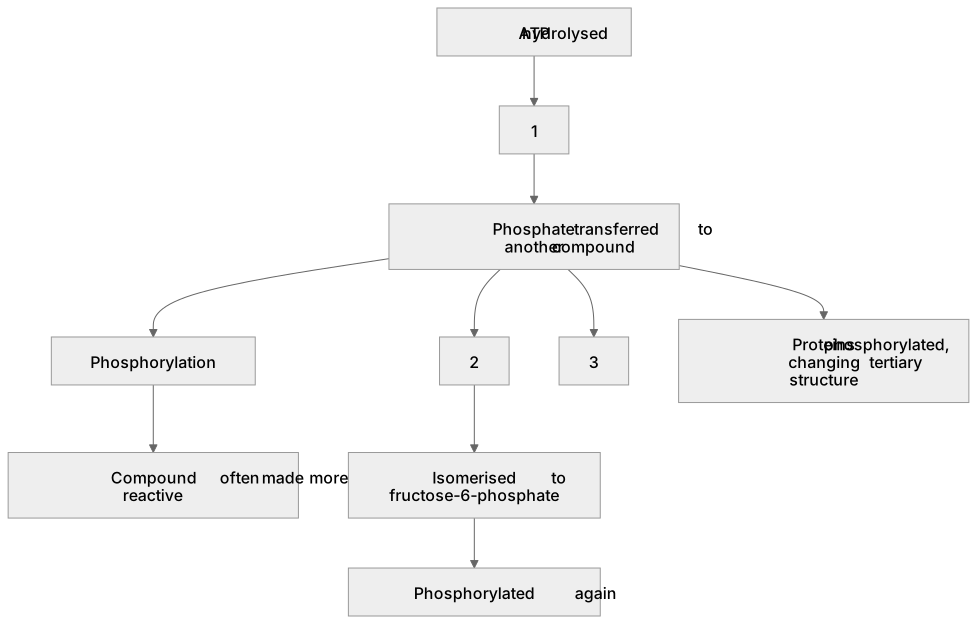
1Box 1
2Box 2
3Box 3
There is more to this lesson
The full lesson goes on to check your understanding and help you earn the marks. Create a free account to carry on, with your progress saved.
A week of Premium from your first lesson · Then the free plan continues · No card, no charge
Test your understanding of ATP: The inorganic phosphate released during the hydrolysis of ATP can be used to phosphorylate other compounds, often making them more reactive.
Active recall beats re-reading. Take an instant quiz now to test what you’ve learned and lock it into long-term memory.
A week of Premium from your first lesson · Then the free plan continues · No card, no charge