AQA · A-Level · Biology
Course version: 7402 · Version from Sept 2016
Biochemical tests using Benedict's solution for reducing sugars and…
Full specification wording
Carbohydrates: Biochemical tests using Benedict's solution for reducing sugars and non-reducing sugars and iodine/potassium iodide for starch.
To test for reducing sugars (e.g. glucose), add Benedict's solution and heat in a water bath.
Checked against the AQA 7402 specification (opens in a new tab) on .
- Point 8 of 8
- 3 key terms
Study notes
From the checked teaching notes for this specification point.
The idea
To test for reducing sugars (e.g. glucose), add Benedict's solution and heat in a water bath. A positive result forms a green, yellow, orange, or brick-red precipitate, as Cu²⁺ reduces to Cu⁺. For non-reducing sugars (e.g. sucrose), first confirm a negative Benedict's result. Then, boil a fresh sample with dilute hydrochloric acid to hydrolyse the glycosidic bonds. Neutralise with sodium hydrogencarbonate, then repeat the Benedict's test. For starch, add iodine in potassium iodide solution; a positive result turns blue-black. Benedict's is qualitative but becomes quantitative by filtering and weighing the precipitate, or by using a colorimeter with a calibration curve.
What earns the marks
- Describe the reducing sugar test: add Benedict's solution and heat in a water bath to observe a green, yellow, orange, or brick-red precipitate.
- Describe the non-reducing sugar test: boil the sample with dilute hydrochloric acid to hydrolyse it, neutralise (e.g., with sodium hydrogencarbonate), and retest with Benedict's solution and heat.
- Describe the starch test: add iodine in potassium iodide solution to the sample, looking for a colour change to blue-black.
- Explain how to make the Benedict's test quantitative: use a colorimeter to measure absorbance and compare against a calibration curve of known glucose concentrations.
Common mistakes and how to put them right
Omitting the heating step during acid hydrolysis for non-reducing sugars.
Put it right: Specify boiling or heating the sample with dilute hydrochloric acid to ensure hydrolysis occurs.
Forgetting to neutralise the sample after acid hydrolysis.
Put it right: State that the solution must be neutralised because Benedict's reagent requires alkaline conditions to function.
Describing the Benedict's positive result as a solution colour change rather than a precipitate.
Put it right: Explicitly state that a coloured precipitate (e.g., brick-red) forms.
Exam tips
- While 'iodine solution' is often accepted in exams, it is best practice to write 'iodine in potassium iodide solution' to demonstrate precise biochemical knowledge.
- When describing the non-reducing sugar test, ensure you sequence the steps logically: initial negative Benedict's test, boil with dilute HCl, neutralise, and finally retest with Benedict's and heat.
Try the lesson
The start of the Carbohydrates: Biochemical tests using Benedict's solution for reducing sugars and non-reducing sugars and iodine/potassium iodide for starch. lesson, made from checked teaching notes for this specification point.
Have a go first
Which colour change shows a positive result when iodine/potassium iodide solution is added to a food sample containing starch?
Listen
To test for reducing sugars (e.g. glucose), add Benedict's solution and heat in a water bath. A positive result forms a green, yellow, orange, or brick-red precipitate, as Cu²⁺ reduces to Cu⁺. For non-reducing sugars (e.g. sucrose), first confirm a negative Benedict's result. Then, boil a fresh sample with dilute hydrochloric acid to hydrolyse the glycosidic bonds. Neutralise with sodium hydrogencarbonate, then repeat the Benedict's test. For starch, add iodine in potassium iodide solution; a positive result turns blue-black. Benedict's is qualitative but becomes quantitative by filtering and weighing the precipitate, or by using a colorimeter with a calibration curve. A strong answer earns marks for these points. Describe the reducing sugar test: add Benedict's solution and heat in a water bath to observe a green, yellow, orange, or brick-red precipitate. Describe the non-reducing sugar test: boil the sample with dilute hydrochloric acid to hydrolyse it, neutralise (e.g., with sodium hydrogencarbonate), and retest with Benedict's solution and heat. Describe the starch test: add iodine in potassium iodide solution to the sample, looking for a colour change to blue-black. Explain how to make the Benedict's test quantitative: use a colorimeter to measure absorbance and compare against a calibration curve of known glucose concentrations. Exam tip: While 'iodine solution' is often accepted in exams, it is best practice to write 'iodine in potassium iodide solution' to demonstrate precise biochemical knowledge.
See it
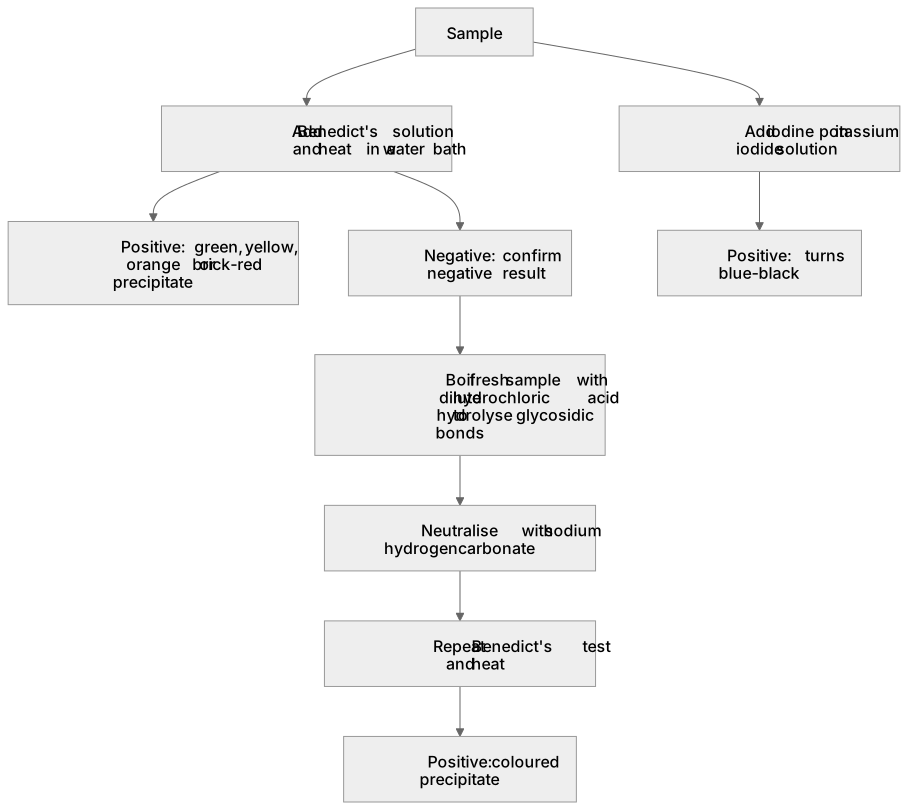
Key words
Say what each word means before you turn the card.
Biochemical tests for carbohydrates
Try answering aloud or in your head before turning the card.
Acid hydrolysis of non-reducing sugars
Try answering aloud or in your head before turning the card.
Qualitative vs quantitative analysis
Try answering aloud or in your head before turning the card.
See every definition
- Biochemical tests for carbohydrates
- Tests using Benedict's solution for reducing sugars and non-reducing sugars, and iodine/potassium iodide for starch.
- Acid hydrolysis of non-reducing sugars
- Boiling a fresh sample with dilute hydrochloric acid to hydrolyse the glycosidic bonds, then neutralising with sodium hydrogencarbonate before repeating the Benedict's test.
- Qualitative vs quantitative analysis
- Benedict's is qualitative but becomes quantitative by filtering and weighing the precipitate, or by using a colorimeter with a calibration curve.
Label the diagram
Some boxes have lost their names. Pick the right name for each number.
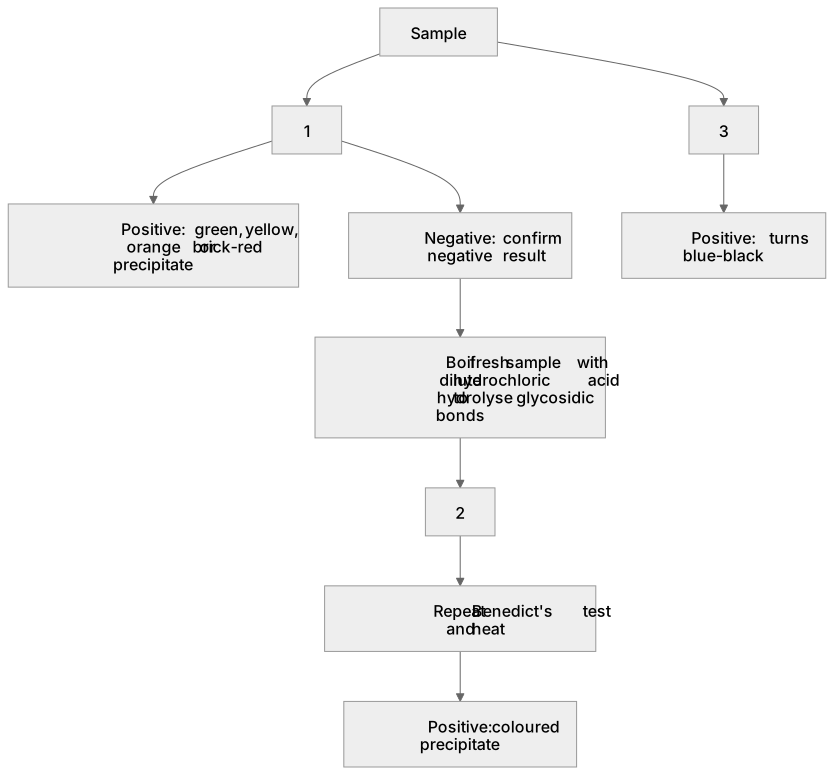
1Box 1
2Box 2
3Box 3
There is more to this lesson
The full lesson goes on to check your understanding and help you earn the marks. Create a free account to carry on, with your progress saved.
A week of Premium from your first lesson · Then the free plan continues · No card, no charge
Test your understanding of Carbohydrates: Biochemical tests using Benedict's solution for reducing sugars and non-reducing sugars and iodine/potassium iodide for starch.
Active recall beats re-reading. Take an instant quiz now to test what you’ve learned and lock it into long-term memory.
A week of Premium from your first lesson · Then the free plan continues · No card, no charge