AQA · A-Level · Biology
Course version: 7402 · Version from Sept 2016
The relationship of structure to function of these substances in animal…
Full specification wording
Carbohydrates: The relationship of structure to function of these substances in animal cells and plant cells.
This is the explain statement, and every point should run structure, then property, then use.
Checked against the AQA 7402 specification (opens in a new tab) on .
- Point 7 of 8
- 4 key terms
Study notes
From the checked teaching notes for this specification point.
The idea
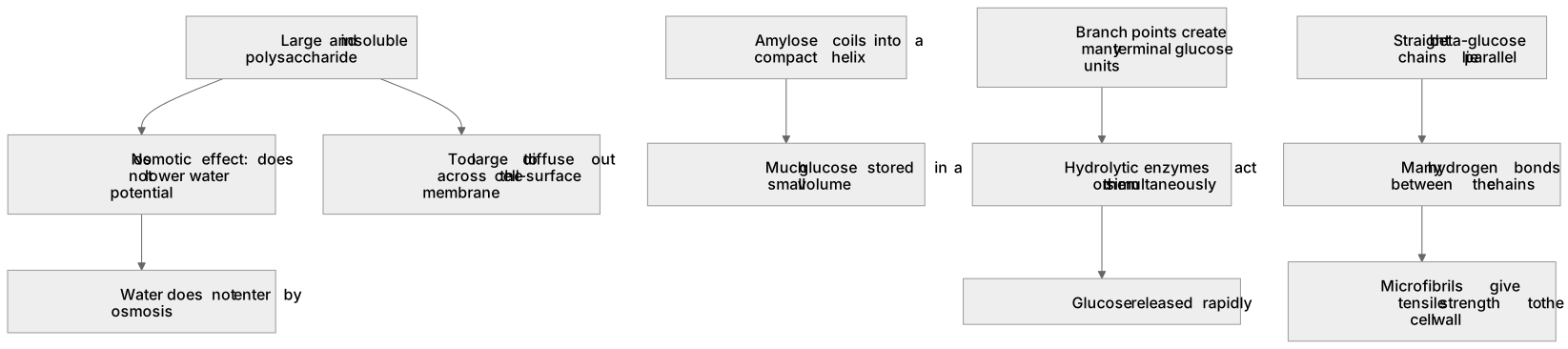
This is the explain statement, and every point should run structure, then property, then use. All three polysaccharides are large and insoluble, so they have no osmotic effect: they do not lower the water potential of the cell, water does not enter by osmosis, and being large they cannot diffuse out across the cell-surface membrane. Amylose coils into a compact helix, so a great deal of glucose is stored in a small volume. Branching is about speed - the 1,6 branch points of amylopectin and glycogen create many terminal glucose units that hydrolytic enzymes can act on simultaneously, so glucose is released rapidly. Glycogen is the more branched of the two, which suits animals with their higher metabolic rate. Cellulose is the opposite design: straight beta-glucose chains lie parallel, and many hydrogen bonds form between the chains.
What earns the marks
- Insoluble, so it has no effect on water potential and water does not enter or leave by osmosis.
- Large, so the molecule cannot cross or leak out of the cell-surface membrane.
- Helical or compact, so a large amount of glucose is stored in a small space.
- Branched with many terminal ends, so glucose is hydrolysed and released rapidly for respiration.
- Hydrogen bonds between parallel cellulose chains forming microfibrils, giving tensile strength to the cell wall.
Common mistakes and how to put them right
Saying starch is insoluble so it can be transported, when insolubility is what stops it moving.
Placing the hydrogen bonds within one cellulose molecule instead of between neighbouring chains.
Describing a single hydrogen bond as strong, rather than many weak bonds acting collectively.
Claiming the cell wall stops water entering the cell, when it resists the pressure that entering water creates.
Giving structural features with no linked consequence, so the answer describes rather than explains.
Exam tips
- Use the phrase 'so that' in every sentence; it forces the structure-to-function link the question is marking.
- Bring water potential into any storage answer - it is the standard credited reason for storing glucose as a polysaccharide.
Try the lesson
The start of the Carbohydrates: The relationship of structure to function of these substances in animal cells and plant cells. lesson, made from checked teaching notes for this specification point.
Have a go first
Which carbohydrate is the main energy storage substance in animal cells?
Listen
This is the explain statement, and every point should run structure, then property, then use. All three polysaccharides are large and insoluble, so they have no osmotic effect: they do not lower the water potential of the cell, water does not enter by osmosis, and being large they cannot diffuse out across the cell-surface membrane. Amylose coils into a compact helix, so a great deal of glucose is stored in a small volume. Branching is about speed - the 1,6 branch points of amylopectin and glycogen create many terminal glucose units that hydrolytic enzymes can act on simultaneously, so glucose is released rapidly. Glycogen is the more branched of the two, which suits animals with their higher metabolic rate. Cellulose is the opposite design: straight beta-glucose chains lie parallel, and many hydrogen bonds form between the chains. A strong answer earns marks for these points. insoluble, so it has no effect on water potential and water does not enter or leave by osmosis. large, so the molecule cannot cross or leak out of the cell-surface membrane. helical or compact, so a large amount of glucose is stored in a small space. branched with many terminal ends, so glucose is hydrolysed and released rapidly for respiration. Exam tip: Use the phrase 'so that' in every sentence; it forces the structure-to-function link the question is marking.
See it
Key words
Say what each word means before you turn the card.
insoluble and osmotically inactive
Try answering aloud or in your head before turning the card.
compact helix for storage
Try answering aloud or in your head before turning the card.
branching and rapid hydrolysis
Try answering aloud or in your head before turning the card.
hydrogen bonds between chains
Try answering aloud or in your head before turning the card.
See every definition
- insoluble and osmotically inactive
- Being large and insoluble means there is no osmotic effect, so water potential is not lowered and water does not enter by osmosis.
- compact helix for storage
- Coiling into a compact helix means a great deal of glucose is stored in a small volume.
- branching and rapid hydrolysis
- Branch points create many terminal glucose units that hydrolytic enzymes can act on simultaneously, so glucose is released rapidly.
- hydrogen bonds between chains
- Many hydrogen bonds form between parallel cellulose chains, forming microfibrils that give tensile strength to the cell wall.
Label the diagram
Some boxes have lost their names. Pick the right name for each number.
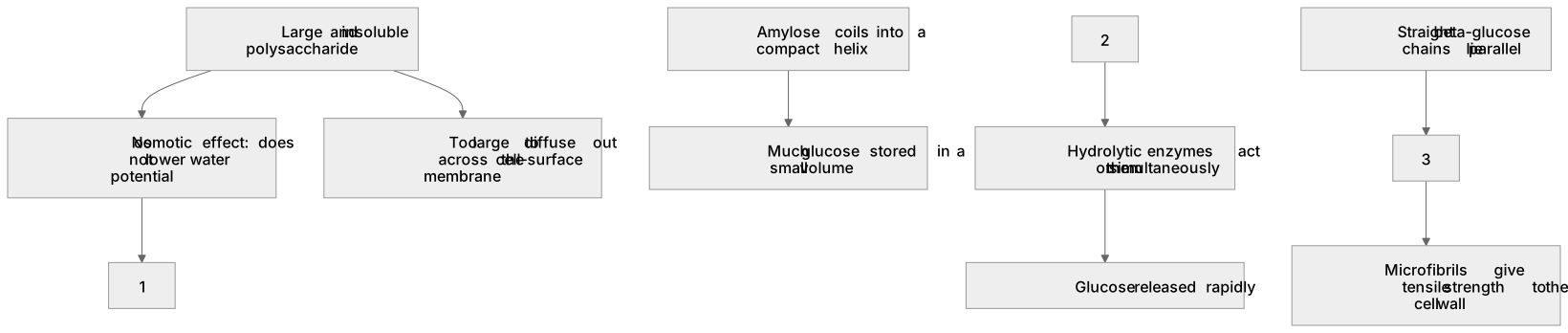
1Box 1
2Box 2
3Box 3
There is more to this lesson
The full lesson goes on to check your understanding and help you earn the marks. Create a free account to carry on, with your progress saved.
A week of Premium from your first lesson · Then the free plan continues · No card, no charge
Test your understanding of Carbohydrates: The relationship of structure to function of these substances in animal cells and plant cells.
Active recall beats re-reading. Take an instant quiz now to test what you’ve learned and lock it into long-term memory.
A week of Premium from your first lesson · Then the free plan continues · No card, no charge