AQA · A-Level · Biology
Course version: 7402 · Version from Sept 2016
Phagocytosis of pathogens. The subsequent destruction of ingested…
Full specification wording
Cell recognition and the immune system: Phagocytosis of pathogens. The subsequent destruction of ingested pathogens by lysozymes.
Phagocytes, such as macrophages, are attracted by chemicals released by pathogens.
Checked against the AQA 7402 specification (opens in a new tab) on .
- Point 3 of 18
- 3 key terms
Study notes
From the checked teaching notes for this specification point.
The idea
Phagocytes, such as macrophages, are attracted by chemicals released by pathogens. Receptors on the phagocyte's cell-surface membrane bind to antigens on the pathogen. The phagocyte membrane extends around the pathogen, engulfing it via endocytosis into a vesicle called a phagosome. Lysosomes migrate to and fuse with the phagosome, releasing lysozymes. These hydrolytic enzymes destroy the ingested pathogen by hydrolysis. Soluble products from this breakdown, such as amino acids, are absorbed into the cytoplasm. Finally, the phagocyte presents the pathogen's antigens on its own cell-surface membrane, becoming an antigen-presenting cell to trigger the specific immune response.
What earns the marks
- The phagocyte is attracted to the pathogen by chemical products and binds to antigens on the pathogen surface.
- The pathogen is engulfed by endocytosis to form a vesicle known as a phagosome.
- Lysosomes migrate towards and fuse with the phagosome.
- Lysozymes are released into the phagosome and destroy the ingested pathogen by hydrolysis.
- The phagocyte displays the pathogen's antigens on its own cell-surface membrane to become an antigen-presenting cell.
Common mistakes and how to put them right
Confusing the lysosome with lysozyme.
Put it right: The lysosome is the organelle (vesicle); lysozyme is the hydrolytic enzyme it releases.
Stating that the pathogen is 'absorbed' or 'dissolved'.
Put it right: Correctly state it is hydrolysed or destroyed by lysozymes.
Describing phagocytosis as a specific response.
Put it right: It is a non-specific immune response that targets any pathogen, unlike the specific lymphocyte response.
Exam tips
- Work through the distinct stages logically: attract, bind, engulf, fuse, hydrolyse, and present. Ensure you name both the phagosome and lysosome.
- Avoid using osmosis or diffusion vocabulary; marks are awarded for specific terms like endocytosis and hydrolysis.
Try the lesson
The start of the Cell recognition and the immune system: Phagocytosis of pathogens. The subsequent destruction of ingested pathogens by lysozymes. lesson, made from checked teaching notes for this specification point.
Have a go first
Which enzyme inside a phagocyte digests the ingested pathogen once it has been enclosed in a vesicle?
Listen
Phagocytes, such as macrophages, are attracted by chemicals released by pathogens. Receptors on the phagocyte's cell-surface membrane bind to antigens on the pathogen. The phagocyte membrane extends around the pathogen, engulfing it via endocytosis into a vesicle called a phagosome. Lysosomes migrate to and fuse with the phagosome, releasing lysozymes. These hydrolytic enzymes destroy the ingested pathogen by hydrolysis. Soluble products from this breakdown, such as amino acids, are absorbed into the cytoplasm. Finally, the phagocyte presents the pathogen's antigens on its own cell-surface membrane, becoming an antigen-presenting cell to trigger the specific immune response. A strong answer earns marks for these points. The phagocyte is attracted to the pathogen by chemical products and binds to antigens on the pathogen surface. The pathogen is engulfed by endocytosis to form a vesicle known as a phagosome. Lysosomes migrate towards and fuse with the phagosome. Lysozymes are released into the phagosome and destroy the ingested pathogen by hydrolysis. A common slip: Confusing the lysosome with lysozyme. Instead, The lysosome is the organelle (vesicle); lysozyme is the hydrolytic enzyme it releases. Exam tip: Work through the distinct stages logically: attract, bind, engulf, fuse, hydrolyse, and present. Ensure you name both the phagosome and lysosome.
See it
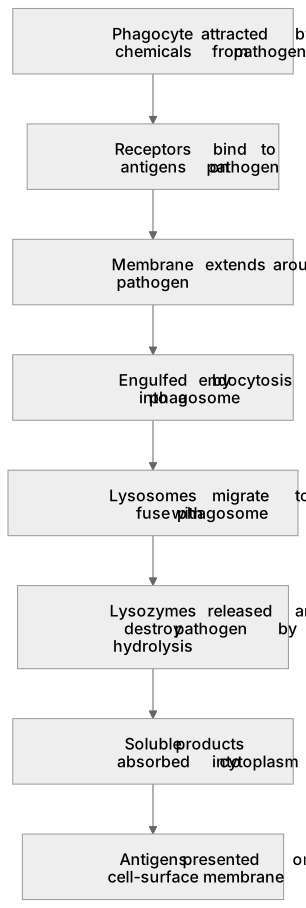
Put it in order
Put these steps in the order they happen.
- 1. Lysosomes migrate to and fuse with phagosome
- 2. Antigens presented on cell-surface membrane
- 3. Lysozymes released and destroy pathogen by hydrolysis
- 4. Phagocyte attracted by chemicals from pathogen
- 5. Receptors bind to antigens on pathogen
- 6. Soluble products absorbed into cytoplasm
- 7. Membrane extends around pathogen
- 8. Engulfed by endocytosis into a phagosome
Key words
Say what each word means before you turn the card.
non-specific defence
Try answering aloud or in your head before turning the card.
endocytosis and the phagosome
Try answering aloud or in your head before turning the card.
lysosomes and lysozymes
Try answering aloud or in your head before turning the card.
See every definition
- non-specific defence
- An immune response that targets any pathogen, unlike the specific lymphocyte response.
- endocytosis and the phagosome
- The phagocyte membrane extends around the pathogen, engulfing it into a vesicle called a phagosome.
- lysosomes and lysozymes
- The lysosome is the organelle (vesicle); lysozyme is the hydrolytic enzyme it releases, destroying the ingested pathogen by hydrolysis.
Label the diagram
Some boxes have lost their names. Pick the right name for each number.
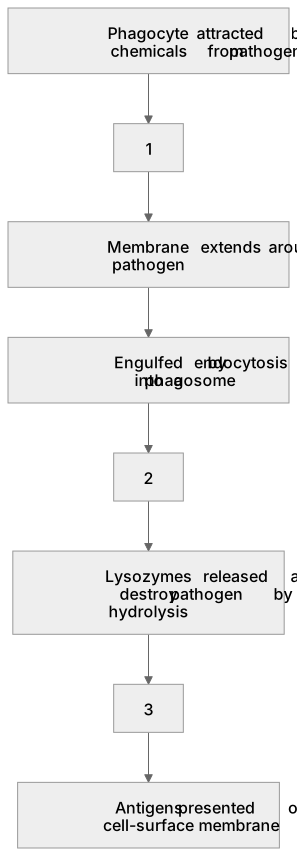
1Box 1
2Box 2
3Box 3
There is more to this lesson
The full lesson goes on to check your understanding and help you earn the marks. Create a free account to carry on, with your progress saved.
A week of Premium from your first lesson · Then the free plan continues · No card, no charge
Test your understanding of Cell recognition and the immune system: Phagocytosis of pathogens. The subsequent destruction of ingested pathogens by lysozymes.
Active recall beats re-reading. Take an instant quiz now to test what you’ve learned and lock it into long-term memory.
A week of Premium from your first lesson · Then the free plan continues · No card, no charge