AQA · A-Level · Biology
Course version: 7402 · Version from Sept 2016
The response of B lymphocytes to a foreign antigen, clonal selection and…
Full specification wording
Cell recognition and the immune system: The response of B lymphocytes to a foreign antigen, clonal selection and the release of monoclonal antibodies (the humoral response).
Each B lymphocyte matures carrying one specific antibody on its cell-surface membrane.
Checked against the AQA 7402 specification (opens in a new tab) on .
- Point 6 of 18
- 4 key terms
Study notes
From the checked teaching notes for this specification point.
The idea
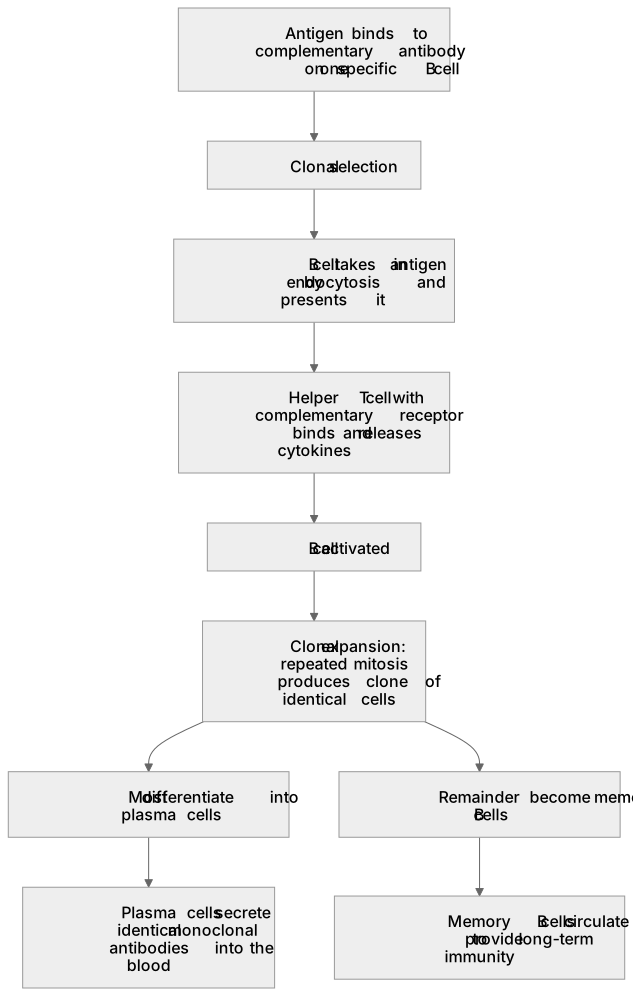
Each B lymphocyte matures carrying one specific antibody on its cell-surface membrane. When a complementary antigen binds to that membrane-bound antibody, this is clonal selection: the antigen selects the B cell whose receptor fits it. The B cell takes the antigen in by endocytosis and presents it on its membrane. A helper T cell with a complementary receptor binds and releases cytokines, which activate the B cell. The activated B cell divides repeatedly by mitosis (clonal expansion), producing a clone of genetically identical cells. Most differentiate into plasma cells, which secrete identical monoclonal antibodies into the blood. The remainder become memory B cells, which circulate to provide long-term immunity.
What earns the marks
- Antigen binds to the complementary antibody or receptor on one specific B cell; this is clonal selection.
- B cell processes and presents the antigen and is activated by cytokines from a helper T cell.
- Clonal expansion follows: division by mitosis to produce a clone of identical cells.
- Plasma cells secrete antibodies that are identical, or monoclonal, and specific to that antigen.
- The remainder of the clone differentiates into memory B cells.
- Distinguish clonal selection (antigen binding to the specific B cell) from clonal expansion (mitotic division of that activated cell).
Common mistakes and how to put them right
Saying the B cell makes a new antibody to fit the antigen.
Put it right: The antigen selects a pre-existing complementary B cell.
Using clonal selection and clonal expansion interchangeably.
Put it right: Keep the two terms for the two distinct events.
Writing that B cells divide by meiosis.
Put it right: Mitosis produces identical plasma and memory cells.
Stating that memory B cells secrete antibodies.
Put it right: Memory B cells remain in circulation and respond rapidly on re-exposure.
Attributing clonal selection to helper T-cell activation.
Put it right: Clonal selection is antigen binding to the B cell; helper cytokines drive clonal expansion.
Exam tips
- Always specify that plasma cells secrete antibodies; do not state that memory cells or T cells produce them.
- Use sequencing verbs (binds, presents, is activated, divides, differentiates, secretes) so the order of events is unambiguous.
Try the lesson
The start of the Cell recognition and the immune system: The response of B lymphocytes to a foreign antigen, clonal selection and the release of monoclonal antibodies (the humoral response). lesson, made from checked teaching notes for this specification point.
Have a go first
Which type of cell releases antibodies during the humoral response?
Listen
Each B lymphocyte matures carrying one specific antibody on its cell-surface membrane. When a complementary antigen binds to that membrane-bound antibody, this is clonal selection: the antigen selects the B cell whose receptor fits it. The B cell takes the antigen in by endocytosis and presents it on its membrane. A helper T cell with a complementary receptor binds and releases cytokines, which activate the B cell. The activated B cell divides repeatedly by mitosis (clonal expansion), producing a clone of genetically identical cells. Most differentiate into plasma cells, which secrete identical monoclonal antibodies into the blood. The remainder become memory B cells, which circulate to provide long-term immunity. A strong answer earns marks for these points. Antigen binds to the complementary antibody or receptor on one specific B cell; this is clonal selection. B cell processes and presents the antigen and is activated by cytokines from a helper T cell. Clonal expansion follows: division by mitosis to produce a clone of identical cells. Plasma cells secrete antibodies that are identical, or monoclonal, and specific to that antigen. A common slip: Saying the B cell makes a new antibody to fit the antigen; the antibody already exists and the antigen selects the cell that makes it. Instead, the antigen selects a pre-existing complementary B cell. Exam tip: Always specify that plasma cells secrete antibodies; do not state that memory cells or T cells produce them.
See it
Key words
Say what each word means before you turn the card.
humoral response
Try answering aloud or in your head before turning the card.
clonal selection
Try answering aloud or in your head before turning the card.
clonal expansion by mitosis
Try answering aloud or in your head before turning the card.
plasma cells
Try answering aloud or in your head before turning the card.
See every definition
- humoral response
- The response of B lymphocytes to a foreign antigen, clonal selection and the release of monoclonal antibodies.
- clonal selection
- The antigen selects the B cell whose membrane-bound antibody fits it when a complementary antigen binds.
- clonal expansion by mitosis
- The activated B cell divides repeatedly by mitosis, producing a clone of genetically identical cells.
- plasma cells
- Most of the clone differentiate into these, which secrete identical monoclonal antibodies into the blood.
Label the diagram
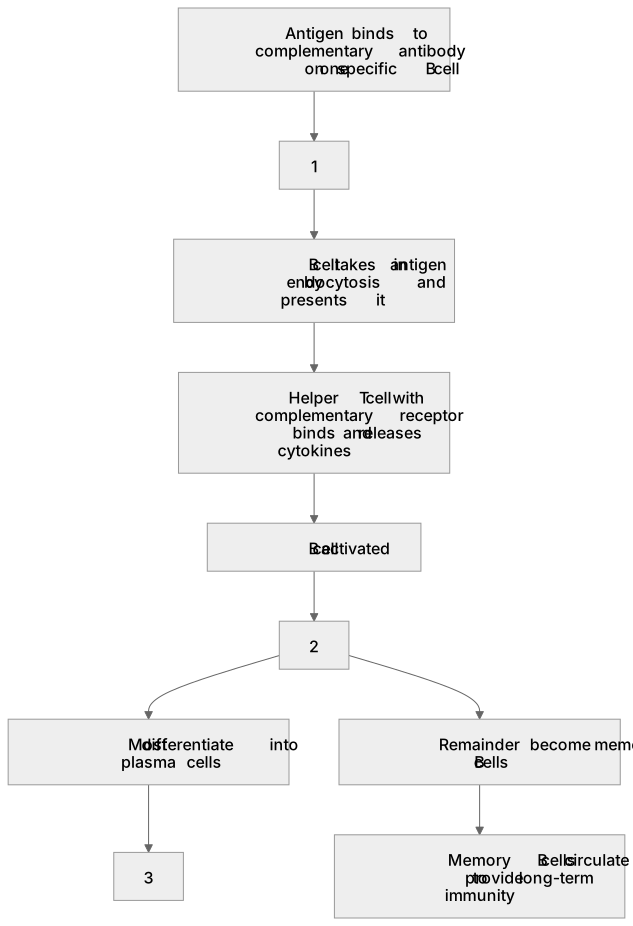
Some boxes have lost their names. Pick the right name for each number.
1Box 1
2Box 2
3Box 3
There is more to this lesson
The full lesson goes on to check your understanding and help you earn the marks. Create a free account to carry on, with your progress saved.
A week of Premium from your first lesson · Then the free plan continues · No card, no charge
Test your understanding of Cell recognition and the immune system: The response of B lymphocytes to a foreign antigen, clonal selection and the release of monoclonal antibodies (the humoral response).
Active recall beats re-reading. Take an instant quiz now to test what you’ve learned and lock it into long-term memory.
A week of Premium from your first lesson · Then the free plan continues · No card, no charge