AQA · A-Level · Biology
Course version: 7402 · Version from Sept 2016
The roles of plasma cells and of memory cells in producing primary and…
Full specification wording
Cell recognition and the immune system: The roles of plasma cells and of memory cells in producing primary and secondary immune responses.
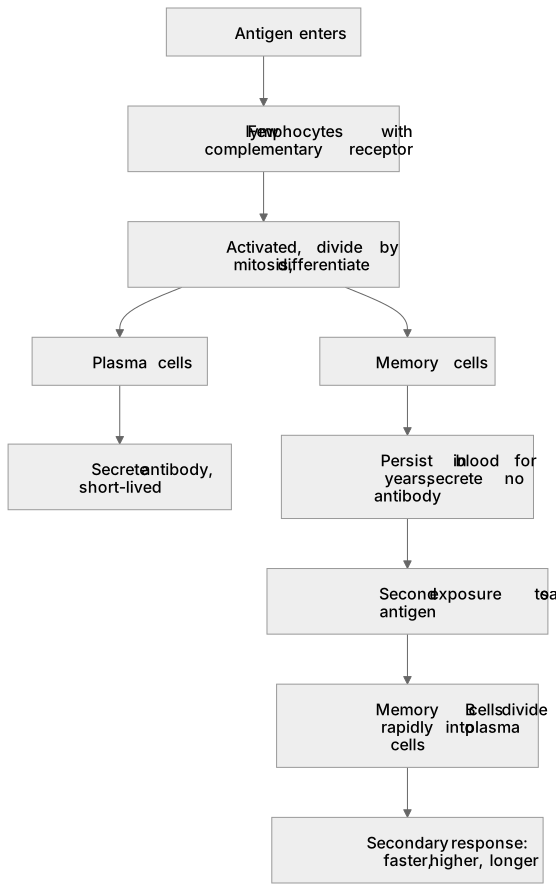
In a primary response the antigen has to find the very few B and T cells whose receptors happen to be complementary to it, and those cells must then be activated, divide by mitosis and differentiate.
Checked against the AQA 7402 specification (opens in a new tab) on .
- Point 10 of 18
- 4 key terms
Study notes
From the checked teaching notes for this specification point.
The idea
In a primary response the antigen has to find the very few B and T cells whose receptors happen to be complementary to it, and those cells must then be activated, divide by mitosis and differentiate. That takes several days, so antibody concentration rises slowly and reaches only a low peak, and meanwhile the pathogen reproduces and the person shows symptoms. Plasma cells are the antibody factories: short-lived, surviving only a few days, but each secreting thousands of antibody molecules per second to clear the current infection. Memory cells secrete no antibody at all. Memory B cells and memory T cells simply persist, circulating in the blood for years.
What earns the marks
- The primary response being slow because few lymphocytes have a complementary receptor and clonal selection and division take time.
- Plasma cells secreting antibody and being short-lived.
- Memory cells remaining in the blood for years without secreting antibody.
- Memory B cells dividing rapidly into plasma cells on second exposure to the same antigen.
- The secondary response producing antibody faster, at a higher concentration and for longer, so symptoms do not appear.
Common mistakes and how to put them right
Saying memory cells produce antibodies.
Put it right: They divide into plasma cells, which do.
Describing secondary antibodies as stronger or better, when the antibody is identical and only the speed and quantity change.
Reading an antibody concentration graph and commenting on the peak but not the time lag.
Assuming memory cells protect against any pathogen, when they are specific to one antigen.
Using 'immune' to mean the pathogen cannot enter the body, when it enters but is destroyed before symptoms appear.
Exam tips
- Graph questions want three comparisons every time: faster, higher, and lasting longer. Quote figures from both axes.
- If the second exposure is to a different pathogen, say so and explain that a primary response happens again.
- Name the cell doing each job; 'the immune system responds faster' scores nothing without plasma cells and memory cells.
Try the lesson
The start of the Cell recognition and the immune system: The roles of plasma cells and of memory cells in producing primary and secondary immune responses. lesson, made from checked teaching notes for this specification point.
Have a go first
Which type of cell produces antibodies during an immune response?
Listen
In a primary response the antigen has to find the very few B and T cells whose receptors happen to be complementary to it, and those cells must then be activated, divide by mitosis and differentiate. That takes several days, so antibody concentration rises slowly and reaches only a low peak, and meanwhile the pathogen reproduces and the person shows symptoms. Plasma cells are the antibody factories: short-lived, surviving only a few days, but each secreting thousands of antibody molecules per second to clear the current infection. Memory cells secrete no antibody at all. Memory B cells and memory T cells simply persist, circulating in the blood for years. A strong answer earns marks for these points. the primary response being slow because few lymphocytes have a complementary receptor and clonal selection and division take time. plasma cells secreting antibody and being short-lived. memory cells remaining in the blood for years without secreting antibody. memory B cells dividing rapidly into plasma cells on second exposure to the same antigen. Exam tip: Graph questions want three comparisons every time: faster, higher, and lasting longer. Quote figures from both axes.
See it
Key words
Say what each word means before you turn the card.
primary response
Try answering aloud or in your head before turning the card.
plasma cells
Try answering aloud or in your head before turning the card.
memory B and T cells
Try answering aloud or in your head before turning the card.
secondary response
Try answering aloud or in your head before turning the card.
See every definition
- primary response
- The antigen has to find the very few B and T cells whose receptors are complementary to it, which are then activated, divide by mitosis and differentiate.
- plasma cells
- Short-lived antibody factories, surviving only a few days, but each secreting thousands of antibody molecules per second to clear the current infection.
- memory B and T cells
- Cells that secrete no antibody at all but simply persist, circulating in the blood for years.
- secondary response
- On second exposure to the same antigen, memory B cells divide rapidly into plasma cells, producing antibody faster, at a higher concentration and for longer, so symptoms do not appear.
Label the diagram
Some boxes have lost their names. Pick the right name for each number.
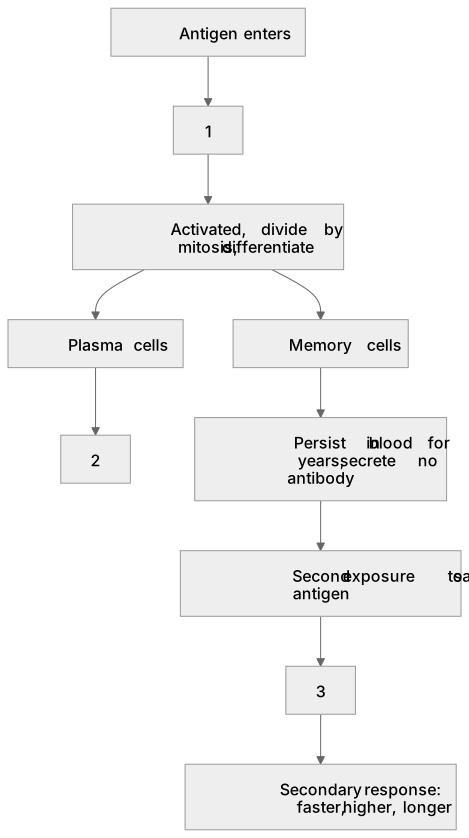
1Box 1
2Box 2
3Box 3
There is more to this lesson
The full lesson goes on to check your understanding and help you earn the marks. Create a free account to carry on, with your progress saved.
A week of Premium from your first lesson · Then the free plan continues · No card, no charge
Test your understanding of Cell recognition and the immune system: The roles of plasma cells and of memory cells in producing primary and secondary immune responses.
Active recall beats re-reading. Take an instant quiz now to test what you’ve learned and lock it into long-term memory.
A week of Premium from your first lesson · Then the free plan continues · No card, no charge