AQA · A-Level · Biology
Course version: 7402 · Version from Sept 2016
The use of vaccines to provide protection for individuals and populations…
Full specification wording
Cell recognition and the immune system: The use of vaccines to provide protection for individuals and populations against disease. The concept of herd immunity.
A vaccine introduces antigens into the body without causing the disease.
Checked against the AQA 7402 specification (opens in a new tab) on .
- Point 11 of 18
- 4 key terms
Study notes
From the checked teaching notes for this specification point.
The idea
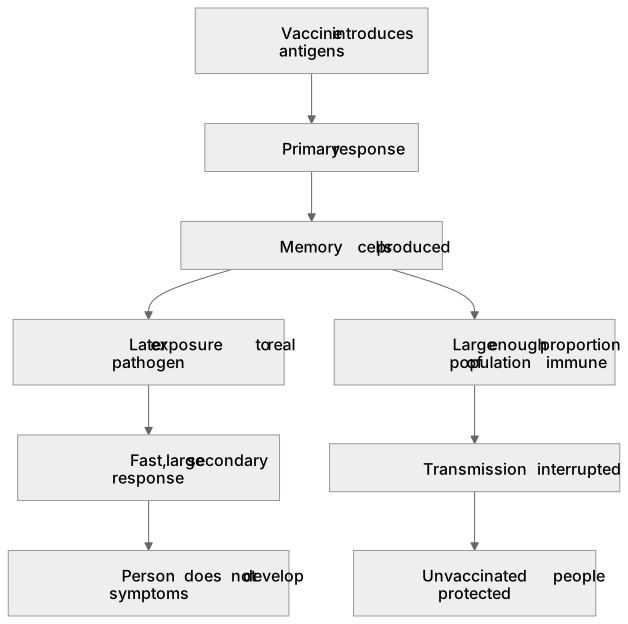
A vaccine introduces antigens into the body without causing the disease. Those antigens may come from a dead pathogen, an attenuated living pathogen, an isolated antigen, an inactivated toxin, or from mRNA that the body's own cells translate into the antigen. They trigger a primary response: clonal selection, division by mitosis and differentiation into plasma cells and, crucially, memory cells. If the real pathogen arrives later, memory B cells divide rapidly into plasma cells and produce a fast, large secondary response, so the person does not develop symptoms. Booster doses raise memory cell numbers further. Herd immunity operates on the population. If a large enough proportion of people are immune, an infected person is unlikely to meet a susceptible one, so transmission is interrupted and the pathogen cannot circulate.
What earns the marks
- The vaccine containing antigens, from a dead or attenuated pathogen or as an isolated antigen.
- A primary response producing memory cells without the person developing the disease.
- Memory cells producing a faster secondary response with a higher concentration of antibody on later exposure.
- Herd immunity described as a large enough proportion of the population being immune or vaccinated.
- Unvaccinated people being protected because the pathogen is less likely to be transmitted to them.
Common mistakes and how to put them right
Writing that a vaccine contains antibodies.
Put it right: It contains antigens and produces active immunity.
Saying vaccination makes a person immune immediately, when the primary response takes days.
Explaining herd immunity as unvaccinated people somehow catching immunity from vaccinated people.
Claiming everyone must be vaccinated, when herd immunity needs a sufficiently large proportion, not all.
Confusing attenuated, meaning weakened but alive, with dead.
Exam tips
- When asked how vaccination protects a population as well as an individual, write the two explanations separately; the population mark is for interrupted transmission.
- Name who benefits from herd immunity, for example babies too young to be vaccinated or immunocompromised patients, to earn the application mark.
- Use 'proportion' or 'percentage' of the population rather than 'lots of people'.
Try the lesson
The start of the Cell recognition and the immune system: The use of vaccines to provide protection for individuals and populations against disease. The concept of herd immunity. lesson, made from checked teaching notes for this specification point.
Have a go first
What is injected during vaccination to make a person immune to a disease?
Listen
A vaccine introduces antigens into the body without causing the disease. Those antigens may come from a dead pathogen, an attenuated living pathogen, an isolated antigen, an inactivated toxin, or from mRNA that the body's own cells translate into the antigen. They trigger a primary response: clonal selection, division by mitosis and differentiation into plasma cells and, crucially, memory cells. If the real pathogen arrives later, memory B cells divide rapidly into plasma cells and produce a fast, large secondary response, so the person does not develop symptoms. Booster doses raise memory cell numbers further. Herd immunity operates on the population. If a large enough proportion of people are immune, an infected person is unlikely to meet a susceptible one, so transmission is interrupted and the pathogen cannot circulate. A strong answer earns marks for these points. the vaccine containing antigens, from a dead or attenuated pathogen or as an isolated antigen. a primary response producing memory cells without the person developing the disease. memory cells producing a faster secondary response with a higher concentration of antibody on later exposure. herd immunity described as a large enough proportion of the population being immune or vaccinated. Exam tip: When asked how vaccination protects a population as well as an individual, write the two explanations separately; the population mark is for interrupted transmission.
See it
Key words
Say what each word means before you turn the card.
antigens in vaccines
Try answering aloud or in your head before turning the card.
memory cell formation
Try answering aloud or in your head before turning the card.
secondary response
Try answering aloud or in your head before turning the card.
herd immunity
Try answering aloud or in your head before turning the card.
See every definition
- antigens in vaccines
- A vaccine introduces antigens into the body without causing the disease, and they may come from a dead pathogen, an attenuated living pathogen, an isolated antigen, an inactivated toxin, or from mRNA.
- memory cell formation
- The antigens trigger a primary response: clonal selection, division by mitosis and differentiation into plasma cells and, crucially, memory cells.
- secondary response
- On later exposure, memory B cells divide rapidly into plasma cells and produce a fast, large response, so the person does not develop symptoms.
- herd immunity
- If a large enough proportion of people are immune, an infected person is unlikely to meet a susceptible one, so transmission is interrupted and the pathogen cannot circulate.
Label the diagram
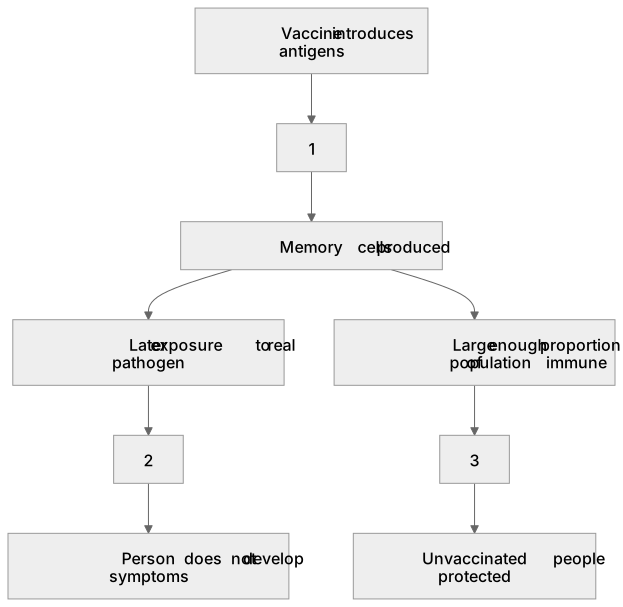
Some boxes have lost their names. Pick the right name for each number.
1Box 1
2Box 2
3Box 3
There is more to this lesson
The full lesson goes on to check your understanding and help you earn the marks. Create a free account to carry on, with your progress saved.
A week of Premium from your first lesson · Then the free plan continues · No card, no charge
Test your understanding of Cell recognition and the immune system: The use of vaccines to provide protection for individuals and populations against disease. The concept of herd immunity.
Active recall beats re-reading. Take an instant quiz now to test what you’ve learned and lock it into long-term memory.
A week of Premium from your first lesson · Then the free plan continues · No card, no charge