AQA · A-Level · Biology
Course version: 7402 · Version from Sept 2016
The use of antibodies in the ELISA test.
Full specification wording
Cell recognition and the immune system: The use of antibodies in the ELISA test.
ELISA (enzyme-linked immunosorbent assay) uses the specificity of antibodies to detect and measure a molecule.
Checked against the AQA 7402 specification (opens in a new tab) on .
- Point 17 of 18
- 3 key terms
Study notes
From the checked teaching notes for this specification point.
The idea
ELISA (enzyme-linked immunosorbent assay) uses the specificity of antibodies to detect and measure a molecule. In a direct test the antigen is immobilised on the surface of a well of a microtitre plate, a monoclonal antibody with an enzyme attached and a binding site complementary to that antigen is added and binds, the well is washed to remove unbound antibody, then a substrate is added and the enzyme converts it, producing a colour change. In an indirect test, such as the HIV test, the antigen is fixed to the well, the patient's plasma is added so any complementary antibodies bind, and a second, enzyme-linked antibody that binds to those antibodies is added before the substrate. Washing between every step is essential, because unbound antibody left behind gives a false positive. The intensity of the colour is proportional to the quantity bound, so the test is quantitative.
What earns the marks
- An antibody with a binding site complementary to the antigen binding to it, forming an antigen-antibody complex.
- A second or labelled antibody, with an enzyme attached, binding to that complex.
- Washing to remove unbound antibody, since otherwise a colour change gives a false positive.
- The enzyme acting on an added substrate to produce a colour change, with the intensity of colour proportional to the quantity present.
- Interpreting a positive result with care, for example maternal antibodies crossing the placenta producing a positive result in an uninfected baby.
Common mistakes and how to put them right
Describing the antigen-antibody binding as an enzyme-substrate reaction.
Put it right: Only the attached label is an enzyme.
Omitting the washing steps, which carry marks in their own right.
Treating a positive result as proof of current infection, when antibodies persist after infection and can be maternal.
Confusing which molecule is fixed to the well.
Put it right: In the HIV test the antigen is fixed and the patient supplies the antibody.
Saying the colour only shows presence, when the depth of colour gives a quantitative result.
Exam tips
- Track each molecule through the diagram in order and name it: antigen, first antibody, second antibody with enzyme, substrate, colour change.
- In 'evaluate this test' questions use the data first, how early the disease is detected and how many positives are found, before commenting on speed, cost and access to laboratories.
- Do not confuse ELISA with lateral flow (immunochromatography) tests: ELISA is performed in wells of a microtitre plate, whereas a lateral flow test uses a test strip with a control line to show the sample has moved along the strip.
Try the lesson
The start of the Cell recognition and the immune system: The use of antibodies in the ELISA test. lesson, made from checked teaching notes for this specification point.
Have a go first
In an indirect ELISA test to detect the presence of antibodies against a specific pathogen in a patient's blood, what is the function of the enzyme-linked antibody?
Listen
ELISA (enzyme-linked immunosorbent assay) uses the specificity of antibodies to detect and measure a molecule. In a direct test the antigen is immobilised on the surface of a well of a microtitre plate, a monoclonal antibody with an enzyme attached and a binding site complementary to that antigen is added and binds, the well is washed to remove unbound antibody, then a substrate is added and the enzyme converts it, producing a colour change. In an indirect test, such as the HIV test, the antigen is fixed to the well, the patient's plasma is added so any complementary antibodies bind, and a second, enzyme-linked antibody that binds to those antibodies is added before the substrate. Washing between every step is essential, because unbound antibody left behind gives a false positive. The intensity of the colour is proportional to the quantity bound, so the test is quantitative. A strong answer earns marks for these points. an antibody with a binding site complementary to the antigen binding to it, forming an antigen-antibody complex. a second or labelled antibody, with an enzyme attached, binding to that complex. washing to remove unbound antibody, since otherwise a colour change gives a false positive. the enzyme acting on an added substrate to produce a colour change, with the intensity of colour proportional to the quantity present. Exam tip: Track each molecule through the diagram in order and name it: antigen, first antibody, second antibody with enzyme, substrate, colour change.
See it
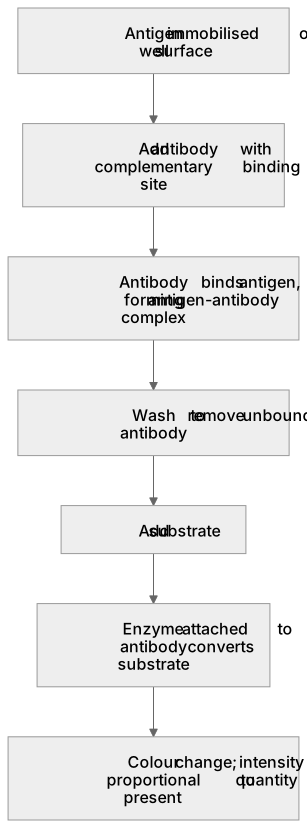
Put it in order
Put these steps in the order they happen.
- 1. Colour change; intensity proportional to quantity present
- 2. Enzyme attached to antibody converts substrate
- 3. Antibody binds antigen, forming antigen-antibody complex
- 4. Add substrate
- 5. Antigen immobilised on well surface
- 6. Add antibody with complementary binding site
- 7. Wash to remove unbound antibody
Key words
Say what each word means before you turn the card.
ELISA
Try answering aloud or in your head before turning the card.
washing and false positives
Try answering aloud or in your head before turning the card.
colour change and quantification
Try answering aloud or in your head before turning the card.
See every definition
- ELISA
- A test that uses the specificity of antibodies to detect and measure a molecule, performed in wells of a microtitre plate.
- washing and false positives
- Washing between every step is essential, because unbound antibody left behind gives a false positive.
- colour change and quantification
- The enzyme converts an added substrate to produce a colour change, and the intensity of the colour is proportional to the quantity bound.
Label the diagram
Some boxes have lost their names. Pick the right name for each number.
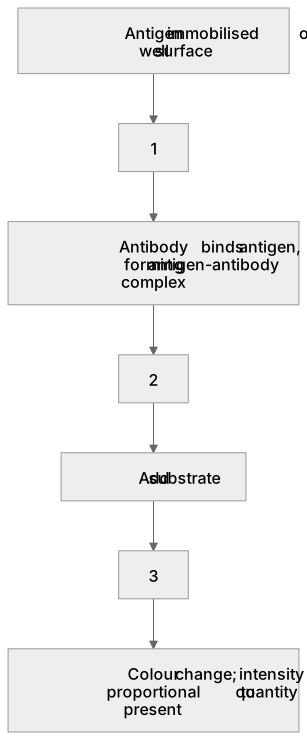
1Box 1
2Box 2
3Box 3
There is more to this lesson
The full lesson goes on to check your understanding and help you earn the marks. Create a free account to carry on, with your progress saved.
A week of Premium from your first lesson · Then the free plan continues · No card, no charge
Test your understanding of Cell recognition and the immune system: The use of antibodies in the ELISA test.
Active recall beats re-reading. Take an instant quiz now to test what you’ve learned and lock it into long-term memory.
A week of Premium from your first lesson · Then the free plan continues · No card, no charge