AQA · A-Level · Biology
Course version: 7402 · Version from Sept 2016
Required practical 11: Production of a dilution series of a glucose…
Full specification wording
Control of blood glucose concentration (A-level only): Required practical 11: Production of a dilution series of a glucose solution and use of colorimetric techniques to produce a calibration curve with which to identify the concentration of glucose in an unknown ‘urine’ sample.
You make a dilution series from a glucose solution of known concentration, usually by serial dilution, mixing equal volumes of stock and distilled water repeatedly so that each tube is half the…
Checked against the AQA 7402 specification (opens in a new tab) on .
- Point 9 of 9
- 4 key terms
Study notes
From the checked teaching notes for this specification point.
The idea
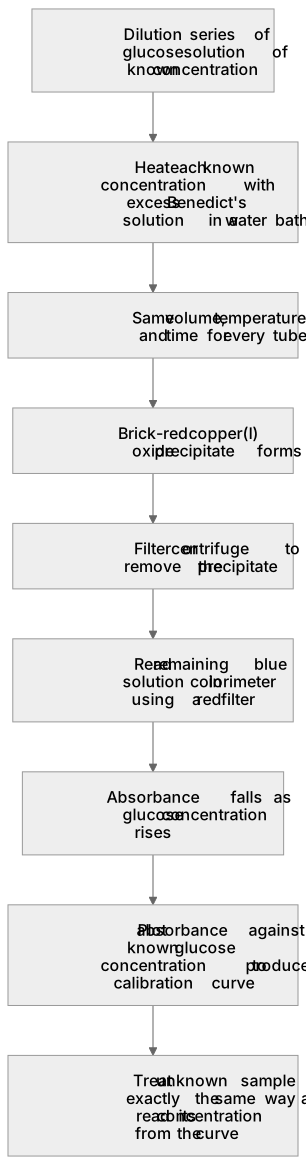
You make a dilution series from a glucose solution of known concentration, usually by serial dilution, mixing equal volumes of stock and distilled water repeatedly so that each tube is half the concentration of the one before, or by mixing measured volumes of stock and water to a fixed total. Each known concentration is then heated with an excess of Benedict's solution in a water bath, all tubes for the same time and at the same temperature, so that the amount of brick-red copper(I) oxide formed depends only on the reducing sugar present. The precipitate is removed by filtering or centrifuging and the remaining blue solution is read in a colorimeter using a red filter. The more glucose there was, the less blue remains, so absorbance falls as concentration rises.
What earns the marks
- Describe a valid dilution method, giving the volumes of stock solution and distilled water used for each concentration.
- Use an excess of Benedict's solution, with the same volume, temperature and time for every tube.
- Filter or centrifuge to remove the precipitate before taking the colorimeter reading.
- Plot absorbance, or transmission, against known glucose concentration to produce the calibration curve.
- Read the concentration of the unknown sample from the curve after treating it in exactly the same way.
Common mistakes and how to put them right
Reading the colorimeter without removing the precipitate, so suspended solid scatters the light and the reading is unreliable.
Put it right: Filter or centrifuge first.
Heating tubes for different times or at different temperatures, which makes the comparison invalid.
Put it right: Keep time and temperature constant for all tubes.
Using too little Benedict's solution, so that it becomes limiting and all the high concentrations give the same reading.
Put it right: Use excess Benedict's solution.
Choosing the wrong filter, when a blue solution is read using a red filter because it absorbs red light.
Put it right: Use a red filter for blue solutions.
Extrapolating beyond the highest standard to read an unknown, instead of diluting the unknown into range.
Put it right: Dilute the unknown so its reading falls within the calibration range.
Exam tips
- Name the control variables explicitly: volume and concentration of Benedict's solution, temperature, time and volume of sample.
- State which axis is which, with known concentration on the x axis and absorbance on the y axis.
- Benedict's test alone is only semi-quantitative; say that the colorimeter is what makes the result quantitative.
Try the lesson
The start of the Control of blood glucose concentration (A-level only): Required practical 11: Production of a dilution series of a glucose solution and use of colorimetric techniques to produce a calibration curve with which to identify the concentration of glucose in an unknown ‘urine’ sample. lesson, made from checked teaching notes for this specification point.
Have a go first
During Required practical 11, a student produces a dilution series of a glucose solution to create a calibration curve using a colorimeter. Which statement best explains why a dilution series of known concentrations is essential for determining the glucose concentration of an unknown 'urine' sample?
Listen
You make a dilution series from a glucose solution of known concentration, usually by serial dilution, mixing equal volumes of stock and distilled water repeatedly so that each tube is half the concentration of the one before, or by mixing measured volumes of stock and water to a fixed total. Each known concentration is then heated with an excess of Benedict's solution in a water bath, all tubes for the same time and at the same temperature, so that the amount of brick-red copper(I) oxide formed depends only on the reducing sugar present. The precipitate is removed by filtering or centrifuging and the remaining blue solution is read in a colorimeter using a red filter. The more glucose there was, the less blue remains, so absorbance falls as concentration rises. A strong answer earns marks for these points. Describe a valid dilution method, giving the volumes of stock solution and distilled water used for each concentration. Use an excess of Benedict's solution, with the same volume, temperature and time for every tube. Filter or centrifuge to remove the precipitate before taking the colorimeter reading. Plot absorbance, or transmission, against known glucose concentration to produce the calibration curve. A common slip: Reading the colorimeter without removing the precipitate, so suspended solid scatters the light and the reading is unreliable. Instead, filter or centrifuge first. Exam tip: Name the control variables explicitly: volume and concentration of Benedict's solution, temperature, time and volume of sample.
See it
Key words
Say what each word means before you turn the card.
serial dilution
Try answering aloud or in your head before turning the card.
reagent in excess
Try answering aloud or in your head before turning the card.
colorimetry and filter choice
Try answering aloud or in your head before turning the card.
calibration curve
Try answering aloud or in your head before turning the card.
See every definition
- serial dilution
- Mixing equal volumes of stock and distilled water repeatedly so that each tube is half the concentration of the one before.
- reagent in excess
- Using enough Benedict's solution that it does not become limiting, so the high concentrations do not all give the same reading.
- colorimetry and filter choice
- Reading the remaining blue solution in a colorimeter using a red filter, because a blue solution absorbs red light.
- calibration curve
- A plot of absorbance, or transmission, against known glucose concentration, from which the concentration of the unknown sample is read after treating it in exactly the same way.
Label the diagram
Some boxes have lost their names. Pick the right name for each number.
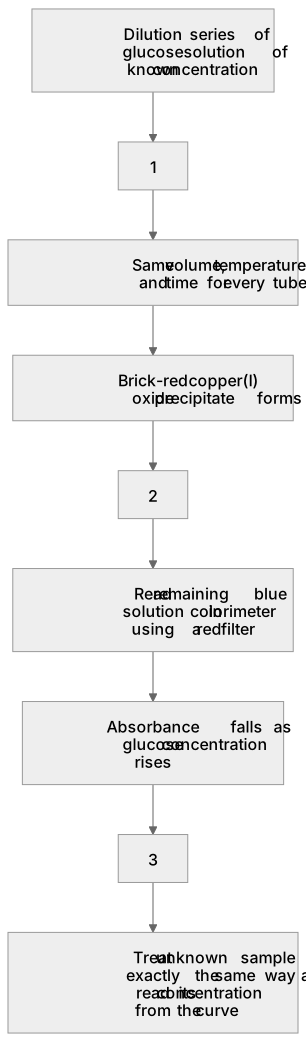
1Box 1
2Box 2
3Box 3
There is more to this lesson
The full lesson goes on to check your understanding and help you earn the marks. Create a free account to carry on, with your progress saved.
A week of Premium from your first lesson · Then the free plan continues · No card, no charge
Test your understanding of Control of blood glucose concentration (A-level only): Required practical 11: Production of a dilution series of a glucose solution and use of colorimetric techniques to produce a calibration curve with which to identify the concentration of glucose in an unknown ‘urine’ sample.
Active recall beats re-reading. Take an instant quiz now to test what you’ve learned and lock it into long-term memory.
A week of Premium from your first lesson · Then the free plan continues · No card, no charge