AQA · A-Level · Biology
Course version: 7402 · Version from Sept 2016
The action of glucagon by: attaching to receptors on the surfaces of…
Full specification wording
Control of blood glucose concentration (A-level only): The action of glucagon by: attaching to receptors on the surfaces of target cells activating enzymes involved in the conversion of glycogen to glucose activating enzymes involved in the conversion of glycerol and amino acids into glucose.
Glucagon is a peptide hormone secreted by the alpha cells of the islets of Langerhans when blood glucose concentration falls.
Checked against the AQA 7402 specification (opens in a new tab) on .
- Point 4 of 9
- 4 key terms
Study notes
From the checked teaching notes for this specification point.
The idea
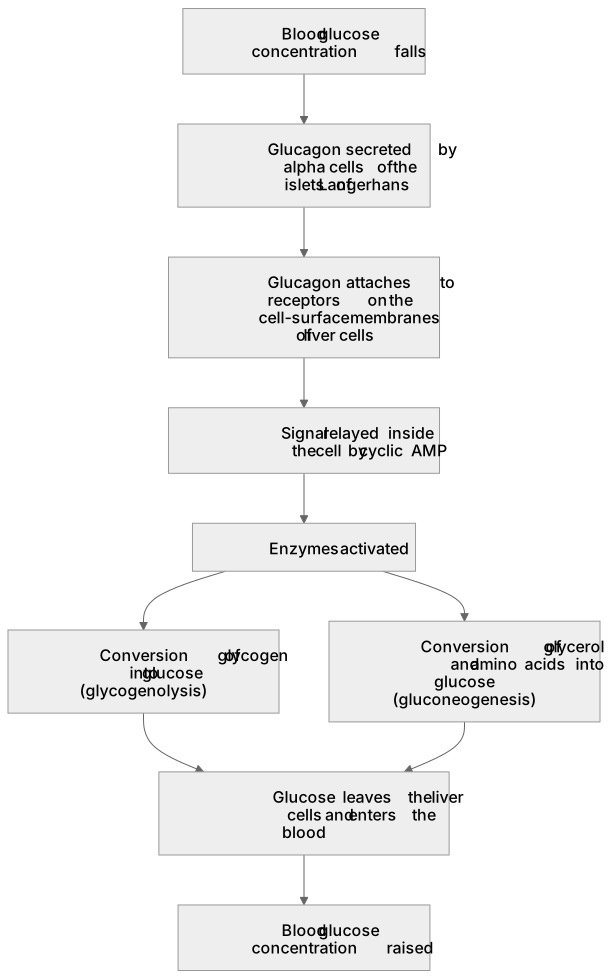
Glucagon is a peptide hormone secreted by the alpha cells of the islets of Langerhans when blood glucose concentration falls. Its main target is the liver, because hepatocytes carry many glucagon receptors. Being a protein, glucagon cannot cross the phospholipid bilayer, so it attaches to receptors on the cell-surface membrane and the signal is relayed inside the cell by a second messenger, cyclic AMP. This activates enzymes that catalyse two processes. Glycogenolysis is the breakdown of stored glycogen into glucose. Gluconeogenesis is the conversion of glycerol and amino acids into glucose. The glucose then leaves the liver cells and enters the blood, raising the concentration back towards normal. Glucagon also inhibits glycogenesis, so glucose is not stored at the same time as it is released.
What earns the marks
- Glucagon is secreted by the alpha cells of the islets of Langerhans when blood glucose concentration falls.
- Glucagon attaches to receptors on the cell-surface membranes of liver cells, its target cells.
- Binding activates enzymes that catalyse the conversion of glycogen into glucose, which is glycogenolysis.
- Binding activates enzymes that catalyse the conversion of glycerol and amino acids into glucose, which is gluconeogenesis.
- Glucose leaves the liver cells and enters the blood, raising blood glucose concentration and reducing further glucagon secretion.
Common mistakes and how to put them right
Swapping alpha and beta cells, so glucagon is attributed to the wrong cells.
Put it right: Glucagon is secreted by alpha cells; insulin by beta cells.
Spelling glucagon as glycogen, or the reverse, which makes the answer unmarkable.
Put it right: Glucagon is the hormone; glycogen is the storage polysaccharide.
Saying glucagon breaks down glycogen directly rather than activating the enzymes that do so. Correction: glucagon activates enzymes such as glycogen phosphorylase.
Claiming glucagon acts on muscle cells to release glucose into the blood.
Put it right: Muscle lacks glucagon receptors and cannot release free glucose into the blood.
Omitting gluconeogenesis, which is half of the specification statement.
Put it right: Include both glycogenolysis and gluconeogenesis.
Exam tips
- Write glucagon and glycogen carefully; examiners cannot give the benefit of the doubt between the two.
- Mirror your insulin answer: same structure, opposite direction, different cells of the islets.
Try the lesson
The start of the Control of blood glucose concentration (A-level only): The action of glucagon by: attaching to receptors on the surfaces of target cells activating enzymes involved in the conversion of glycogen to glucose activating enzymes involved in the conversion of glycerol and amino acids into glucose. lesson, made from checked teaching notes for this specification point.
Have a go first
Where does glucagon attach when it acts on a target cell?
Listen
Glucagon is a peptide hormone secreted by the alpha cells of the islets of Langerhans when blood glucose concentration falls. Its main target is the liver, because hepatocytes carry many glucagon receptors. Being a protein, glucagon cannot cross the phospholipid bilayer, so it attaches to receptors on the cell-surface membrane and the signal is relayed inside the cell by a second messenger, cyclic AMP. This activates enzymes that catalyse two processes. Glycogenolysis is the breakdown of stored glycogen into glucose. Gluconeogenesis is the conversion of glycerol and amino acids into glucose. The glucose then leaves the liver cells and enters the blood, raising the concentration back towards normal. Glucagon also inhibits glycogenesis, so glucose is not stored at the same time as it is released. A strong answer earns marks for these points. Glucagon is secreted by the alpha cells of the islets of Langerhans when blood glucose concentration falls. Glucagon attaches to receptors on the cell-surface membranes of liver cells, its target cells. Binding activates enzymes that catalyse the conversion of glycogen into glucose, which is glycogenolysis. Binding activates enzymes that catalyse the conversion of glycerol and amino acids into glucose, which is gluconeogenesis. A common slip: Swapping alpha and beta cells, so glucagon is attributed to the wrong cells. Instead, glucagon is secreted by alpha cells; insulin by beta cells. Exam tip: Write glucagon and glycogen carefully; examiners cannot give the benefit of the doubt between the two.
See it
Key words
Say what each word means before you turn the card.
alpha cells of the islets of Langerhans
Try answering aloud or in your head before turning the card.
liver as target organ
Try answering aloud or in your head before turning the card.
receptor binding on the cell-surface membrane
Try answering aloud or in your head before turning the card.
glycogenolysis
Try answering aloud or in your head before turning the card.
See every definition
- alpha cells of the islets of Langerhans
- The cells that secrete glucagon when blood glucose concentration falls.
- liver as target organ
- The main target of glucagon, because hepatocytes carry many glucagon receptors.
- receptor binding on the cell-surface membrane
- Glucagon cannot cross the phospholipid bilayer, so it attaches to receptors on the cell-surface membrane and the signal is relayed inside the cell by a second messenger, cyclic AMP.
- glycogenolysis
- The breakdown of stored glycogen into glucose.
Label the diagram
Some boxes have lost their names. Pick the right name for each number.
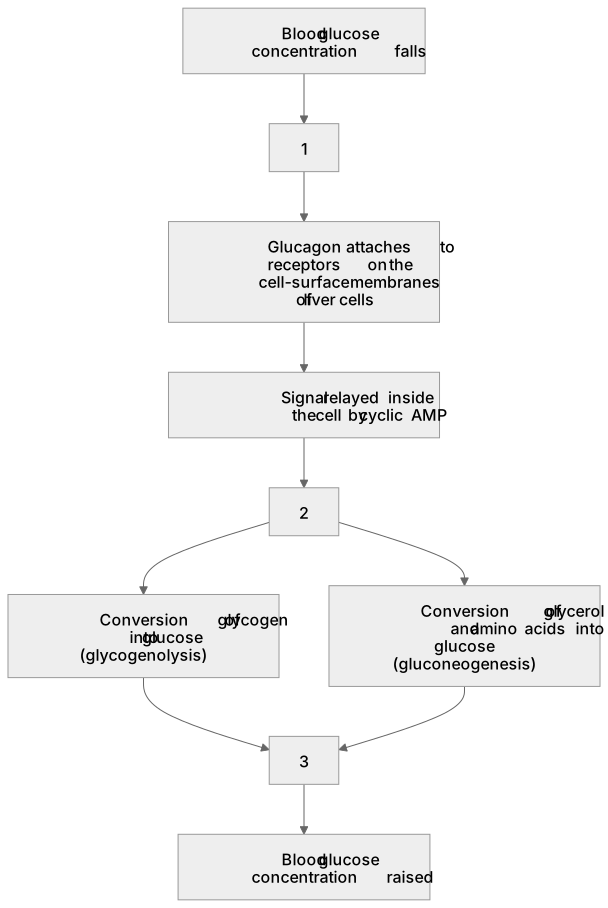
1Box 1
2Box 2
3Box 3
There is more to this lesson
The full lesson goes on to check your understanding and help you earn the marks. Create a free account to carry on, with your progress saved.
A week of Premium from your first lesson · Then the free plan continues · No card, no charge
Test your understanding of Control of blood glucose concentration (A-level only): The action of glucagon by: attaching to receptors on the surfaces of target cells activating enzymes involved in the conversion of glycogen to glucose activating enzymes involved in the conversion of glycerol and amino acids into glucose.
Active recall beats re-reading. Take an instant quiz now to test what you’ve learned and lock it into long-term memory.
A week of Premium from your first lesson · Then the free plan continues · No card, no charge