AQA · A-Level · Biology
Course version: 7402 · Version from Sept 2016
In eukaryotes, much of the nuclear DNA does not code for polypeptides.
Full specification wording
DNA, genes and chromosomes: In eukaryotes, much of the nuclear DNA does not code for polypeptides.
In eukaryotes, a significant proportion of nuclear DNA does not code for polypeptides.
Checked against the AQA 7402 specification (opens in a new tab) on .
- Point 8 of 11
- 4 key terms
Study notes
From the checked teaching notes for this specification point.
The idea
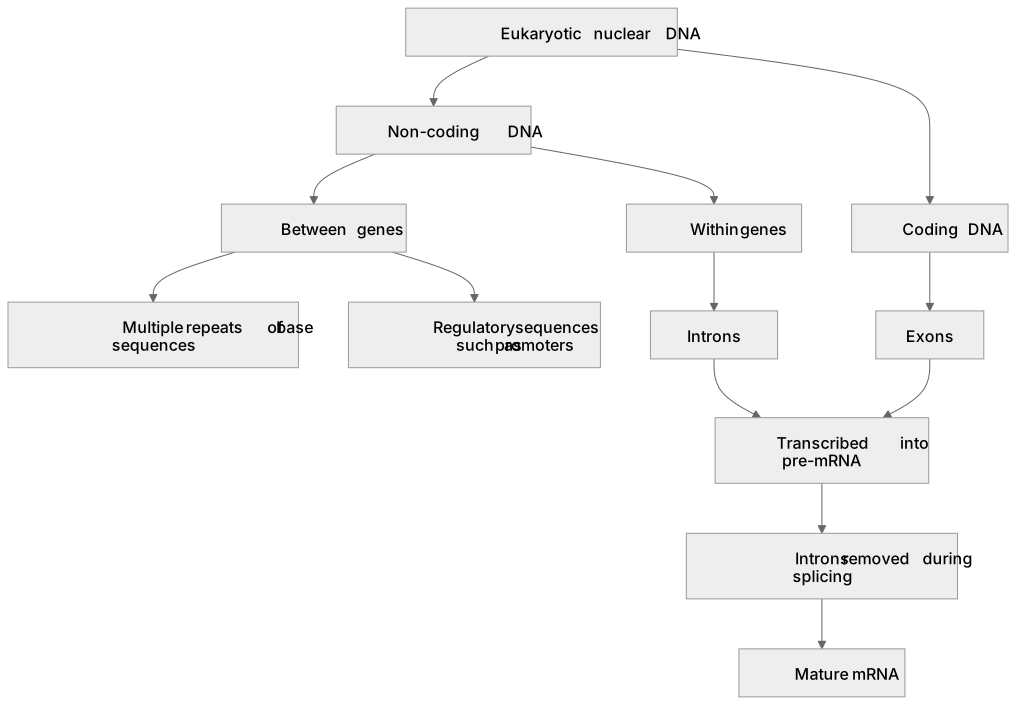
In eukaryotes, a significant proportion of nuclear DNA does not code for polypeptides. This non-coding DNA exists in two main forms: between genes and within genes. Between genes, there are non-coding multiple repeats of base sequences, as well as regulatory sequences such as promoters. Within genes, there are non-coding sequences called introns, which separate the coding sequences called exons. During transcription, both introns and exons are transcribed into pre-mRNA, but introns are subsequently removed during splicing to form mature mRNA. This contrasts with prokaryotic DNA, which generally lacks spliceosomal introns. Some non-coding DNA also codes for functional RNAs like ribosomal RNA (rRNA) and transfer RNA (tRNA).
What earns the marks
- State that much of eukaryotic nuclear DNA does not code for polypeptides.
- Identify that non-coding DNA between genes includes multiple repeats of base sequences, and may also include regulatory sequences.
- Explain that non-coding sequences within genes are called introns and they separate exons.
- Describe how introns are transcribed into pre-mRNA but are removed during splicing before translation.
- Contrast eukaryotic DNA with prokaryotic DNA by stating that prokaryotic DNA generally lacks spliceosomal introns.
Common mistakes and how to put them right
Stating that DNA is translated into polypeptides.
Put it right: DNA is transcribed into mRNA, which is then translated at the ribosomes.
Confusing introns and exons.
Put it right: Introns are the non-coding intervening sequences that are removed, while exons are the coding sequences that are expressed.
Suggesting prokaryotes have introns.
Put it right: Prokaryotic DNA generally lacks spliceosomal introns, which is a key difference from eukaryotic nuclear DNA.
Exam tips
- When asked for examples of non-coding DNA, specifically name multiple repeats between genes or introns within genes rather than using vague terms like 'spacer DNA'.
- Be precise with terminology: state that introns are removed from pre-mRNA during splicing, not from the DNA itself.
Try the lesson
The start of the DNA, genes and chromosomes: In eukaryotes, much of the nuclear DNA does not code for polypeptides. lesson, made from checked teaching notes for this specification point.
Have a go first
Which of the following statements correctly describes a characteristic of nuclear DNA in eukaryotes?
Listen
In eukaryotes, a significant proportion of nuclear DNA does not code for polypeptides. This non-coding DNA exists in two main forms: between genes and within genes. Between genes, there are non-coding multiple repeats of base sequences, as well as regulatory sequences such as promoters. Within genes, there are non-coding sequences called introns, which separate the coding sequences called exons. During transcription, both introns and exons are transcribed into pre-mRNA, but introns are subsequently removed during splicing to form mature mRNA. This contrasts with prokaryotic DNA, which generally lacks spliceosomal introns. Some non-coding DNA also codes for functional RNAs like ribosomal RNA (rRNA) and transfer RNA (tRNA). A strong answer earns marks for these points. State that much of eukaryotic nuclear DNA does not code for polypeptides. Identify that non-coding DNA between genes includes multiple repeats of base sequences, and may also include regulatory sequences. Explain that non-coding sequences within genes are called introns and they separate exons. Describe how introns are transcribed into pre-mRNA but are removed during splicing before translation. A common slip: Stating that DNA is translated into polypeptides. Instead, DNA is transcribed into mRNA, which is then translated at the ribosomes. Exam tip: When asked for examples of non-coding DNA, specifically name multiple repeats between genes or introns within genes rather than using vague terms like 'spacer DNA'.
See it
Key words
Say what each word means before you turn the card.
non-coding DNA
Try answering aloud or in your head before turning the card.
introns and exons
Try answering aloud or in your head before turning the card.
multiple repeats
Try answering aloud or in your head before turning the card.
transcription and splicing
Try answering aloud or in your head before turning the card.
See every definition
- non-coding DNA
- Much of the nuclear DNA in eukaryotes does not code for polypeptides, and exists between genes and within genes.
- introns and exons
- Non-coding sequences within genes are called introns, and they separate the coding sequences called exons.
- multiple repeats
- Between genes there are non-coding multiple repeats of base sequences.
- transcription and splicing
- During transcription both introns and exons are transcribed into pre-mRNA, but introns are subsequently removed during splicing to form mature mRNA.
Label the diagram
Some boxes have lost their names. Pick the right name for each number.
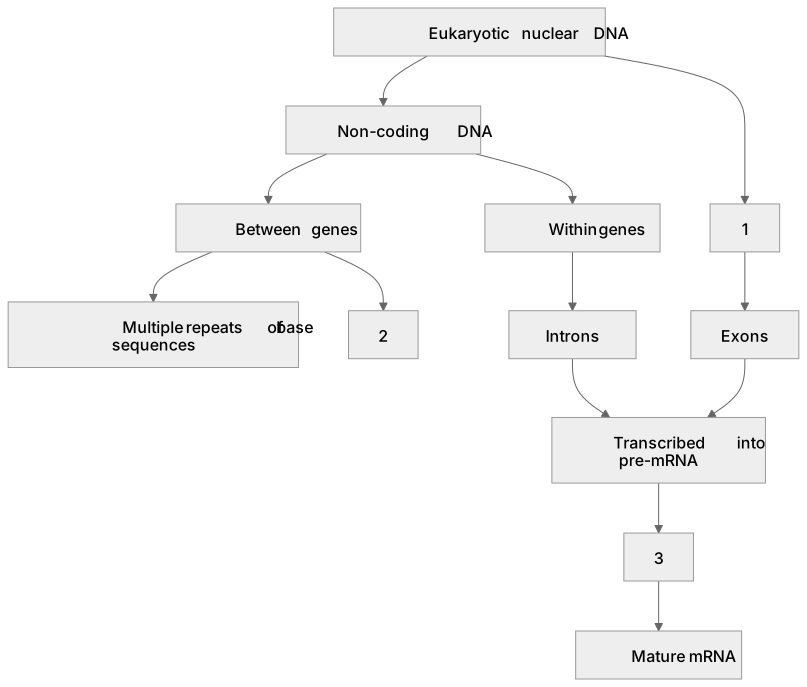
1Box 1
2Box 2
3Box 3
There is more to this lesson
The full lesson goes on to check your understanding and help you earn the marks. Create a free account to carry on, with your progress saved.
A week of Premium from your first lesson · Then the free plan continues · No card, no charge
Test your understanding of DNA, genes and chromosomes: In eukaryotes, much of the nuclear DNA does not code for polypeptides.
Active recall beats re-reading. Take an instant quiz now to test what you’ve learned and lock it into long-term memory.
A week of Premium from your first lesson · Then the free plan continues · No card, no charge