AQA · A-Level · Biology
Course version: 7402 · Version from Sept 2016
There are, for example, non-coding multiple repeats of base sequences…
Full specification wording
DNA, genes and chromosomes: There are, for example, non-coding multiple repeats of base sequences between genes.
Between genes, eukaryotic DNA contains short base sequences repeated many times, known as variable number tandem repeats (VNTRs).
Checked against the AQA 7402 specification (opens in a new tab) on .
- Point 9 of 11
- 4 key terms
Study notes
From the checked teaching notes for this specification point.
The idea
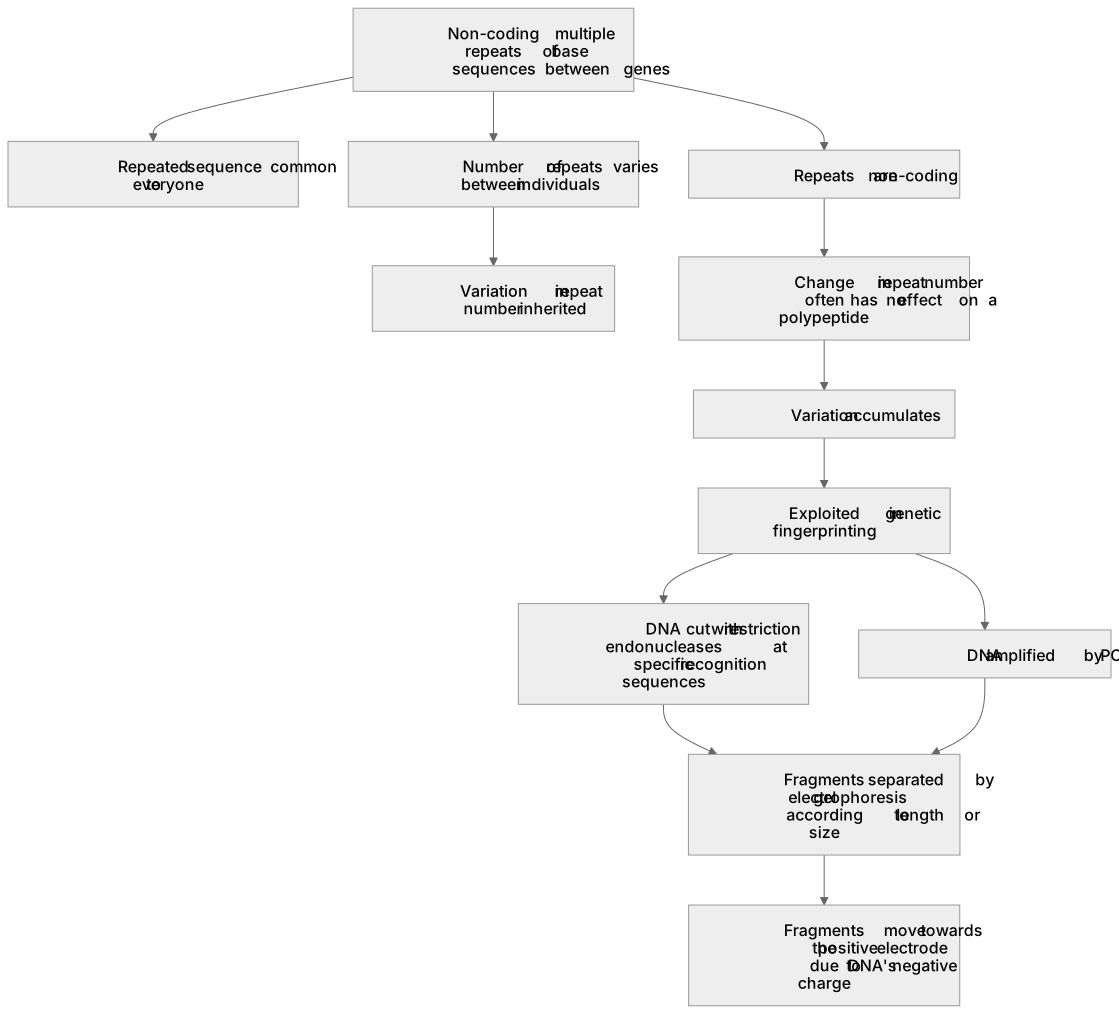
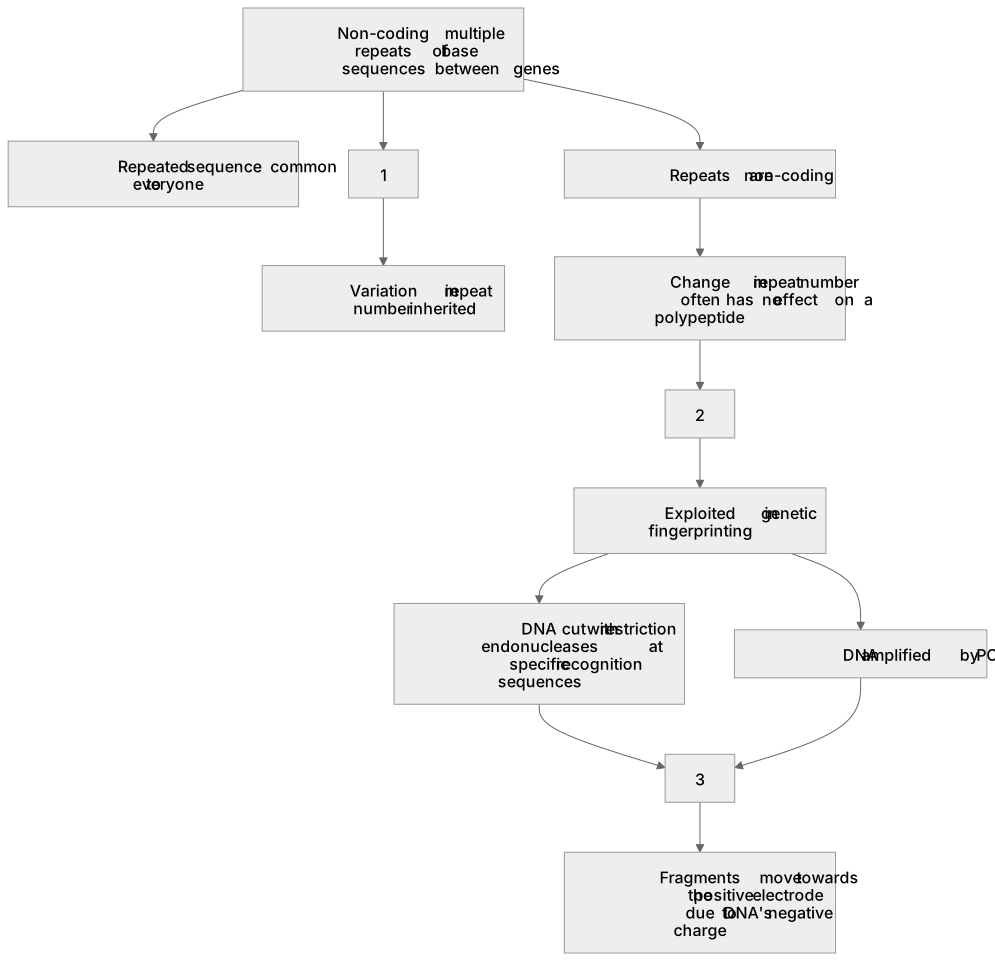
Between genes, eukaryotic DNA contains short base sequences repeated many times, known as variable number tandem repeats (VNTRs). The repeated sequence, for example AGAT, is common to everyone, but the number of repeats at a given position varies between individuals and is inherited. Because these repeats lie between genes and are non-coding, a change in repeat number often has no effect on a polypeptide, allowing variation to accumulate. This variation is exploited in genetic fingerprinting: DNA is cut with restriction endonucleases at specific recognition sequences, or amplified by PCR. The fragments are then separated by gel electrophoresis according to their length or size, moving towards the positive electrode due to DNA's negative charge.
What earns the marks
- The repeated sequences are non-coding and lie between genes, so variation in repeat number often does not alter a polypeptide.
- The number of repeats varies between individuals while the repeated sequence itself is common to all.
- Fragments differ in length, size or mass, which allows them to be separated by gel electrophoresis.
- DNA fragments carry a negative charge, causing them to move towards the positive electrode.
- Restriction endonucleases cut DNA at specific recognition sequences, not at random positions.
Common mistakes and how to put them right
Giving 'they are short' on its own as the reason fragments separate.
Put it right: Link separation to differences in length, size or mass.
Stating that DNA fragments are positively charged.
Put it right: DNA is negatively charged and moves to the positive electrode.
Claiming the repeats code for a protein.
Put it right: They are non-coding sequences located between genes.
Saying restriction enzymes cut DNA at random positions.
Put it right: They cut at specific recognition sites.
Exam tips
- When explaining separation in gel electrophoresis, clearly distinguish that negative charge causes movement, while differences in length or size cause the actual separation.
- State early in any fingerprinting answer that the repeats are non-coding.
- Name restriction endonucleases and recognition sites rather than writing 'cutting enzymes'.
Try the lesson
The start of the DNA, genes and chromosomes: There are, for example, non-coding multiple repeats of base sequences between genes. lesson, made from checked teaching notes for this specification point.
Have a go first
What is meant by the term non-coding multiple repeats of base sequences between genes?
Listen
Between genes, eukaryotic DNA contains short base sequences repeated many times, known as variable number tandem repeats (VNTRs). The repeated sequence, for example AGAT, is common to everyone, but the number of repeats at a given position varies between individuals and is inherited. Because these repeats lie between genes and are non-coding, a change in repeat number often has no effect on a polypeptide, allowing variation to accumulate. This variation is exploited in genetic fingerprinting: DNA is cut with restriction endonucleases at specific recognition sequences, or amplified by PCR. The fragments are then separated by gel electrophoresis according to their length or size, moving towards the positive electrode due to DNA's negative charge. A strong answer earns marks for these points. The repeated sequences are non-coding and lie between genes, so variation in repeat number often does not alter a polypeptide. The number of repeats varies between individuals while the repeated sequence itself is common to all. Fragments differ in length, size or mass, which allows them to be separated by gel electrophoresis. DNA fragments carry a negative charge, causing them to move towards the positive electrode. Exam tip: When explaining separation in gel electrophoresis, clearly distinguish that negative charge causes movement, while differences in length or size cause the actual separation.
See it
Key words
Say what each word means before you turn the card.
variable number tandem repeats
Try answering aloud or in your head before turning the card.
non-coding DNA between genes
Try answering aloud or in your head before turning the card.
restriction endonucleases
Try answering aloud or in your head before turning the card.
gel electrophoresis
Try answering aloud or in your head before turning the card.
See every definition
- variable number tandem repeats
- Short base sequences repeated many times between genes, where the number of repeats at a given position varies between individuals and is inherited.
- non-coding DNA between genes
- Multiple repeats of base sequences that lie between genes, so a change in repeat number often has no effect on a polypeptide.
- restriction endonucleases
- Enzymes that cut DNA at specific recognition sequences, not at random positions.
- gel electrophoresis
- A method that separates fragments according to their length or size, with fragments moving towards the positive electrode due to DNA's negative charge.
Label the diagram
Some boxes have lost their names. Pick the right name for each number.
1Box 1
2Box 2
3Box 3
There is more to this lesson
The full lesson goes on to check your understanding and help you earn the marks. Create a free account to carry on, with your progress saved.
A week of Premium from your first lesson · Then the free plan continues · No card, no charge
Test your understanding of DNA, genes and chromosomes: There are, for example, non-coding multiple repeats of base sequences between genes.
Active recall beats re-reading. Take an instant quiz now to test what you’ve learned and lock it into long-term memory.
A week of Premium from your first lesson · Then the free plan continues · No card, no charge