AQA · A-Level · Biology
Course version: 7402 · Version from Sept 2016
In the nucleus of eukaryotic cells, DNA molecules are very long, linear…
Full specification wording
DNA, genes and chromosomes: In the nucleus of eukaryotic cells, DNA molecules are very long, linear and associated with proteins, called histones.
In a eukaryotic nucleus each DNA molecule is very long and linear, meaning it has two ends rather than forming a loop, and it is wound around histone proteins.
Checked against the AQA 7402 specification (opens in a new tab) on .
- Point 2 of 11
- 4 key terms
Study notes
From the checked teaching notes for this specification point.
The idea
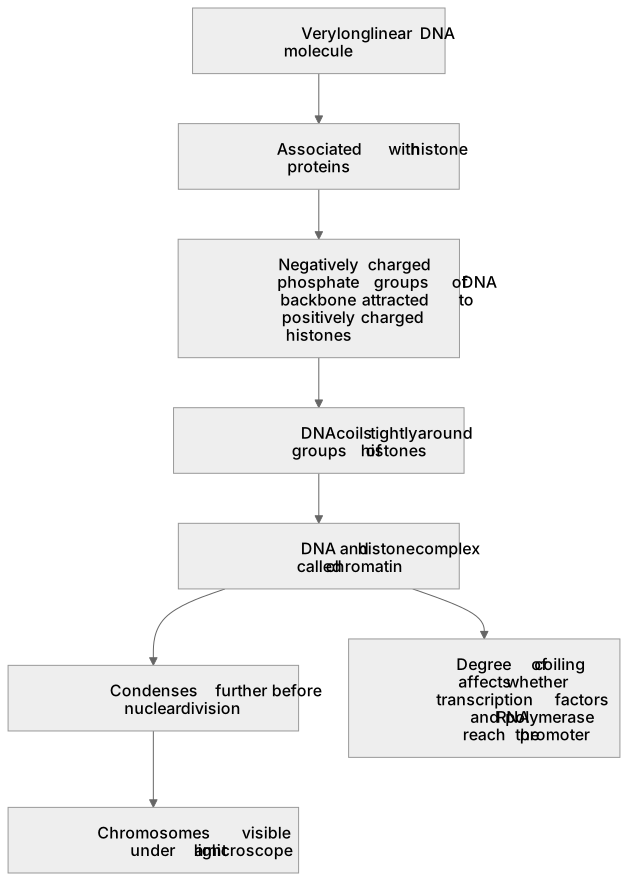
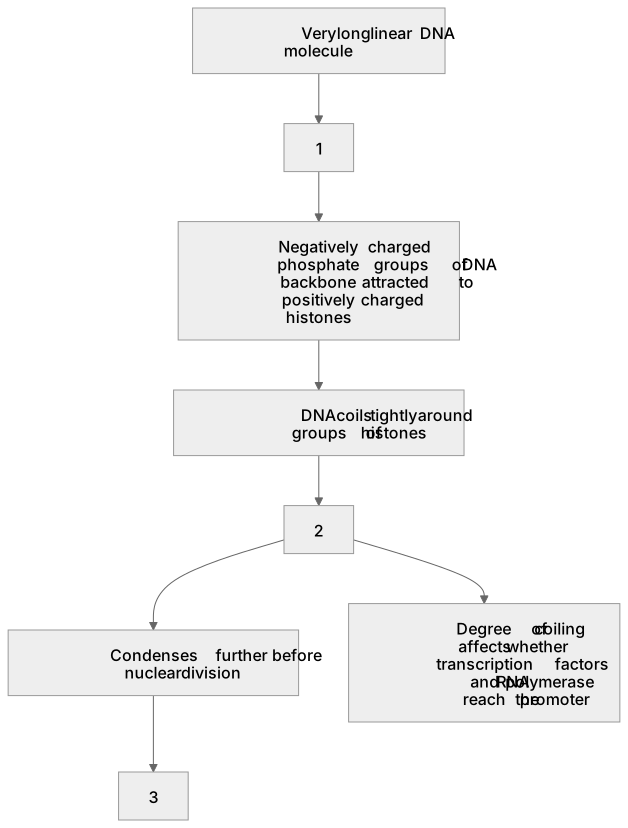
In a eukaryotic nucleus each DNA molecule is very long and linear, meaning it has two ends rather than forming a loop, and it is wound around histone proteins. Histones are basic, positively charged proteins, and the negatively charged phosphate groups of the DNA backbone are attracted to them, so the DNA coils tightly around groups of histones. That coiling condenses what would be metres of DNA into a nucleus only a few micrometres across. The DNA and histone complex is called chromatin; it condenses further before nuclear division to form the chromosomes visible under a light microscope. The winding is not merely packaging. How tightly a region is wound determines whether transcription factors and RNA polymerase can reach the promoter of a gene, which is the basis of epigenetic control later in the course.
What earns the marks
- Nuclear DNA is linear rather than circular.
- The DNA is associated with proteins called histones, forming chromatin.
- The DNA is very long, so it must be coiled or condensed to fit inside the nucleus.
- Replication of linear DNA is associated with a cell cycle involving mitosis.
- Credit depends on the wording of the actual question; the points above are teaching guidance, not an official question-specific mark scheme.
Common mistakes and how to put them right
Answering that the DNA is in the nucleus when the question asked about its shape or its associated proteins.
Describing histones as enzymes, or as molecules that code for proteins.
Treating chromatin and chromosome as different molecules rather than the same DNA at different degrees of condensation.
Claiming all eukaryotic DNA is linear and forgetting mitochondrial and chloroplast DNA.
Writing genetic material where the mark scheme ignores it and requires DNA with histones.
Exam tips
- Two words carry the marks here: linear and histones.
- If the question asks for a difference from prokaryotes, put both sides of it in the same sentence.
- Remember chromatin, chromosome and chromatid describe the same DNA at different stages, not different substances.
Try the lesson
The start of the DNA, genes and chromosomes: In the nucleus of eukaryotic cells, DNA molecules are very long, linear and associated with proteins, called histones. lesson, made from checked teaching notes for this specification point.
Have a go first
Which combination of features correctly describes eukaryotic nuclear DNA?
Listen
In a eukaryotic nucleus each DNA molecule is very long and linear, meaning it has two ends rather than forming a loop, and it is wound around histone proteins. Histones are basic, positively charged proteins, and the negatively charged phosphate groups of the DNA backbone are attracted to them, so the DNA coils tightly around groups of histones. That coiling condenses what would be metres of DNA into a nucleus only a few micrometres across. The DNA and histone complex is called chromatin; it condenses further before nuclear division to form the chromosomes visible under a light microscope. The winding is not merely packaging. How tightly a region is wound determines whether transcription factors and RNA polymerase can reach the promoter of a gene, which is the basis of epigenetic control later in the course. A strong answer earns marks for these points. Nuclear DNA is linear rather than circular. The DNA is associated with proteins called histones, forming chromatin. The DNA is very long, so it must be coiled or condensed to fit inside the nucleus. Replication of linear DNA is associated with a cell cycle involving mitosis. Exam tip: Two words carry the marks here: linear and histones.
See it
Key words
Say what each word means before you turn the card.
linear DNA
Try answering aloud or in your head before turning the card.
histone proteins
Try answering aloud or in your head before turning the card.
chromatin
Try answering aloud or in your head before turning the card.
nuclear envelope
Try answering aloud or in your head before turning the card.
See every definition
- linear DNA
- Very long DNA molecules in the nucleus of eukaryotic cells that have two ends rather than forming a loop.
- histone proteins
- Basic, positively charged proteins that the negatively charged phosphate groups of the DNA backbone are attracted to, so the DNA coils tightly around groups of them.
- chromatin
- The complex of DNA and histone proteins, which condenses further before nuclear division to form the chromosomes visible under a light microscope.
- nuclear envelope
- The structure enclosing this DNA, containing pores.
Label the diagram
Some boxes have lost their names. Pick the right name for each number.
1Box 1
2Box 2
3Box 3
There is more to this lesson
The full lesson goes on to check your understanding and help you earn the marks. Create a free account to carry on, with your progress saved.
A week of Premium from your first lesson · Then the free plan continues · No card, no charge
Test your understanding of DNA, genes and chromosomes: In the nucleus of eukaryotic cells, DNA molecules are very long, linear and associated with proteins, called histones.
Active recall beats re-reading. Take an instant quiz now to test what you’ve learned and lock it into long-term memory.
A week of Premium from your first lesson · Then the free plan continues · No card, no charge