AQA · A-Level · Biology
Course version: 7402 · Version from Sept 2016
Within the gene, these exons are separated by one or more non-coding…
Full specification wording
DNA, genes and chromosomes: Within the gene, these exons are separated by one or more non-coding sequences, called introns.
Introns are non-coding base sequences lying between the exons of a eukaryotic gene.
Checked against the AQA 7402 specification (opens in a new tab) on .
- Point 11 of 11
- 3 key terms
Study notes
From the checked teaching notes for this specification point.
The idea
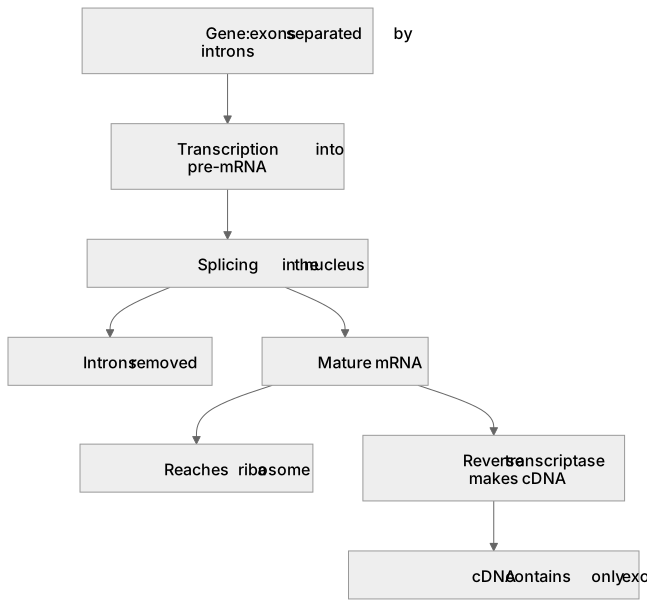
Introns are non-coding base sequences lying between the exons of a eukaryotic gene. They are transcribed into pre-mRNA along with exons, then removed by splicing in the nucleus. Because they never reach a ribosome, their bases are not translated into amino acids. A mutation within an intron usually has no effect on the polypeptide, unless it alters a splice site. For genes containing introns, the gene is longer than the mature mRNA transcribed from it. This length difference is useful: complementary DNA (cDNA), made by reverse transcriptase from mature mRNA, contains only exons. Comparing cDNA to the original gene shows where the introns lay.
What earns the marks
- Introns are non-coding sequences within a gene, lying between the exons.
- Introns are transcribed into pre-messenger RNA and then removed by splicing.
- Splicing occurs in the nucleus, before the messenger RNA reaches a ribosome.
- For genes with introns, the DNA sequence is longer than the mature messenger RNA transcribed from it.
- Complementary DNA made from mature messenger RNA contains no introns.
Common mistakes and how to put them right
Saying introns are cut out of the DNA itself.
Put it right: They are spliced out of the pre-messenger RNA.
Describing introns as having no function.
Put it right: Mutations at splice sites can alter which sections are removed.
Assuming all eukaryotic genes have introns.
Put it right: Some, like histone genes, are intronless.
Calculating the number of amino acids from the whole length of a eukaryotic gene.
Put it right: Use only the exon bases.
Exam tips
- When calculating amino acid number, use only the exon bases and divide by three.
- State explicitly that splicing happens in the nucleus.
Try the lesson
The start of the DNA, genes and chromosomes: Within the gene, these exons are separated by one or more non-coding sequences, called introns. lesson, made from checked teaching notes for this specification point.
Have a go first
What name is given to the non-coding sequences that separate exons within a gene?
Listen
Introns are non-coding base sequences lying between the exons of a eukaryotic gene. They are transcribed into pre-mRNA along with exons, then removed by splicing in the nucleus. Because they never reach a ribosome, their bases are not translated into amino acids. A mutation within an intron usually has no effect on the polypeptide, unless it alters a splice site. For genes containing introns, the gene is longer than the mature mRNA transcribed from it. This length difference is useful: complementary DNA (cDNA), made by reverse transcriptase from mature mRNA, contains only exons. Comparing cDNA to the original gene shows where the introns lay. A strong answer earns marks for these points. Introns are non-coding sequences within a gene, lying between the exons. Introns are transcribed into pre-messenger RNA and then removed by splicing. Splicing occurs in the nucleus, before the messenger RNA reaches a ribosome. For genes with introns, the DNA sequence is longer than the mature messenger RNA transcribed from it. A common slip: Saying introns are cut out of the DNA itself. Instead, they are spliced out of the pre-messenger RNA. Exam tip: When calculating amino acid number, use only the exon bases and divide by three.
See it
Key words
Say what each word means before you turn the card.
introns
Try answering aloud or in your head before turning the card.
pre-messenger RNA
Try answering aloud or in your head before turning the card.
splicing
Try answering aloud or in your head before turning the card.
See every definition
- introns
- Non-coding sequences within a gene, lying between the exons.
- pre-messenger RNA
- The molecule into which introns are transcribed along with exons, before they are removed by splicing.
- splicing
- The removal of introns, occurring in the nucleus before the messenger RNA reaches a ribosome.
Label the diagram
Some boxes have lost their names. Pick the right name for each number.
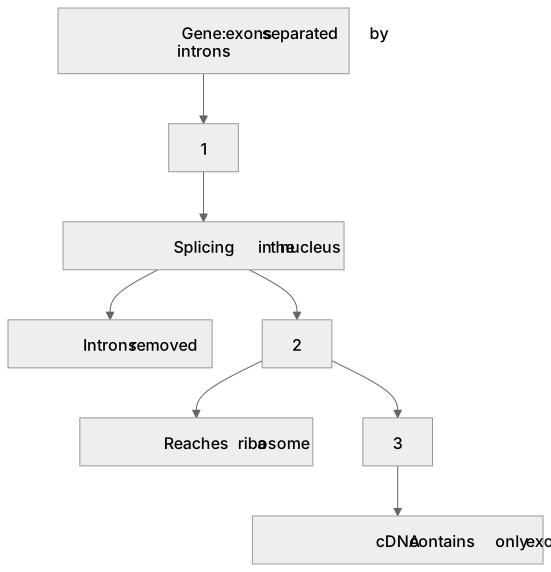
1Box 1
2Box 2
3Box 3
There is more to this lesson
The full lesson goes on to check your understanding and help you earn the marks. Create a free account to carry on, with your progress saved.
A week of Premium from your first lesson · Then the free plan continues · No card, no charge
Test your understanding of DNA, genes and chromosomes: Within the gene, these exons are separated by one or more non-coding sequences, called introns.
Active recall beats re-reading. Take an instant quiz now to test what you’ve learned and lock it into long-term memory.
A week of Premium from your first lesson · Then the free plan continues · No card, no charge