AQA · A-Level · Biology
Course version: 7402 · Version from Sept 2016
Even within a gene only some sequences, called exons, code for amino acid…
Full specification wording
DNA, genes and chromosomes: Even within a gene only some sequences, called exons, code for amino acid sequences.
A eukaryotic gene is not one continuous coding stretch.
Checked against the AQA 7402 specification (opens in a new tab) on .
- Point 10 of 11
- 4 key terms
Study notes
From the checked teaching notes for this specification point.
The idea
A eukaryotic gene is not one continuous coding stretch. Within the gene, exons are the sections whose base sequence is read as the amino acid sequence of the polypeptide; remember exons are expressed. The other sections, introns, do not code for amino acids. When the gene is transcribed, RNA polymerase copies the whole gene, exons and introns alike, producing pre-messenger RNA. Splicing then removes the introns and joins the exons, giving mature messenger RNA, which leaves the nucleus through a nuclear pore to a ribosome in the cytoplasm. Because splicing can join different combinations of exons from the same pre-messenger RNA, one gene can give rise to more than one messenger RNA and therefore more than one polypeptide. Prokaryotic genes are generally continuous, with no introns, so they need no splicing.
What earns the marks
- Exons being the sections of a gene whose base sequence codes for amino acids.
- Introns being non-coding sections within the gene.
- Pre-messenger RNA containing both exons and introns, because the whole gene is transcribed.
- Splicing removing introns and joining exons to form mature messenger RNA.
- Contrasting this with prokaryotic genes, which are generally continuous and need no splicing.
Common mistakes and how to put them right
Saying messenger RNA is transcribed from the exons only, so the pre-messenger RNA stage disappears.
Confusing an exon with a codon.
Put it right: An exon is a section of a gene, a codon is three bases on messenger RNA.
Saying splicing happens at the ribosome or in the cytoplasm rather than in the nucleus.
Claiming that removing the introns changes the amino acids coded for by the exons.
Applying splicing to a bacterial gene in a recombinant DNA question.
Put it right: Bacteria cannot splice eukaryotic introns.
Exam tips
- Remember that exons are expressed; the mnemonic has rescued a great many marks.
- Use pre-messenger RNA and mature messenger RNA as separate terms in any eukaryotic transcription answer.
- If a question puts a eukaryotic gene into a bacterium, say the bacterium cannot splice, so complementary DNA made from mature messenger RNA must be used.
Try the lesson
The start of the DNA, genes and chromosomes: Even within a gene only some sequences, called exons, code for amino acid sequences. lesson, made from checked teaching notes for this specification point.
Have a go first
Within a gene, which sequences are called exons?
Listen
A eukaryotic gene is not one continuous coding stretch. Within the gene, exons are the sections whose base sequence is read as the amino acid sequence of the polypeptide; remember exons are expressed. The other sections, introns, do not code for amino acids. When the gene is transcribed, RNA polymerase copies the whole gene, exons and introns alike, producing pre-messenger RNA. Splicing then removes the introns and joins the exons, giving mature messenger RNA, which leaves the nucleus through a nuclear pore to a ribosome in the cytoplasm. Because splicing can join different combinations of exons from the same pre-messenger RNA, one gene can give rise to more than one messenger RNA and therefore more than one polypeptide. Prokaryotic genes are generally continuous, with no introns, so they need no splicing. A strong answer earns marks for these points. exons being the sections of a gene whose base sequence codes for amino acids. introns being non-coding sections within the gene. pre-messenger RNA containing both exons and introns, because the whole gene is transcribed. splicing removing introns and joining exons to form mature messenger RNA. Exam tip: Remember that exons are expressed; the mnemonic has rescued a great many marks.
See it
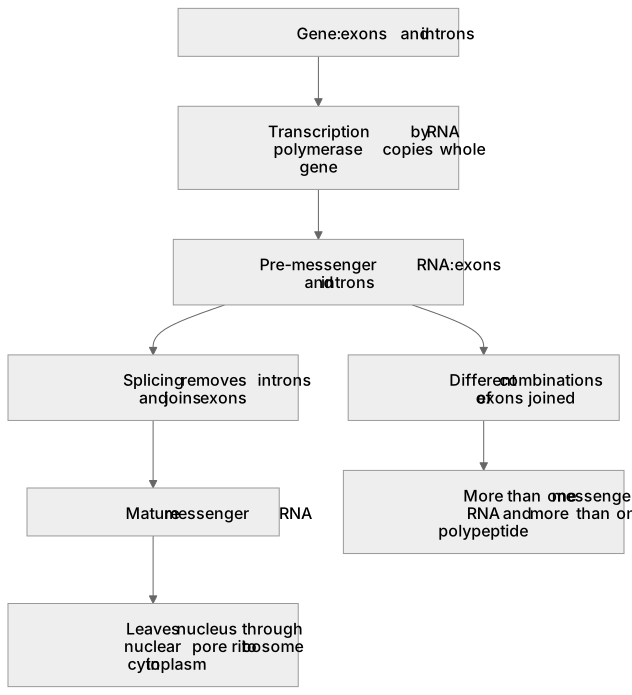
Key words
Say what each word means before you turn the card.
exons
Try answering aloud or in your head before turning the card.
introns
Try answering aloud or in your head before turning the card.
pre-messenger RNA
Try answering aloud or in your head before turning the card.
splicing
Try answering aloud or in your head before turning the card.
See every definition
- exons
- Sections of a gene whose base sequence codes for amino acids, and they are expressed.
- introns
- Sections within the gene that do not code for amino acids.
- pre-messenger RNA
- Produced when RNA polymerase copies the whole gene, exons and introns alike.
- splicing
- Removes the introns and joins the exons, giving mature messenger RNA.
Label the diagram
Some boxes have lost their names. Pick the right name for each number.
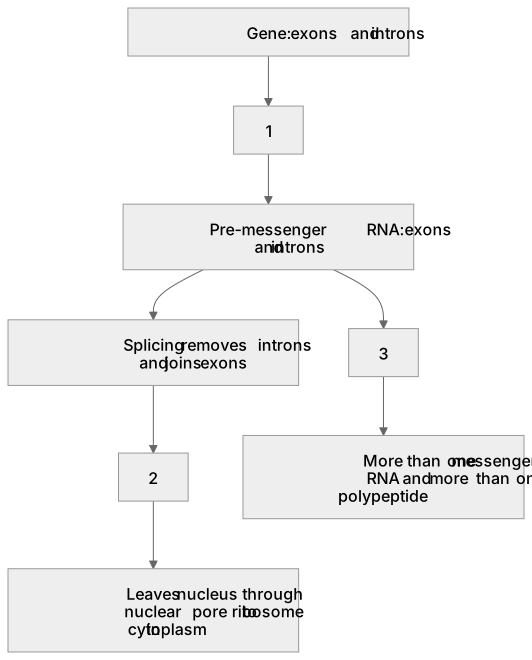
1Box 1
2Box 2
3Box 3
There is more to this lesson
The full lesson goes on to check your understanding and help you earn the marks. Create a free account to carry on, with your progress saved.
A week of Premium from your first lesson · Then the free plan continues · No card, no charge
Test your understanding of DNA, genes and chromosomes: Even within a gene only some sequences, called exons, code for amino acid sequences.
Active recall beats re-reading. Take an instant quiz now to test what you’ve learned and lock it into long-term memory.
A week of Premium from your first lesson · Then the free plan continues · No card, no charge