AQA · A-Level · Biology
Course version: 7402 · Version from Sept 2016
Gross primary production ( GPP) is the chemical energy store in plant…
Full specification wording
Energy and ecosystems (A-level only): Gross primary production ( GPP) is the chemical energy store in plant biomass, in a given area or volume.
Plants convert light energy into chemical energy during photosynthesis, storing it in organic molecules.
Checked against the AQA 7402 specification (opens in a new tab) on .
- Point 7 of 11
Study notes
From the checked teaching notes for this specification point.
The idea
Plants convert light energy into chemical energy during photosynthesis, storing it in organic molecules. This total accumulated chemical energy in a specific area or volume is gross primary production. It represents the absolute maximum energy captured by producers before any metabolic use. Only one to three per cent of incident sunlight is successfully converted into this store. The rest is lost because it is the wrong wavelength, is reflected by the leaf surface, passes straight through the tissue, or misses the chloroplasts entirely. When expressed as a store, units are typically kJ m-2. If measured over time as a rate, units become kJ m-2 year-1.
What earns the marks
- Defining gross primary production as the total chemical energy store in plant biomass in a given area or volume.
- Identifying that only a small percentage of incident light energy is converted into this chemical energy store.
- Explaining light loss by stating it is the wrong wavelength, reflected, or transmitted through the leaf.
- Stating correct units for a store (e.g., kJ m-2) or a rate (e.g., kJ m-2 year-1) depending on the context.
Common mistakes and how to put them right
Defining gross primary production as the energy available to herbivores.
Put it right: It is the total energy fixed, not the energy available after plant respiration.
Writing 'energy produced by the plant'.
Put it right: Energy is transferred and stored in organic molecules, never created or produced.
Assuming most light reaching a leaf becomes gross primary production.
Put it right: Only one to three per cent is converted, as much misses the chlorophyll or is reflected.
Exam tips
- Read the printed units carefully: a kJ m-2 value represents a store, whereas a kJ m-2 year-1 value represents a rate.
- Use the words 'store' and 'transferred' rather than 'made' or 'produced' whenever you write about energy in ecosystems.
Try the lesson
The start of the Energy and ecosystems (A-level only): Gross primary production ( GPP) is the chemical energy store in plant biomass, in a given area or volume. lesson, made from checked teaching notes for this specification point.
Have a go first
What does gross primary production (GPP) represent in an ecosystem?
Listen
Plants convert light energy into chemical energy during photosynthesis, storing it in organic molecules. This total accumulated chemical energy in a specific area or volume is gross primary production. It represents the absolute maximum energy captured by producers before any metabolic use. Only one to three per cent of incident sunlight is successfully converted into this store. The rest is lost because it is the wrong wavelength, is reflected by the leaf surface, passes straight through the tissue, or misses the chloroplasts entirely. When expressed as a store, units are typically kJ m-2. If measured over time as a rate, units become kJ m-2 year-1. A strong answer earns marks for these points. Defining gross primary production as the total chemical energy store in plant biomass in a given area or volume. Identifying that only a small percentage of incident light energy is converted into this chemical energy store. Explaining light loss by stating it is the wrong wavelength, reflected, or transmitted through the leaf. Stating correct units for a store (e.g., kJ m-2) or a rate (e.g., kJ m-2 year-1) depending on the context. A common slip: Defining gross primary production as the energy available to herbivores. Instead, it is the total energy fixed, not the energy available after plant respiration. Exam tip: Read the printed units carefully: a kJ m-2 value represents a store, whereas a kJ m-2 year-1 value represents a rate.
See it
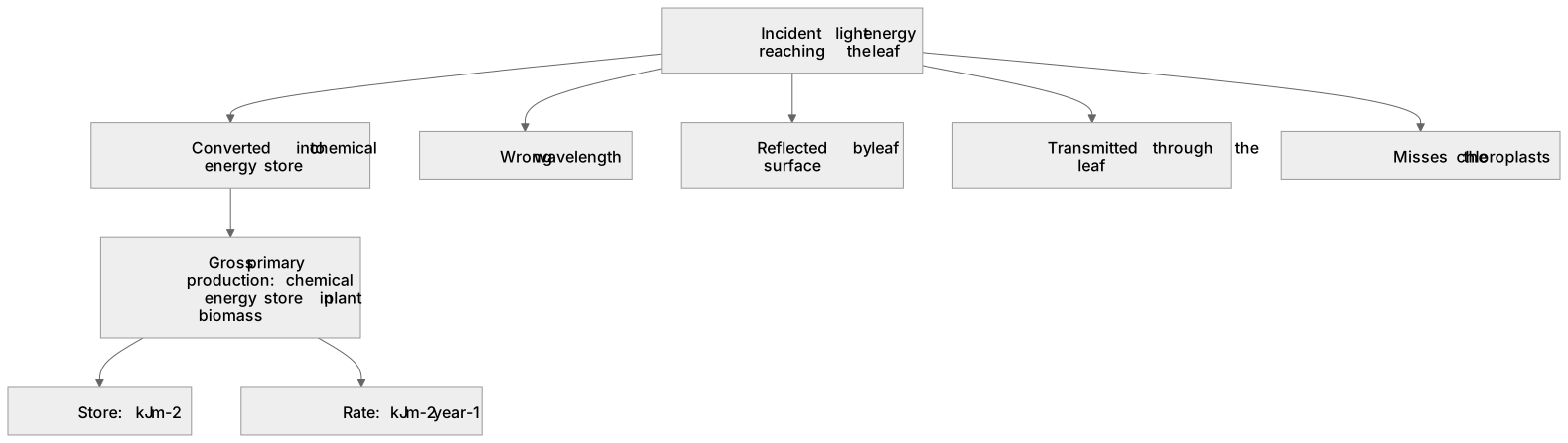
Label the diagram
Some boxes have lost their names. Pick the right name for each number.
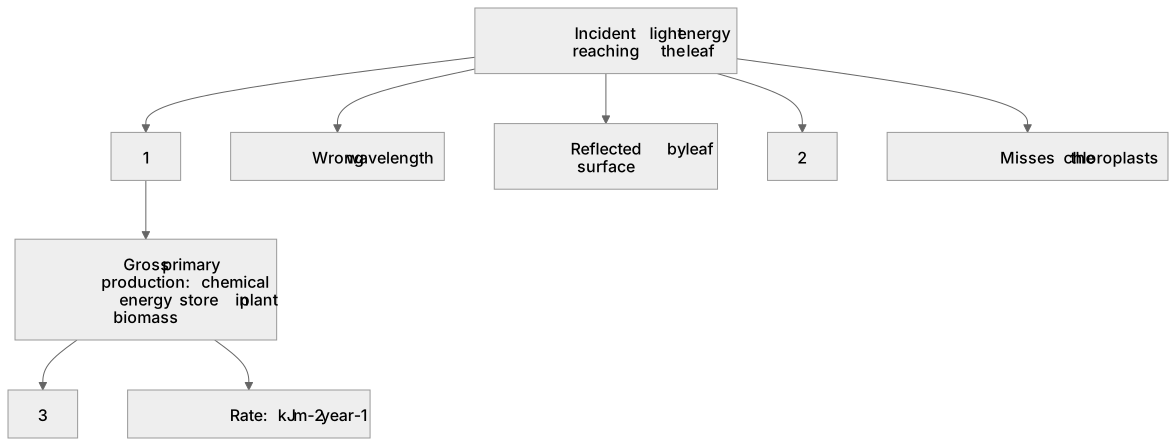
1Box 1
2Box 2
3Box 3
There is more to this lesson
The full lesson goes on to check your understanding and help you earn the marks. Create a free account to carry on, with your progress saved.
A week of Premium from your first lesson · Then the free plan continues · No card, no charge
Test your understanding of Energy and ecosystems (A-level only): Gross primary production ( GPP) is the chemical energy store in plant biomass, in a given area or volume.
Active recall beats re-reading. Take an instant quiz now to test what you’ve learned and lock it into long-term memory.
A week of Premium from your first lesson · Then the free plan continues · No card, no charge