AQA · A-Level · Biology
Course version: 7402 · Version from Sept 2016
This net primary production is available for plant growth and reproduction.
Full specification wording
Energy and ecosystems (A-level only): This net primary production is available for plant growth and reproduction.
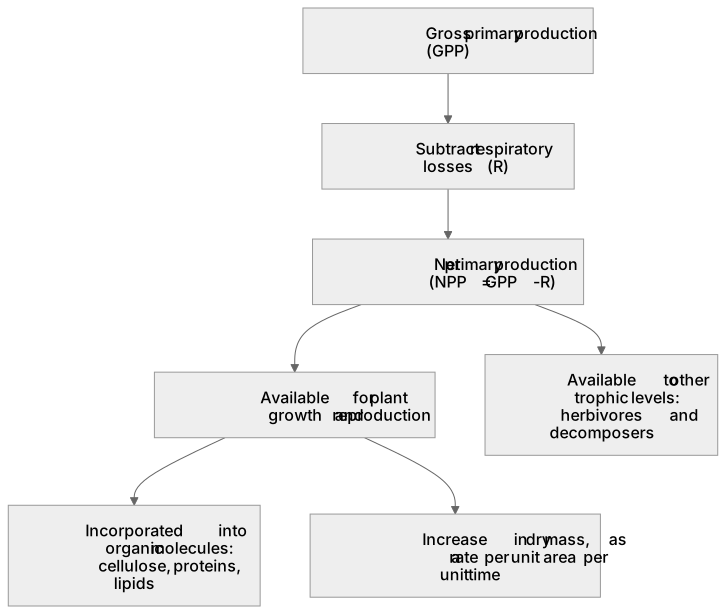
Net primary production (NPP) is the chemical energy store in plant biomass after respiratory losses (R) are subtracted from gross primary production (GPP).
Checked against the AQA 7402 specification (opens in a new tab) on .
- Point 8 of 11
- 4 key terms
Study notes
From the checked teaching notes for this specification point.
The idea
Net primary production (NPP) is the chemical energy store in plant biomass after respiratory losses (R) are subtracted from gross primary production (GPP). Therefore, NPP = GPP - R. This energy is available for plant growth and reproduction, being incorporated into organic molecules like cellulose, proteins, and lipids. It represents the rate of biomass accumulation, appearing as an increase in dry mass. NPP is measured per unit area per unit time, for example, kJ m-2 year-1. This biomass is also available to other trophic levels, such as herbivores and decomposers. A higher GPP does not guarantee a higher NPP, as growth depends on the balance of GPP minus R; a plant with high respiration may retain less energy.
What earns the marks
- State that net primary production is the chemical energy remaining after the producer's respiratory losses, NPP = GPP - R.
- State that this energy is available for plant growth and reproduction.
- Name a chemical store into which that energy goes, such as cellulose, protein, starch or lipid.
- Link net primary production to an increase in dry mass, expressed as a rate with units of area and time (e.g. kJ m-2 year-1 or g m-2 year-1).
- Explain that a higher GPP does not necessarily give a higher NPP, because respiratory loss may also be greater.
Common mistakes and how to put them right
Writing that net primary production is the total energy fixed by the plant, instead of the energy remaining after respiration.
Put it right: NPP is the energy left after respiratory losses (R) have been subtracted from GPP.
Quoting a net primary production figure without a unit of time, treating it as a static store rather than a rate.
Put it right: NPP is a rate of biomass production, so it must include time and area units, such as kJ m-2 year-1.
Answering only that 'the plant grows', without naming organic molecules or the increase in dry mass.
Put it right: Name specific organic molecules such as cellulose or starch, and refer to the increase in dry mass.
Assuming high gross primary production always means high net primary production.
Put it right: NPP depends on the balance GPP - R, so a plant with high GPP but high respiration may have low NPP.
Exam tips
- Quote NPP = GPP - R even in a description question; it earns the definition mark quickly and clearly.
- Always include 'per year' or another time unit when giving units for NPP, as it is a rate (e.g. kJ m-2 year-1).
- Explain growth in linked steps: more sugar fixed, more organic material synthesised, greater increase in dry mass.
Try the lesson
The start of the Energy and ecosystems (A-level only): This net primary production is available for plant growth and reproduction. lesson, made from checked teaching notes for this specification point.
Have a go first
Which term describes the energy in a plant's biomass that is available for growth and reproduction?
Listen
Net primary production (NPP) is the chemical energy store in plant biomass after respiratory losses (R) are subtracted from gross primary production (GPP). Therefore, NPP = GPP - R. This energy is available for plant growth and reproduction, being incorporated into organic molecules like cellulose, proteins, and lipids. It represents the rate of biomass accumulation, appearing as an increase in dry mass. NPP is measured per unit area per unit time, for example, kJ m-2 year-1. This biomass is also available to other trophic levels, such as herbivores and decomposers. A higher GPP does not guarantee a higher NPP, as growth depends on the balance of GPP minus R; a plant with high respiration may retain less energy. A strong answer earns marks for these points. State that net primary production is the chemical energy remaining after the producer's respiratory losses, NPP = GPP - R. State that this energy is available for plant growth and reproduction. Name a chemical store into which that energy goes, such as cellulose, protein, starch or lipid. Link net primary production to an increase in dry mass, expressed as a rate with units of area and time (e.g. kJ m-2 year-1 or g m-2 year-1). A common slip: Writing that net primary production is the total energy fixed by the plant, instead of the energy remaining after respiration. Instead, NPP is the energy left after respiratory losses (R) have been subtracted from GPP. Exam tip: Quote NPP = GPP - R even in a description question; it earns the definition mark quickly and clearly.
See it
Key words
Say what each word means before you turn the card.
net primary production
Try answering aloud or in your head before turning the card.
NPP = GPP - R
Try answering aloud or in your head before turning the card.
increase in dry mass
Try answering aloud or in your head before turning the card.
growth and reproduction
Try answering aloud or in your head before turning the card.
See every definition
- net primary production
- The chemical energy store in plant biomass after respiratory losses are subtracted from gross primary production.
- NPP = GPP - R
- The relationship in which respiratory losses are subtracted from gross primary production to give net primary production.
- increase in dry mass
- The rate of biomass accumulation that net primary production appears as, measured per unit area per unit time.
- growth and reproduction
- What net primary production is available for, being incorporated into organic molecules like cellulose, proteins and lipids.
Label the diagram
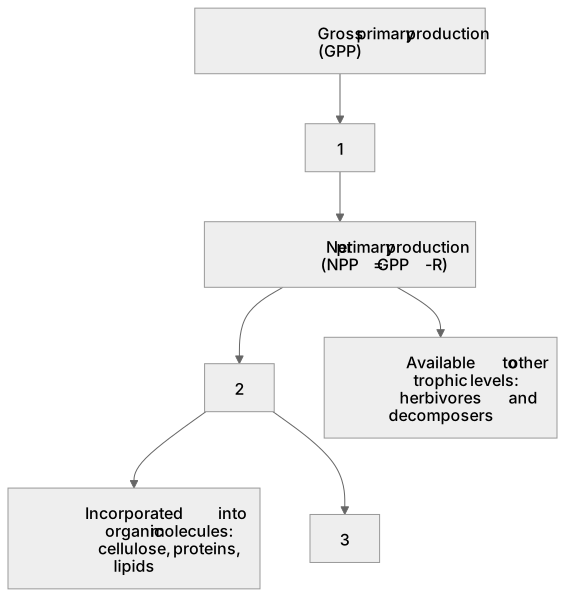
Some boxes have lost their names. Pick the right name for each number.
1Box 1
2Box 2
3Box 3
There is more to this lesson
The full lesson goes on to check your understanding and help you earn the marks. Create a free account to carry on, with your progress saved.
A week of Premium from your first lesson · Then the free plan continues · No card, no charge
Test your understanding of Energy and ecosystems (A-level only): This net primary production is available for plant growth and reproduction.
Active recall beats re-reading. Take an instant quiz now to test what you’ve learned and lock it into long-term memory.
A week of Premium from your first lesson · Then the free plan continues · No card, no charge