AQA · A-Level · Biology
Course version: 7402 · Version from Sept 2016
It is also available to other trophic levels in the ecosystem, such as…
Full specification wording
Energy and ecosystems (A-level only): It is also available to other trophic levels in the ecosystem, such as herbivores and decomposers.
Net primary production is the energy entering the food web, but most never reaches a herbivore's tissue.
Checked against the AQA 7402 specification (opens in a new tab) on .
- Point 9 of 11
- 4 key terms
Study notes
From the checked teaching notes for this specification point.
The idea
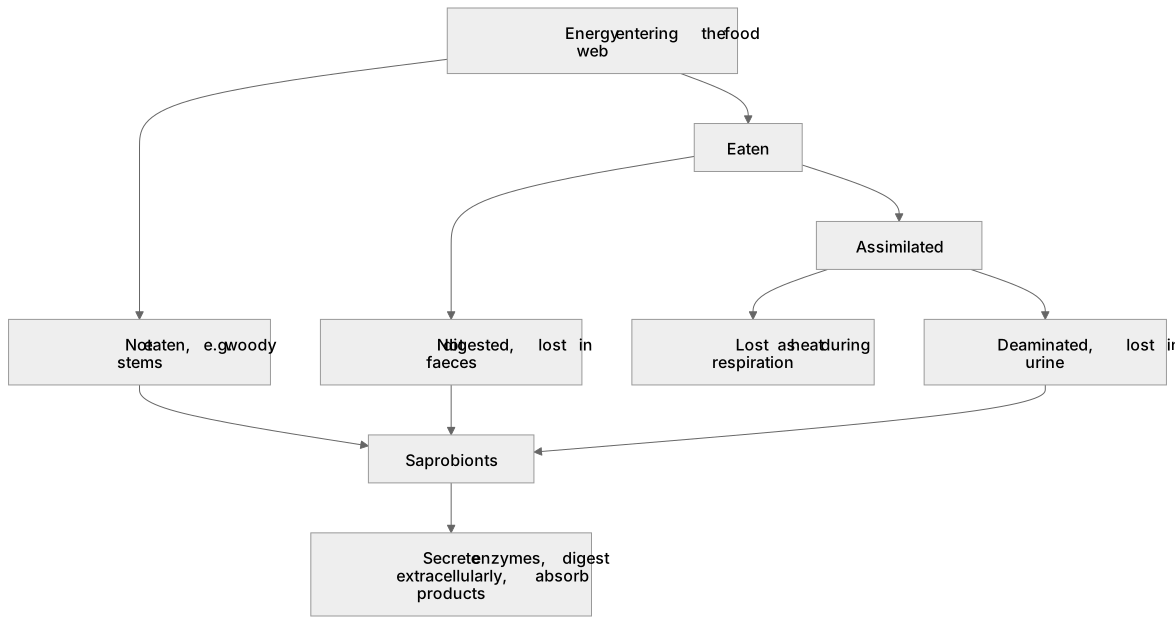
Net primary production is the energy entering the food web, but most never reaches a herbivore's tissue. Some plant material, like woody stems, is not eaten. Not everything eaten is digested, so a large fraction leaves the herbivore in faeces. Of the assimilated energy, much is lost as heat to the surroundings during respiration. Surplus amino acids are deaminated, losing energy in urine. Consequently, transfer between consumer trophic levels is typically around ten per cent, and roughly one per cent from light to producers. While energy is ultimately lost as heat, the chemical energy remaining in dead plants, faeces and urine passes to saprobionts. These secrete enzymes, digest material extracellularly and absorb the products.
What earns the marks
- State that energy is lost between or at each trophic level.
- Name a valid route of energy loss, such as heat from respiration, excretion or faeces.
- Explain that material not eaten, or eaten but not digested, reduces transfer efficiency.
- Describe decomposers or saprobionts obtaining the chemical energy remaining in dead material, faeces and urine.
- Calculate a correct percentage efficiency of energy transfer from given data.
Common mistakes and how to put them right
Writing 'energy is used in respiration' instead of the accurate phrase 'energy is lost as heat during respiration'.
Stating that energy is recycled in the ecosystem.
Put it right: Matter cycles, but energy flows through and is ultimately lost as heat.
Forgetting that inedible parts such as roots and wood are never ingested at all.
Stating only that 'energy is lost' without naming the specific mechanism or where it goes.
Exam tips
- Always use the phrase 'lost as heat from respiration' rather than 'used in respiration' to ensure clarity about energy flow.
- If asked for multiple reasons for inefficient energy transfer, provide distinct routes (e.g., heat from respiration, faeces, and parts not eaten) rather than grouping them.
Try the lesson
The start of the Energy and ecosystems (A-level only): It is also available to other trophic levels in the ecosystem, such as herbivores and decomposers. lesson, made from checked teaching notes for this specification point.
Have a go first
Which group of organisms obtains energy directly from the net primary production of plants?
Listen
Net primary production is the energy entering the food web, but most never reaches a herbivore's tissue. Some plant material, like woody stems, is not eaten. Not everything eaten is digested, so a large fraction leaves the herbivore in faeces. Of the assimilated energy, much is lost as heat to the surroundings during respiration. Surplus amino acids are deaminated, losing energy in urine. Consequently, transfer between consumer trophic levels is typically around ten per cent, and roughly one per cent from light to producers. While energy is ultimately lost as heat, the chemical energy remaining in dead plants, faeces and urine passes to saprobionts. These secrete enzymes, digest material extracellularly and absorb the products. A strong answer earns marks for these points. State that energy is lost between or at each trophic level. Name a valid route of energy loss, such as heat from respiration, excretion or faeces. Explain that material not eaten, or eaten but not digested, reduces transfer efficiency. Describe decomposers or saprobionts obtaining the chemical energy remaining in dead material, faeces and urine. Exam tip: Always use the phrase 'lost as heat from respiration' rather than 'used in respiration' to ensure clarity about energy flow.
See it
Key words
Say what each word means before you turn the card.
heat loss from respiration
Try answering aloud or in your head before turning the card.
faeces and excretion
Try answering aloud or in your head before turning the card.
decomposers and saprobionts
Try answering aloud or in your head before turning the card.
percentage efficiency
Try answering aloud or in your head before turning the card.
See every definition
- heat loss from respiration
- Much of the assimilated energy is lost as heat to the surroundings during respiration.
- faeces and excretion
- Not everything eaten is digested, so a large fraction leaves the herbivore in faeces, and surplus amino acids are deaminated, losing energy in urine.
- decomposers and saprobionts
- The chemical energy remaining in dead plants, faeces and urine passes to these, which secrete enzymes, digest material extracellularly and absorb the products.
- percentage efficiency
- Transfer between consumer trophic levels is typically around ten per cent, and roughly one per cent from light to producers.
Label the diagram
Some boxes have lost their names. Pick the right name for each number.
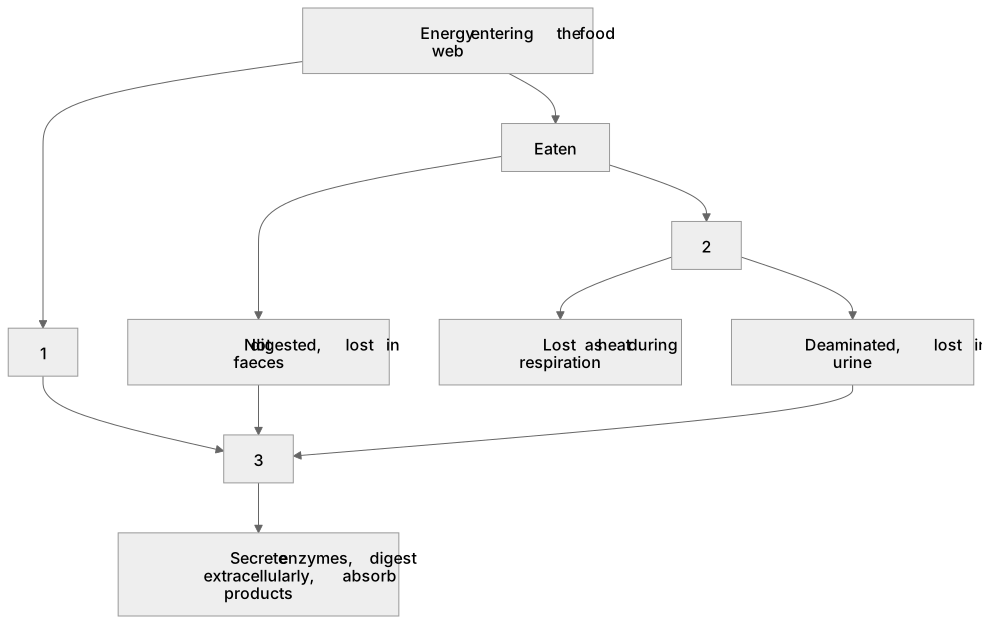
1Box 1
2Box 2
3Box 3
There is more to this lesson
The full lesson goes on to check your understanding and help you earn the marks. Create a free account to carry on, with your progress saved.
A week of Premium from your first lesson · Then the free plan continues · No card, no charge
Test your understanding of Energy and ecosystems (A-level only): It is also available to other trophic levels in the ecosystem, such as herbivores and decomposers.
Active recall beats re-reading. Take an instant quiz now to test what you’ve learned and lock it into long-term memory.
A week of Premium from your first lesson · Then the free plan continues · No card, no charge