AQA · A-Level · Biology
Course version: 7402 · Version from Sept 2016
Evolution as a change in the allele frequencies in a population.
Full specification wording
Evolution may lead to speciation (A-level only): Evolution as a change in the allele frequencies in a population.
At A-level, evolution has a precise definition: a change in the allele frequencies of a population over time.
Checked against the AQA 7402 specification (opens in a new tab) on .
- Point 9 of 14
- 4 key terms
Study notes
From the checked teaching notes for this specification point.
The idea
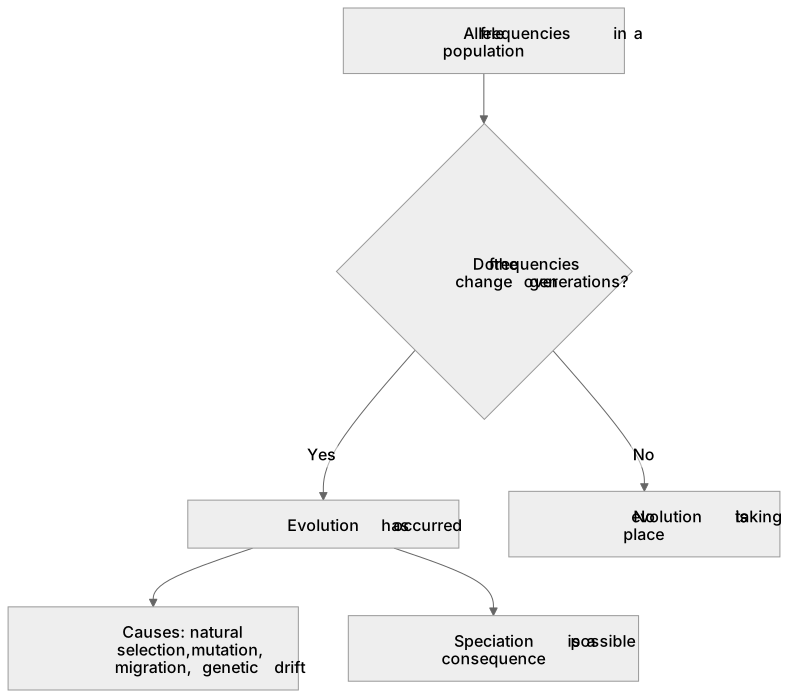
At A-level, evolution has a precise definition: a change in the allele frequencies of a population over time. The definition is deliberately narrow. It concerns populations, not individuals, because an individual's alleles are fixed at fertilisation, so an individual cannot evolve. It concerns frequencies, so evolution has occurred whenever the proportions change, whether the change is an increase or a decrease, and whether or not a new species appears. And it is measurable, which is what makes the Hardy-Weinberg principle useful: if allele frequencies stay constant across generations, no evolution is taking place, and if they change, one of the Hardy-Weinberg conditions has been broken. Natural selection is the most important cause of that change but not the only one, since mutation, migration and genetic drift also alter frequencies.
What earns the marks
- Defining evolution as a change in allele frequency in a population.
- The change being an increase or a decrease, occurring over generations.
- Stating that constant allele frequencies mean no evolution is taking place.
- Naming a cause of the change, such as natural selection, mutation, migration or genetic drift.
Common mistakes and how to put them right
Defining evolution as the formation of new species, which is speciation and only a possible consequence.
Saying that an individual organism evolves during its lifetime.
Describing evolution as organisms getting better, more advanced or more complex.
Writing about a change in the number of organisms rather than in the frequency of an allele.
Leaving out the population, so it is unclear what has changed.
Exam tips
- If a question gives allele frequencies for two generations, comparing them is all the evidence of evolution you need.
- Use the word frequency in the definition, because a change in alleles is too vague to score.
- Link your answer back to the Hardy-Weinberg conditions when the question asks why the frequencies changed.
Try the lesson
The start of the Evolution may lead to speciation (A-level only): Evolution as a change in the allele frequencies in a population. lesson, made from checked teaching notes for this specification point.
Have a go first
Which of the following best describes evolution in terms of population genetics?
Listen
At A-level, evolution has a precise definition: a change in the allele frequencies of a population over time. The definition is deliberately narrow. It concerns populations, not individuals, because an individual's alleles are fixed at fertilisation, so an individual cannot evolve. It concerns frequencies, so evolution has occurred whenever the proportions change, whether the change is an increase or a decrease, and whether or not a new species appears. And it is measurable, which is what makes the Hardy-Weinberg principle useful: if allele frequencies stay constant across generations, no evolution is taking place, and if they change, one of the Hardy-Weinberg conditions has been broken. Natural selection is the most important cause of that change but not the only one, since mutation, migration and genetic drift also alter frequencies. A strong answer earns marks for these points. defining evolution as a change in allele frequency in a population. the change being an increase or a decrease, occurring over generations. stating that constant allele frequencies mean no evolution is taking place. naming a cause of the change, such as natural selection, mutation, migration or genetic drift. Exam tip: If a question gives allele frequencies for two generations, comparing them is all the evidence of evolution you need.
See it
Key words
Say what each word means before you turn the card.
allele frequency change
Try answering aloud or in your head before turning the card.
population level
Try answering aloud or in your head before turning the card.
change over generations
Try answering aloud or in your head before turning the card.
causes of change
Try answering aloud or in your head before turning the card.
See every definition
- allele frequency change
- A change in the proportions of alleles in a population, whether an increase or a decrease, occurring over generations.
- population level
- Evolution concerns populations, not individuals, because an individual's alleles are fixed at fertilisation, so an individual cannot evolve.
- change over generations
- Evolution has occurred whenever the proportions change over generations, whether or not a new species appears.
- causes of change
- Natural selection is the most important cause of that change but not the only one, since mutation, migration and genetic drift also alter frequencies.
There is more to this lesson
The full lesson goes on to check your understanding and help you earn the marks. Create a free account to carry on, with your progress saved.
A week of Premium from your first lesson · Then the free plan continues · No card, no charge
Test your understanding of Evolution may lead to speciation (A-level only): Evolution as a change in the allele frequencies in a population.
Active recall beats re-reading. Take an instant quiz now to test what you’ve learned and lock it into long-term memory.
A week of Premium from your first lesson · Then the free plan continues · No card, no charge