AQA · A-Level · Biology
Course version: 7402 · Version from Sept 2016
Reproductive separation of two populations can result in the accumulation…
Full specification wording
Evolution may lead to speciation (A-level only): Reproductive separation of two populations can result in the accumulation of difference in their gene pools.
Reproductive separation occurs when a barrier prevents gene flow between populations.
Checked against the AQA 7402 specification (opens in a new tab) on .
- Point 10 of 14
- 3 key terms
Study notes
From the checked teaching notes for this specification point.
The idea
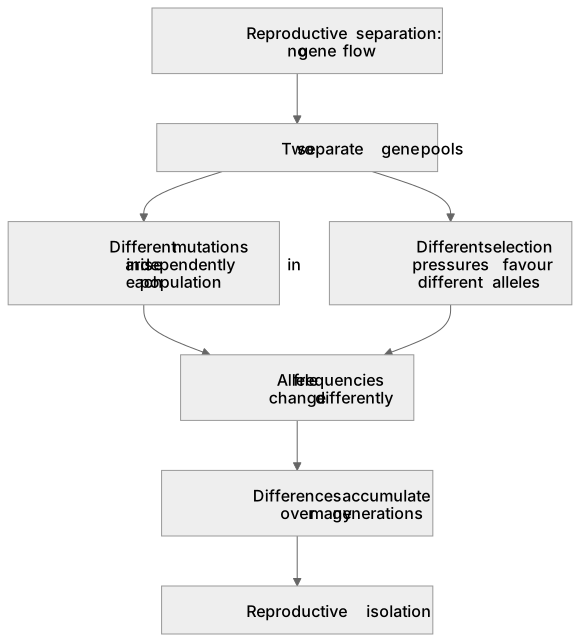
Reproductive separation occurs when a barrier prevents gene flow between populations. This initial separation can be allopatric (geographical barriers like rivers) or sympatric (ecological or behavioural barriers in the same area). Once separated, the two gene pools change independently. Different mutations arise in each population. They face different selection pressures—either from different environments or distinct ecological niches—favouring different alleles. Consequently, allele frequencies diverge. Genetic drift adds further divergence, especially in small populations. Over time, these genetic differences accumulate until the populations can no longer interbreed to produce fertile offspring, resulting in reproductive isolation.
What earns the marks
- Reproductive separation occurs, preventing gene flow between the two populations.
- The two populations now have separate gene pools.
- Different mutations arise independently in each population.
- Different selection pressures act on each population, favouring different alleles.
- Allele frequencies change differently, accumulating differences until reproductive isolation occurs.
Common mistakes and how to put them right
Conflating reproductive separation (the initial barrier to gene flow) with reproductive isolation (the final evolutionary outcome).
Writing 'no inbreeding' instead of 'no interbreeding' between the two populations.
Put it right: The wrong term is rejected.
Assuming genetic differences appear immediately, rather than accumulating over many generations.
Exam tips
- Use the phrases 'no gene flow' or 'separate gene pools', as both are directly creditworthy.
- Order matters: state separation first, then independent mutation and different selection pressures, leading to changed allele frequencies and finally reproductive isolation.
Try the lesson
The start of the Evolution may lead to speciation (A-level only): Reproductive separation of two populations can result in the accumulation of difference in their gene pools. lesson, made from checked teaching notes for this specification point.
Have a go first
What is the direct result of reproductive separation of two populations over many generations?
Listen
Reproductive separation occurs when a barrier prevents gene flow between populations. This initial separation can be allopatric (geographical barriers like rivers) or sympatric (ecological or behavioural barriers in the same area). Once separated, the two gene pools change independently. Different mutations arise in each population. They face different selection pressures—either from different environments or distinct ecological niches—favouring different alleles. Consequently, allele frequencies diverge. Genetic drift adds further divergence, especially in small populations. Over time, these genetic differences accumulate until the populations can no longer interbreed to produce fertile offspring, resulting in reproductive isolation. A strong answer earns marks for these points. Reproductive separation occurs, preventing gene flow between the two populations. The two populations now have separate gene pools. Different mutations arise independently in each population. Different selection pressures act on each population, favouring different alleles. Exam tip: Use the phrases 'no gene flow' or 'separate gene pools', as both are directly creditworthy.
See it
Key words
Say what each word means before you turn the card.
reproductive separation
Try answering aloud or in your head before turning the card.
separate gene pools
Try answering aloud or in your head before turning the card.
different selection pressures
Try answering aloud or in your head before turning the card.
See every definition
- reproductive separation
- A barrier prevents gene flow between populations, and this initial separation can be allopatric or sympatric.
- separate gene pools
- Once separated, the two gene pools change independently of one another.
- different selection pressures
- Each population faces different selection pressures, favouring different alleles.
Label the diagram
Some boxes have lost their names. Pick the right name for each number.
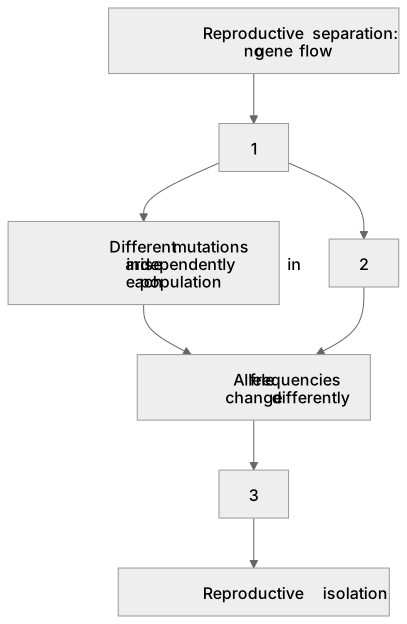
1Box 1
2Box 2
3Box 3
There is more to this lesson
The full lesson goes on to check your understanding and help you earn the marks. Create a free account to carry on, with your progress saved.
A week of Premium from your first lesson · Then the free plan continues · No card, no charge
Test your understanding of Evolution may lead to speciation (A-level only): Reproductive separation of two populations can result in the accumulation of difference in their gene pools.
Active recall beats re-reading. Take an instant quiz now to test what you’ve learned and lock it into long-term memory.
A week of Premium from your first lesson · Then the free plan continues · No card, no charge