AQA · A-Level · Biology
Course version: 7402 · Version from Sept 2016
Individuals within a population of a species may show a wide range of…
Full specification wording
Evolution may lead to speciation (A-level only): Individuals within a population of a species may show a wide range of variation in phenotype.
No two members of a population are identical.
Checked against the AQA 7402 specification (opens in a new tab) on .
- Point 1 of 14
- 4 key terms
Study notes
From the checked teaching notes for this specification point.
The idea
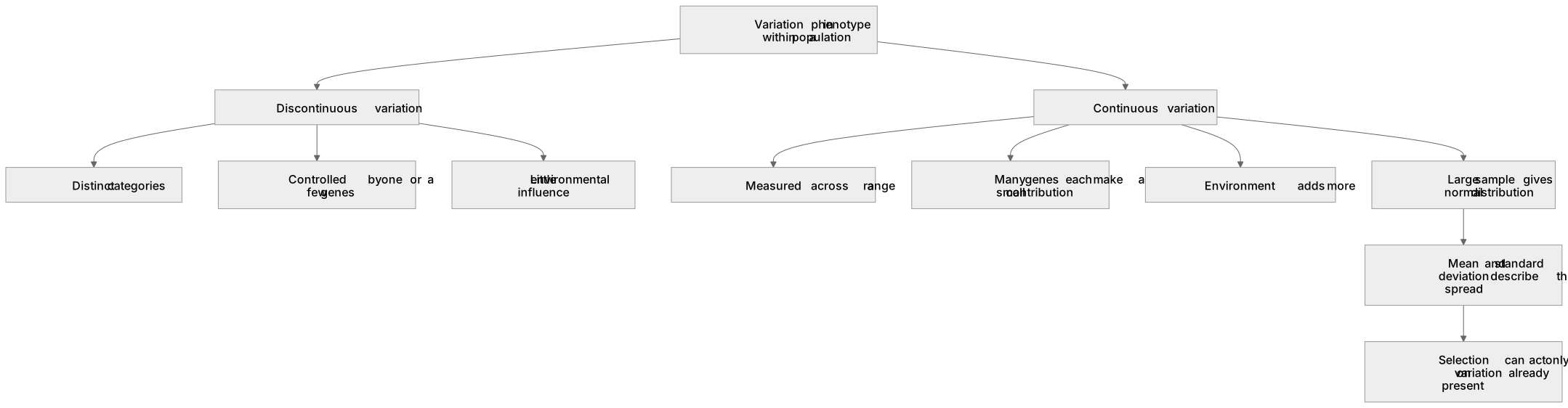
No two members of a population are identical. Some characteristics vary in discrete categories, such as blood group or flower colour in a species with two pigment alleles, and this discontinuous variation is usually controlled by one or a few genes with little environmental influence. Others, such as height, body mass or the concentration of a chemical a plant produces, vary continuously across a range, because many genes each make a small contribution and the environment adds more. Plotting a continuous characteristic for a large sample gives a normal distribution, with most individuals near the mean and few at the extremes, and the standard deviation measures how widely they are spread around that mean. This spread is the raw material of natural selection, because selection can only favour phenotypes that already exist in the population.
What earns the marks
- Distinguishing continuous variation, measured across a range, from discontinuous variation in distinct categories.
- Stating that a continuously varying characteristic is influenced by many genes and by the environment.
- Describing the spread of a characteristic using the mean and the standard deviation.
- Recognising that selection can act only on variation already present in the population.
Common mistakes and how to put them right
Explaining variation as due to mutation alone, with no mention of meiosis, random fertilisation or the environment.
Treating a difference between two sample means as real without checking whether the standard deviations overlap.
Saying an organism changes its phenotype to suit its environment, which describes the individual rather than variation within a population.
Confusing variation within a population with variation between species.
Describing a bar chart of discontinuous data as a normal distribution.
Exam tips
- If a figure shows error bars, say whether they overlap before you claim a difference between the groups.
- Name the type of variation and then say what causes it, because both halves are usually needed for the marks.
- Random sampling is worth naming whenever you are asked how to measure variation in a population.
Try the lesson
The start of the Evolution may lead to speciation (A-level only): Individuals within a population of a species may show a wide range of variation in phenotype. lesson, made from checked teaching notes for this specification point.
Have a go first
What term describes the differences in phenotype shown by individuals within a single population of a species?
Listen
No two members of a population are identical. Some characteristics vary in discrete categories, such as blood group or flower colour in a species with two pigment alleles, and this discontinuous variation is usually controlled by one or a few genes with little environmental influence. Others, such as height, body mass or the concentration of a chemical a plant produces, vary continuously across a range, because many genes each make a small contribution and the environment adds more. Plotting a continuous characteristic for a large sample gives a normal distribution, with most individuals near the mean and few at the extremes, and the standard deviation measures how widely they are spread around that mean. This spread is the raw material of natural selection, because selection can only favour phenotypes that already exist in the population. A strong answer earns marks for these points. distinguishing continuous variation, measured across a range, from discontinuous variation in distinct categories. stating that a continuously varying characteristic is influenced by many genes and by the environment. describing the spread of a characteristic using the mean and the standard deviation. recognising that selection can act only on variation already present in the population. Exam tip: If a figure shows error bars, say whether they overlap before you claim a difference between the groups.
See it
Key words
Say what each word means before you turn the card.
continuous variation
Try answering aloud or in your head before turning the card.
discontinuous variation
Try answering aloud or in your head before turning the card.
normal distribution
Try answering aloud or in your head before turning the card.
standard deviation
Try answering aloud or in your head before turning the card.
See every definition
- continuous variation
- A characteristic that varies across a range because many genes each make a small contribution and the environment adds more.
- discontinuous variation
- Variation in discrete categories, usually controlled by one or a few genes with little environmental influence.
- normal distribution
- The result of plotting a continuous characteristic for a large sample, with most individuals near the mean and few at the extremes.
- standard deviation
- A measure of how widely individuals are spread around the mean.
Label the diagram
Some boxes have lost their names. Pick the right name for each number.
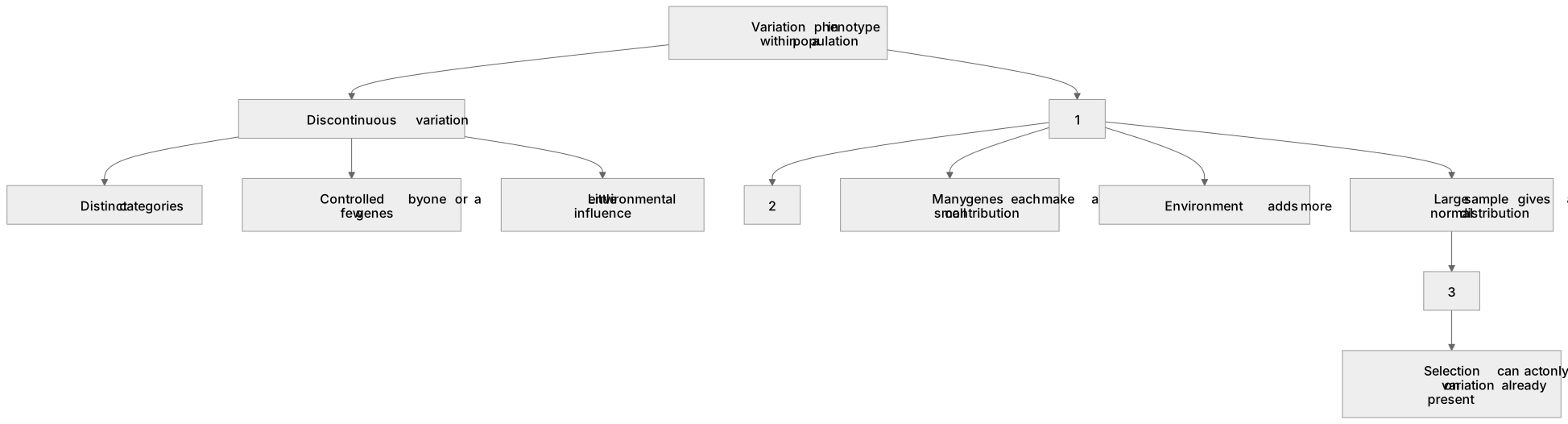
1Box 1
2Box 2
3Box 3
There is more to this lesson
The full lesson goes on to check your understanding and help you earn the marks. Create a free account to carry on, with your progress saved.
A week of Premium from your first lesson · Then the free plan continues · No card, no charge
Test your understanding of Evolution may lead to speciation (A-level only): Individuals within a population of a species may show a wide range of variation in phenotype.
Active recall beats re-reading. Take an instant quiz now to test what you’ve learned and lock it into long-term memory.
A week of Premium from your first lesson · Then the free plan continues · No card, no charge