AQA · A-Level · Biology
Course version: 7402 · Version from Sept 2016
This is due to genetic and environmental factors.
Full specification wording
Evolution may lead to speciation (A-level only): This is due to genetic and environmental factors.
Phenotypic variation has two sources.
Checked against the AQA 7402 specification (opens in a new tab) on .
- Point 2 of 14
- 3 key terms
Study notes
From the checked teaching notes for this specification point.
The idea
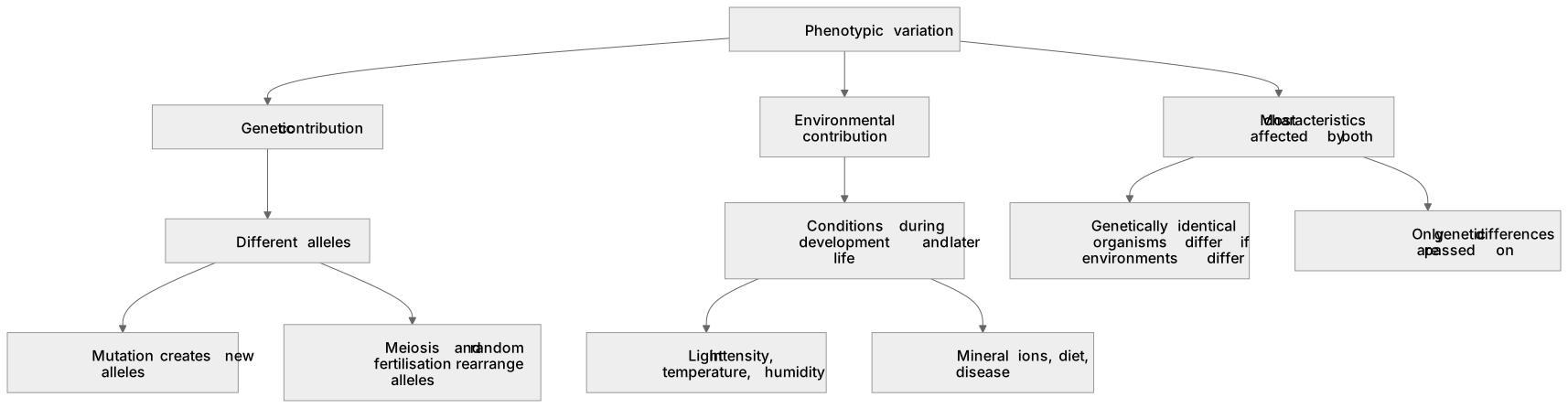
Phenotypic variation has two sources. The genetic contribution comes from individuals carrying different alleles: mutation creates new alleles, while meiosis and random fertilisation shuffle existing alleles into new combinations. The environmental contribution comes from conditions during development and later life, including light intensity, temperature, humidity, the supply of mineral ions, diet and disease. Most characteristics are affected by both, so two plants from one clone, genetically identical, reach different heights in shade and in full sun, and two rats of the same genotype reach different body masses on diets containing different amounts of fat. Separating the two sources is the point of many experiments: use genetically identical organisms and vary the environment, or hold the environment constant and compare genotypes.
What earns the marks
- Genetic variation arising from different alleles, produced by mutation and rearranged by meiosis and random fertilisation.
- A named environmental or abiotic factor, such as temperature, light intensity or humidity.
- Explaining that genetically identical organisms can still differ if their environments differ.
- Stating that only genetic differences are passed on to offspring.
Common mistakes and how to put them right
Offering different altitudes or different habitats as the environmental factor, when the mark requires the factor itself, such as temperature or humidity.
Claiming that an environmentally caused characteristic can be inherited.
Naming mutation as the only genetic source and forgetting meiosis and random fertilisation.
Saying the environment changes the genes rather than affecting how they are expressed.
Giving a factor without saying in which direction it affects the characteristic.
Exam tips
- Whenever you write different environments, add the specific abiotic factor immediately afterwards.
- In an experiment question, say what you would keep constant, because that is how the two sources of variation are separated.
- Diet, disease and competition all count as environmental factors and are often the ones the data point towards.
Try the lesson
The start of the Evolution may lead to speciation (A-level only): This is due to genetic and environmental factors. lesson, made from checked teaching notes for this specification point.
Have a go first
Which two factors together cause the variation in phenotype seen within a population?
Listen
Phenotypic variation has two sources. The genetic contribution comes from individuals carrying different alleles: mutation creates new alleles, while meiosis and random fertilisation shuffle existing alleles into new combinations. The environmental contribution comes from conditions during development and later life, including light intensity, temperature, humidity, the supply of mineral ions, diet and disease. Most characteristics are affected by both, so two plants from one clone, genetically identical, reach different heights in shade and in full sun, and two rats of the same genotype reach different body masses on diets containing different amounts of fat. Separating the two sources is the point of many experiments: use genetically identical organisms and vary the environment, or hold the environment constant and compare genotypes. A strong answer earns marks for these points. genetic variation arising from different alleles, produced by mutation and rearranged by meiosis and random fertilisation. a named environmental or abiotic factor, such as temperature, light intensity or humidity. explaining that genetically identical organisms can still differ if their environments differ. stating that only genetic differences are passed on to offspring. Exam tip: Whenever you write different environments, add the specific abiotic factor immediately afterwards.
See it
Key words
Say what each word means before you turn the card.
genetic variation
Try answering aloud or in your head before turning the card.
environmental factors
Try answering aloud or in your head before turning the card.
inherited and non-inherited variation
Try answering aloud or in your head before turning the card.
See every definition
- genetic variation
- Arises from individuals carrying different alleles, produced by mutation and rearranged by meiosis and random fertilisation.
- environmental factors
- Conditions during development and later life, including light intensity, temperature, humidity, the supply of mineral ions, diet and disease.
- inherited and non-inherited variation
- Only genetic differences are passed on to offspring, whereas environmentally caused characteristics cannot be inherited.
Label the diagram
Some boxes have lost their names. Pick the right name for each number.
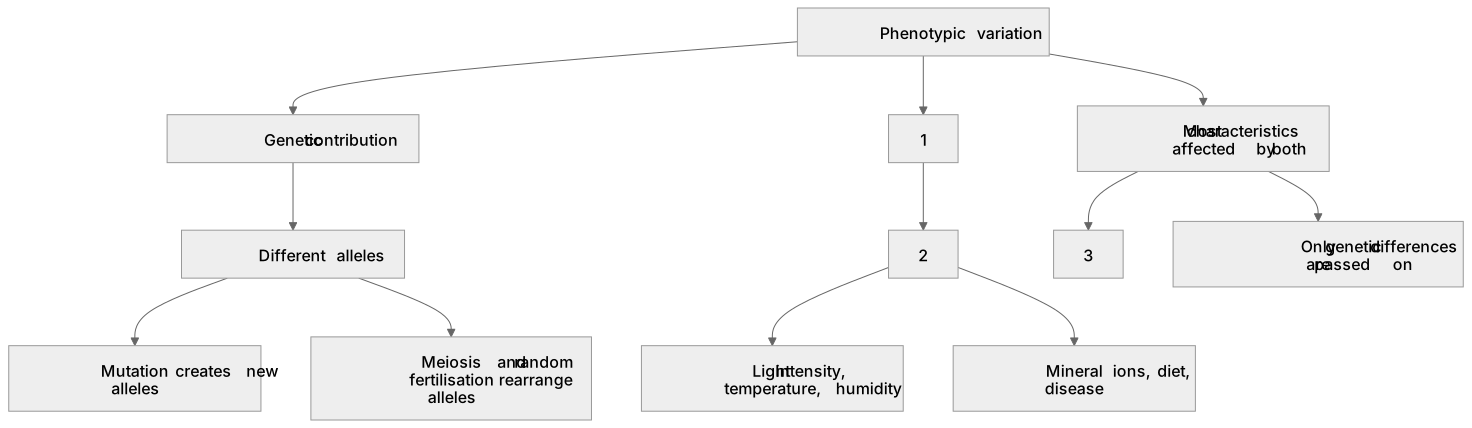
1Box 1
2Box 2
3Box 3
There is more to this lesson
The full lesson goes on to check your understanding and help you earn the marks. Create a free account to carry on, with your progress saved.
A week of Premium from your first lesson · Then the free plan continues · No card, no charge
Test your understanding of Evolution may lead to speciation (A-level only): This is due to genetic and environmental factors.
Active recall beats re-reading. Take an instant quiz now to test what you’ve learned and lock it into long-term memory.
A week of Premium from your first lesson · Then the free plan continues · No card, no charge