AQA · A-Level · Biology
Course version: 7402 · Version from Sept 2016
Predation, disease and competition for the means of survival result in…
Full specification wording
Evolution may lead to speciation (A-level only): Predation, disease and competition for the means of survival result in differential survival and reproduction, ie natural selection.
A selection pressure is any factor that makes some phenotypes more likely than others to survive and reproduce.
Checked against the AQA 7402 specification (opens in a new tab) on .
- Point 5 of 14
- 4 key terms
Study notes
From the checked teaching notes for this specification point.
The idea
A selection pressure is any factor that makes some phenotypes more likely than others to survive and reproduce. Predation removes the individuals easiest to catch, so alleles for better camouflage, speed or vigilance become more common in the prey population. Disease removes the individuals whose immune systems cannot cope, so alleles giving resistance are favoured. For example, in regions where malaria is common, the sickle-cell allele persists because heterozygotes have some resistance to the parasite, not because of a general immune-system improvement. Competition, whether between members of the same species or between species, means that when food, water, light, mineral ions, territory or mates are in short supply the individuals best able to obtain them survive and breed. None of these pressures changes an organism during its life; they change which organisms leave offspring.
What earns the marks
- Naming the selection pressure acting on the population, such as predation, a named pathogen or competition for a named resource.
- Variation already existing in the population, caused by mutation.
- Individuals with the advantageous phenotype being more likely to survive.
- Those survivors reproducing and passing on the advantageous allele.
- The frequency of the advantageous allele increasing over generations.
Common mistakes and how to put them right
Writing that organisms adapt, get stronger or become resistant during their lifetime, instead of the population changing over generations.
Saying the fittest survive without saying which characteristic makes them fitter in that particular environment.
Referring to immunity when the answer requires a resistance allele.
Leaving out reproduction, so the advantage never reaches the next generation.
Naming competition without naming the resource being competed for.
Exam tips
- Give the selection pressure by name, then the advantageous phenotype, then survival, then reproduction, then allele frequency.
- Start with variation that already exists, because natural selection explanations normally begin there.
- Use more likely to rather than will, because selection is about probability, not certainty.
- Name the specific resource or pathogen so the selection pressure is clearly identified.
Try the lesson
The start of the Evolution may lead to speciation (A-level only): Predation, disease and competition for the means of survival result in differential survival and reproduction, ie natural selection. lesson, made from checked teaching notes for this specification point.
Have a go first
Which process describes the differential survival and reproduction of organisms as a result of predation, disease and competition?
Listen
A selection pressure is any factor that makes some phenotypes more likely than others to survive and reproduce. Predation removes the individuals easiest to catch, so alleles for better camouflage, speed or vigilance become more common in the prey population. Disease removes the individuals whose immune systems cannot cope, so alleles giving resistance are favoured. For example, in regions where malaria is common, the sickle-cell allele persists because heterozygotes have some resistance to the parasite, not because of a general immune-system improvement. Competition, whether between members of the same species or between species, means that when food, water, light, mineral ions, territory or mates are in short supply the individuals best able to obtain them survive and breed. None of these pressures changes an organism during its life; they change which organisms leave offspring. A strong answer earns marks for these points. naming the selection pressure acting on the population, such as predation, a named pathogen or competition for a named resource. variation already existing in the population, caused by mutation. individuals with the advantageous phenotype being more likely to survive. those survivors reproducing and passing on the advantageous allele. Exam tip: Give the selection pressure by name, then the advantageous phenotype, then survival, then reproduction, then allele frequency.
See it
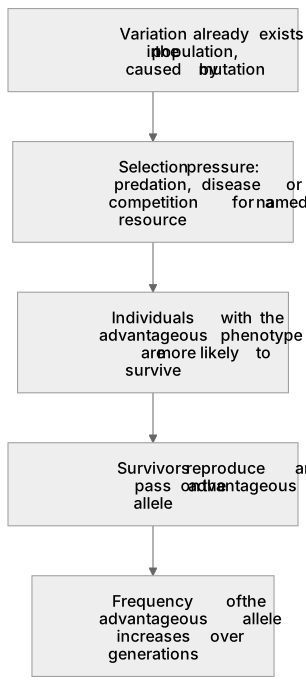
Put it in order
Put these steps in the order they happen.
- 1. Selection pressure: predation, disease or competition for a named resource
- 2. Individuals with the advantageous phenotype are more likely to survive
- 3. Variation already exists in the population, caused by mutation
- 4. Frequency of the advantageous allele increases over generations
- 5. Survivors reproduce and pass on the advantageous allele
Key words
Say what each word means before you turn the card.
selection pressure
Try answering aloud or in your head before turning the card.
predation
Try answering aloud or in your head before turning the card.
disease
Try answering aloud or in your head before turning the card.
competition for resources
Try answering aloud or in your head before turning the card.
See every definition
- selection pressure
- Any factor that makes some phenotypes more likely than others to survive and reproduce.
- predation
- Removes the individuals easiest to catch, so alleles for better camouflage, speed or vigilance become more common in the prey population.
- disease
- Removes the individuals whose immune systems cannot cope, so alleles giving resistance are favoured.
- competition for resources
- When food, water, light, mineral ions, territory or mates are in short supply, the individuals best able to obtain them survive and breed.
Label the diagram
Some boxes have lost their names. Pick the right name for each number.
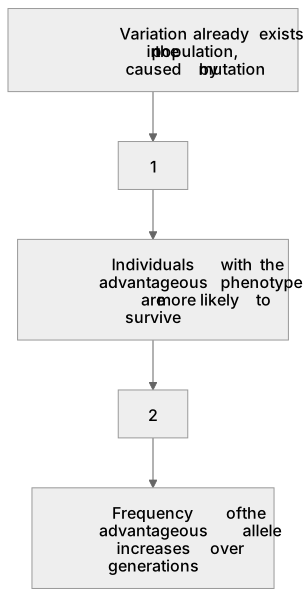
1Box 1
2Box 2
There is more to this lesson
The full lesson goes on to check your understanding and help you earn the marks. Create a free account to carry on, with your progress saved.
A week of Premium from your first lesson · Then the free plan continues · No card, no charge
Test your understanding of Evolution may lead to speciation (A-level only): Predation, disease and competition for the means of survival result in differential survival and reproduction, ie natural selection.
Active recall beats re-reading. Take an instant quiz now to test what you’ve learned and lock it into long-term memory.
A week of Premium from your first lesson · Then the free plan continues · No card, no charge