AQA · A-Level · Biology
Course version: 7402 · Version from Sept 2016
Meiosis and the random fertilisation of gametes during sexual reproduction…
Full specification wording
Evolution may lead to speciation (A-level only): Meiosis and the random fertilisation of gametes during sexual reproduction produce further genetic variation.
Meiosis and fertilisation do not make new alleles; they make new combinations of the alleles already present, and three processes do the work.
Checked against the AQA 7402 specification (opens in a new tab) on .
- Point 4 of 14
- 3 key terms
Study notes
From the checked teaching notes for this specification point.
The idea
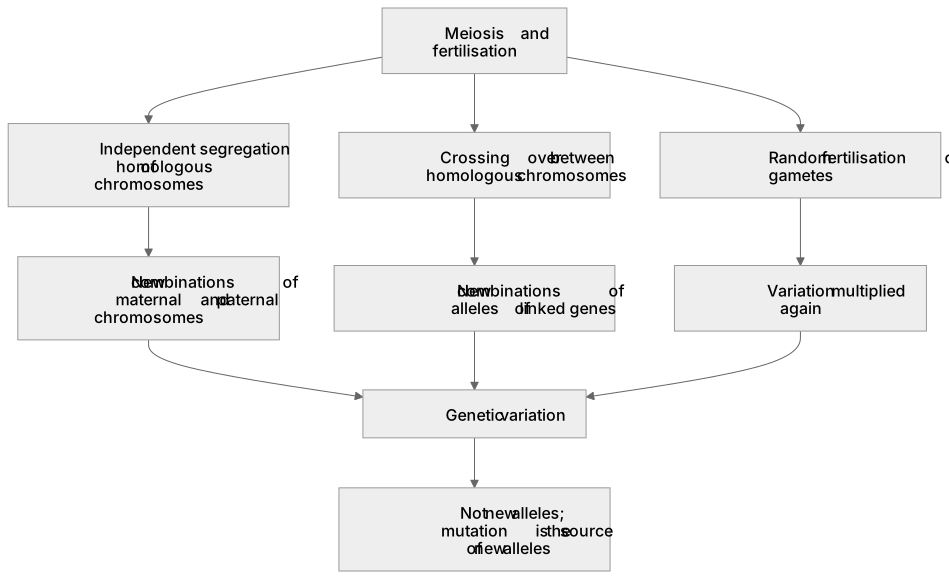
Meiosis and fertilisation do not make new alleles; they make new combinations of the alleles already present, and three processes do the work. In metaphase I, homologous chromosome pairs line up on the equator and the orientation of each pair is independent of every other pair, so independent segregation sends a random mixture of maternal and paternal chromosomes into each daughter cell; with 23 pairs that alone gives 2^23 = 8,388,608 combinations. In prophase I, homologous chromosomes form bivalents and crossing over exchanges sections of chromatid at the chiasmata, producing chromosomes that carry new combinations of alleles of linked genes. Then random fertilisation means that any one of the genetically different male gametes can fuse with any one of the female gametes, multiplying the variation again.
What earns the marks
- Independent segregation, or random assortment, of homologous chromosomes.
- Crossing over between homologous chromosomes, or within a bivalent.
- Random fertilisation, or random fusion, of gametes.
- Stating that these processes produce new combinations of alleles, or of maternal and paternal chromosomes.
- Distinguishing these processes from mutation, which is the source of new alleles.
Common mistakes and how to put them right
Writing random mating when the marking point is the random fertilisation of gametes.
Saying meiosis creates new alleles, when it only recombines alleles that already exist.
Describing crossing over as occurring between sister chromatids rather than between homologous chromosomes.
Naming the processes without saying what they produce, so the new combinations of alleles mark is lost.
Placing independent segregation in mitosis, or in meiosis II.
Exam tips
- Clearly list the three named processes and explicitly state their outcome to ensure all aspects of the mechanism are covered.
- Write homologous every time you mention the chromosome pairs, because that word is needed for precision.
- If the question has already given you mutation, do not repeat it; it is asking for the other processes.
- Show the calculation 2^23 = 8,388,608 if asked to explain the number of combinations.
Try the lesson
The start of the Evolution may lead to speciation (A-level only): Meiosis and the random fertilisation of gametes during sexual reproduction produce further genetic variation. lesson, made from checked teaching notes for this specification point.
Have a go first
Which process during meiosis produces new combinations of alleles on a single chromosome?
Listen
Meiosis and fertilisation do not make new alleles; they make new combinations of the alleles already present, and three processes do the work. In metaphase I, homologous chromosome pairs line up on the equator and the orientation of each pair is independent of every other pair, so independent segregation sends a random mixture of maternal and paternal chromosomes into each daughter cell; with 23 pairs that alone gives 2^23 = 8,388,608 combinations. In prophase I, homologous chromosomes form bivalents and crossing over exchanges sections of chromatid at the chiasmata, producing chromosomes that carry new combinations of alleles of linked genes. Then random fertilisation means that any one of the genetically different male gametes can fuse with any one of the female gametes, multiplying the variation again. A strong answer earns marks for these points. independent segregation, or random assortment, of homologous chromosomes. crossing over between homologous chromosomes, or within a bivalent. random fertilisation, or random fusion, of gametes. stating that these processes produce new combinations of alleles, or of maternal and paternal chromosomes. Exam tip: Clearly list the three named processes and explicitly state their outcome to ensure all aspects of the mechanism are covered.
See it
Key words
Say what each word means before you turn the card.
crossing over
Try answering aloud or in your head before turning the card.
random fertilisation
Try answering aloud or in your head before turning the card.
new combinations of alleles
Try answering aloud or in your head before turning the card.
See every definition
- crossing over
- In prophase I, homologous chromosomes form bivalents and sections of chromatid are exchanged at the chiasmata, producing chromosomes that carry new combinations of alleles of linked genes.
- random fertilisation
- Any one of the genetically different male gametes can fuse with any one of the female gametes, multiplying the variation again.
- new combinations of alleles
- Meiosis and fertilisation do not make new alleles; they make new combinations of the alleles already present.
Label the diagram
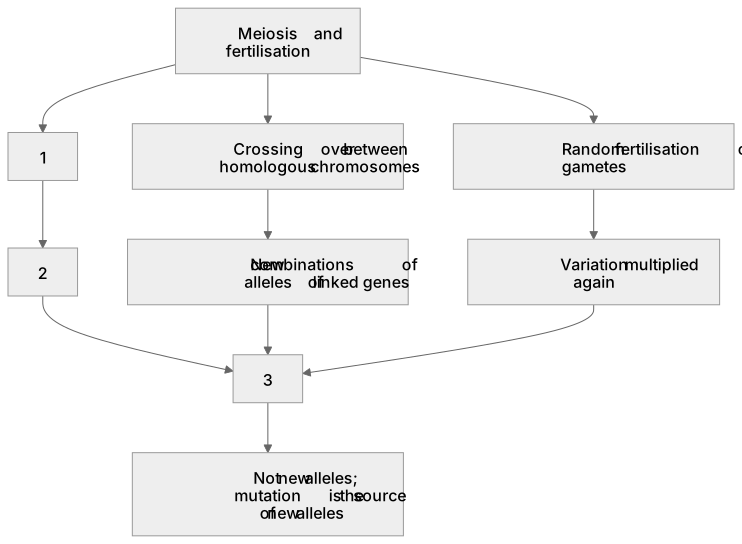
Some boxes have lost their names. Pick the right name for each number.
1Box 1
2Box 2
3Box 3
There is more to this lesson
The full lesson goes on to check your understanding and help you earn the marks. Create a free account to carry on, with your progress saved.
A week of Premium from your first lesson · Then the free plan continues · No card, no charge
Test your understanding of Evolution may lead to speciation (A-level only): Meiosis and the random fertilisation of gametes during sexual reproduction produce further genetic variation.
Active recall beats re-reading. Take an instant quiz now to test what you’ve learned and lock it into long-term memory.
A week of Premium from your first lesson · Then the free plan continues · No card, no charge