AQA · A-Level · Biology
Course version: 7402 · Version from Sept 2016
Structural and functional compromises between the opposing needs for…
Full specification wording
Gas exchange: Structural and functional compromises between the opposing needs for efficient gas exchange and the limitation of water loss shown by terrestrial insects and xerophytic plants.
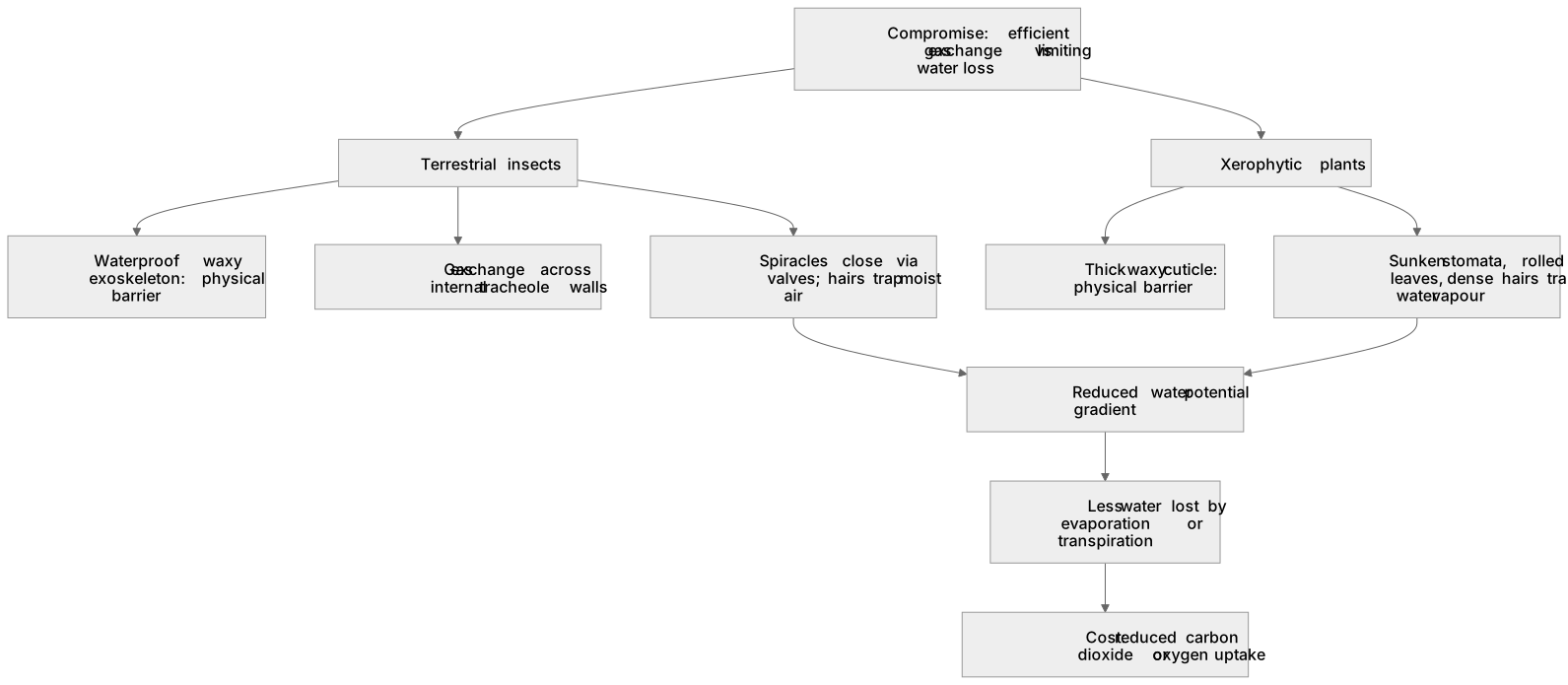
Terrestrial organisms face a compromise: surfaces thin and permeable enough for efficient gas exchange also allow water evaporation.
Checked against the AQA 7402 specification (opens in a new tab) on .
- Point 2 of 7
- 3 key terms
Study notes
From the checked teaching notes for this specification point.
The idea
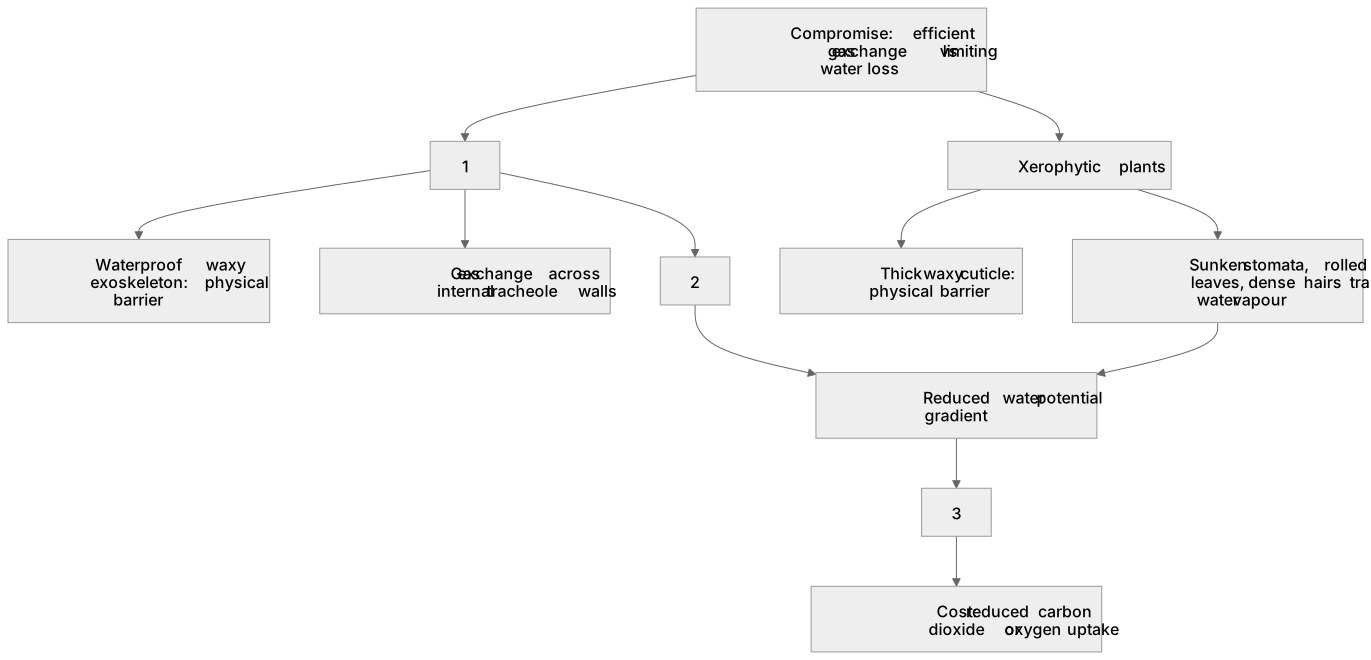
Terrestrial organisms face a compromise: surfaces thin and permeable enough for efficient gas exchange also allow water evaporation. Insects have a waterproof waxy exoskeleton acting as a physical barrier. Their gas exchange occurs across internal tracheole walls, reducing exposure to dry air. Spiracles can close via valves and have hairs that trap moist air, reducing the water potential gradient. Xerophytes feature a thick waxy cuticle to physically reduce evaporation. Additionally, adaptations like sunken stomata, rolled leaves, and dense hairs trap water vapour. This lowers the water potential gradient between the leaf air spaces and the atmosphere, limiting water loss but at the cost of reduced carbon dioxide uptake for photosynthesis.
What earns the marks
- Name specific adaptations correctly, such as sunken stomata, rolled leaves, hairs, a thick waxy cuticle, or spiracle valves.
- Distinguish between adaptations that act as a physical waterproof barrier (waxy cuticle) and those that trap water vapour (sunken stomata, rolled leaves, hairs).
- Explain the mechanism for trapping vapour: it reduces the water potential gradient between the inside of the leaf or spiracle and the outside air.
- State the consequence of the reduced gradient: less water is lost by evaporation in insects or transpiration in plants.
- Identify the functional compromise: adaptations that restrict water loss also reduce the uptake of carbon dioxide or oxygen.
Common mistakes and how to put them right
Saying rolled leaves or hairs 'stop water escaping', rather than explaining they trap water vapour and reduce the water potential gradient.
Stating that a thick waxy cuticle traps water vapour.
Put it right: It actually acts as a physical waterproof barrier to reduce evaporation.
Claiming xerophytes lose no water at all, or that their stomata never open.
Leaving out the compromise entirely, failing to mention the negative effect on gas exchange (e.g., reduced carbon dioxide uptake).
Exam tips
- Structure adaptation answers in three parts: the feature, its effect on the water potential gradient or barrier function, and the cost to gas exchange.
- Be specific about which stomata close and when; stating 'the plant closes its stomata' without a condition rarely provides enough detail.
Try the lesson
The start of the Gas exchange: Structural and functional compromises between the opposing needs for efficient gas exchange and the limitation of water loss shown by terrestrial insects and xerophytic plants. lesson, made from checked teaching notes for this specification point.
Have a go first
A terrestrial insect such as a locust lives in a dry environment. Which feature of its gas exchange system reduces water loss while still allowing gas exchange?
Listen
Terrestrial organisms face a compromise: surfaces thin and permeable enough for efficient gas exchange also allow water evaporation. Insects have a waterproof waxy exoskeleton acting as a physical barrier. Their gas exchange occurs across internal tracheole walls, reducing exposure to dry air. Spiracles can close via valves and have hairs that trap moist air, reducing the water potential gradient. Xerophytes feature a thick waxy cuticle to physically reduce evaporation. Additionally, adaptations like sunken stomata, rolled leaves, and dense hairs trap water vapour. This lowers the water potential gradient between the leaf air spaces and the atmosphere, limiting water loss but at the cost of reduced carbon dioxide uptake for photosynthesis. A strong answer earns marks for these points. Name specific adaptations correctly, such as sunken stomata, rolled leaves, hairs, a thick waxy cuticle, or spiracle valves. Distinguish between adaptations that act as a physical waterproof barrier (waxy cuticle) and those that trap water vapour (sunken stomata, rolled leaves, hairs). Explain the mechanism for trapping vapour: it reduces the water potential gradient between the inside of the leaf or spiracle and the outside air. State the consequence of the reduced gradient: less water is lost by evaporation in insects or transpiration in plants. Exam tip: Structure adaptation answers in three parts: the feature, its effect on the water potential gradient or barrier function, and the cost to gas exchange.
See it
Key words
Say what each word means before you turn the card.
sunken stomata and rolled leaves
Try answering aloud or in your head before turning the card.
waxy cuticle
Try answering aloud or in your head before turning the card.
spiracles and valves
Try answering aloud or in your head before turning the card.
See every definition
- sunken stomata and rolled leaves
- Adaptations that trap water vapour, lowering the water potential gradient between the leaf air spaces and the atmosphere, limiting water loss but at the cost of reduced carbon dioxide uptake for photosynthesis.
- waxy cuticle
- A thick physical waterproof barrier that physically reduces evaporation, rather than trapping water vapour.
- spiracles and valves
- Structures that can close via valves and have hairs that trap moist air, reducing the water potential gradient.
Label the diagram
Some boxes have lost their names. Pick the right name for each number.
1Box 1
2Box 2
3Box 3
There is more to this lesson
The full lesson goes on to check your understanding and help you earn the marks. Create a free account to carry on, with your progress saved.
A week of Premium from your first lesson · Then the free plan continues · No card, no charge
Test your understanding of Gas exchange: Structural and functional compromises between the opposing needs for efficient gas exchange and the limitation of water loss shown by terrestrial insects and xerophytic plants.
Active recall beats re-reading. Take an instant quiz now to test what you’ve learned and lock it into long-term memory.
A week of Premium from your first lesson · Then the free plan continues · No card, no charge