AQA · A-Level · Biology
Course version: 7402 · Version from Sept 2016
The gross structure of the human gas exchange system limited to the…
Full specification wording
Gas exchange: The gross structure of the human gas exchange system limited to the alveoli, bronchioles, bronchi, trachea and lungs.
Air enters the trachea, a wide tube supported by C-shaped cartilage rings that prevent collapse.
Checked against the AQA 7402 specification (opens in a new tab) on .
- Point 3 of 7
- 4 key terms
Study notes
From the checked teaching notes for this specification point.
The idea
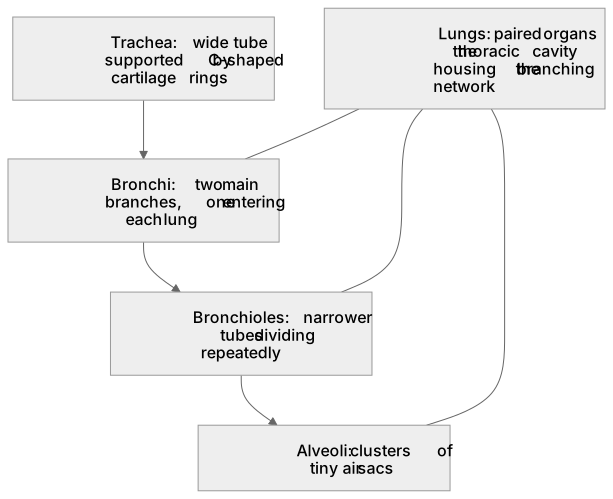
Air enters the trachea, a wide tube supported by C-shaped cartilage rings that prevent collapse. The trachea bifurcates into two bronchi, one entering each lung. Inside the lungs, these bronchi divide repeatedly into a network of narrower tubes called bronchioles. The bronchioles terminate in clusters of tiny air sacs known as alveoli, which provide a massive surface area for gas exchange. The lungs are the paired organs situated within the thoracic cavity that house this branching network. This specification point is strictly limited to the gross macroscopic structure and the correct sequence of these named parts. Microscopic histology and ventilation mechanisms are covered elsewhere.
What earns the marks
- Award credit for correctly sequencing the macroscopic pathway of air: trachea, bronchi, bronchioles, alveoli.
- Award credit for identifying the trachea as a tube supported by incomplete or C-shaped rings of cartilage.
- Award credit for describing bronchi as the two main branches of the trachea that lead into the lungs.
- Award credit for describing bronchioles as the highly branched, narrower tubes connecting bronchi to alveoli.
- Award credit for identifying alveoli as tiny air sacs clustered at the ends of bronchioles.
- Award credit for stating that the lungs are the paired organs within the thoracic cavity containing the branching network of bronchi, bronchioles and alveoli.
Common mistakes and how to put them right
Putting bronchioles before bronchi in the sequence.
Put it right: The correct order is trachea, bronchi, bronchioles, alveoli.
Stating that all bronchi are outside the lung tissue.
Put it right: While the primary bronchi begin outside, they continue to branch inside the lungs as intrapulmonary bronchi.
Including histological details like ciliated epithelium or goblet cells when asked specifically for gross structure.
Put it right: Stick to macroscopic features like cartilage rings and the branching network.
Describing the mechanism of breathing (ventilation) when the question asks only for gross structure.
Put it right: These belong to a separate specification point.
Exam tips
- Learn the exact sequence of structures from the trachea to the alveoli, as sequencing questions are common.
- Pay attention to the term 'gross structure' in the prompt; do not waste time describing cellular details or ventilation mechanisms unless explicitly asked.
Try the lesson
The start of the Gas exchange: The gross structure of the human gas exchange system limited to the alveoli, bronchioles, bronchi, trachea and lungs. lesson, made from checked teaching notes for this specification point.
Have a go first
Which structure of the human gas exchange system carries air from the trachea directly into a lung?
Listen
Air enters the trachea, a wide tube supported by C-shaped cartilage rings that prevent collapse. The trachea bifurcates into two bronchi, one entering each lung. Inside the lungs, these bronchi divide repeatedly into a network of narrower tubes called bronchioles. The bronchioles terminate in clusters of tiny air sacs known as alveoli, which provide a massive surface area for gas exchange. The lungs are the paired organs situated within the thoracic cavity that house this branching network. This specification point is strictly limited to the gross macroscopic structure and the correct sequence of these named parts. Microscopic histology and ventilation mechanisms are covered elsewhere. A strong answer earns marks for these points. Award credit for correctly sequencing the macroscopic pathway of air: trachea, bronchi, bronchioles, alveoli. Award credit for identifying the trachea as a tube supported by incomplete or C-shaped rings of cartilage. Award credit for describing bronchi as the two main branches of the trachea that lead into the lungs. Award credit for describing bronchioles as the highly branched, narrower tubes connecting bronchi to alveoli. Exam tip: Learn the exact sequence of structures from the trachea to the alveoli, as sequencing questions are common.
See it
Key words
Say what each word means before you turn the card.
Trachea
Try answering aloud or in your head before turning the card.
Bronchioles
Try answering aloud or in your head before turning the card.
Alveoli
Try answering aloud or in your head before turning the card.
Lungs
Try answering aloud or in your head before turning the card.
See every definition
- Trachea
- A wide tube supported by C-shaped cartilage rings that prevent collapse, and which bifurcates into two bronchi.
- Bronchioles
- A network of narrower tubes inside the lungs that bronchi divide repeatedly into, and which terminate in clusters of tiny air sacs.
- Alveoli
- Clusters of tiny air sacs at the ends of bronchioles that provide a massive surface area for gas exchange.
- Lungs
- The paired organs situated within the thoracic cavity that house the branching network of bronchi, bronchioles and alveoli.
Label the diagram
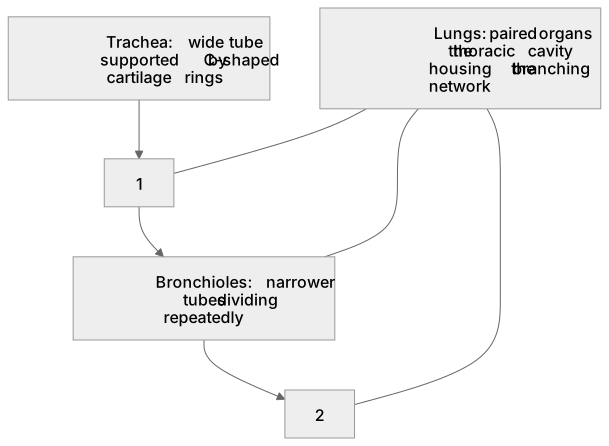
Some boxes have lost their names. Pick the right name for each number.
1Box 1
2Box 2
There is more to this lesson
The full lesson goes on to check your understanding and help you earn the marks. Create a free account to carry on, with your progress saved.
A week of Premium from your first lesson · Then the free plan continues · No card, no charge
Test your understanding of Gas exchange: The gross structure of the human gas exchange system limited to the alveoli, bronchioles, bronchi, trachea and lungs.
Active recall beats re-reading. Take an instant quiz now to test what you’ve learned and lock it into long-term memory.
A week of Premium from your first lesson · Then the free plan continues · No card, no charge