AQA · A-Level · Biology
Course version: 7402 · Version from Sept 2016
Directional selection, exemplified by antibiotic resistance in bacteria,…
Full specification wording
Genetic diversity and adaptation: Directional selection, exemplified by antibiotic resistance in bacteria, and stabilising selection, exemplified by human birth weights.
The two types differ in which phenotypes are selected against.
Checked against the AQA 7402 specification (opens in a new tab) on .
- Point 8 of 11
- 2 key terms
Study notes
From the checked teaching notes for this specification point.
The idea
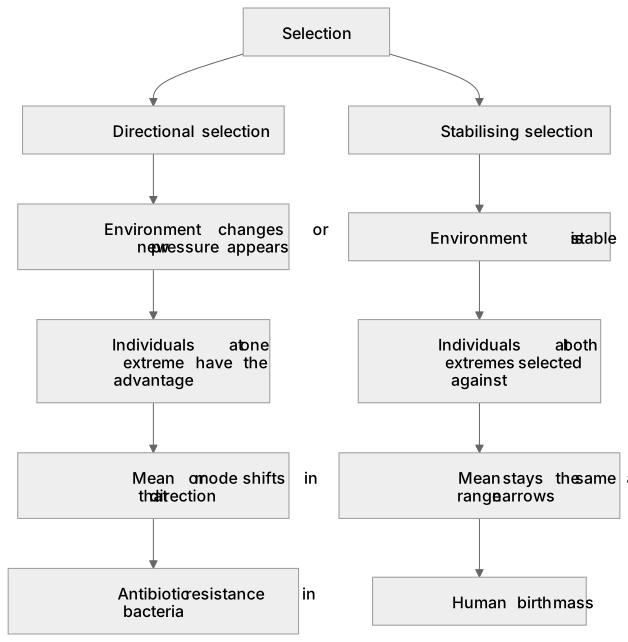
The two types differ in which phenotypes are selected against. Directional selection acts when the environment changes or a new pressure appears: individuals at one extreme of the range have the advantage, so the modal value shifts in that direction over generations and the whole distribution curve moves along the axis. Antibiotic resistance is the example. Before widespread antibiotic use, resistant bacteria were rare; the antibiotic kills the non-resistant, the resistant survive and reproduce, and the mean level of resistance in the population rises. Stabilising selection acts when the environment is stable: individuals at both extremes are selected against and those near the mean have the advantage, so the mean stays the same while the range narrows and the curve becomes taller and thinner.
What earns the marks
- Directional selection favouring individuals at one extreme, so the mean or mode shifts in that direction.
- Stabilising selection favouring individuals near the mean and selecting against both extremes, reducing the range.
- Stating that resistant bacteria survive the antibiotic and reproduce, so resistance increases in the population.
- Stating that very low and very high birth masses give lower survival, so those alleles are passed on less often.
- Interpreting distribution curves correctly, the peak shifted along the axis versus the peak higher and narrower.
Common mistakes and how to put them right
Saying stabilising selection means nothing changes, when allele frequencies at the extremes do fall.
Describing directional selection as favouring the strongest rather than one extreme of a measured characteristic.
Drawing a curve that changes height but not position for directional selection.
Writing that antibiotics make bacteria resistant.
Giving birth mass as the example without stating which extremes are disadvantaged and why.
Exam tips
- Sketch both curves before and after selection, labelling the axes as number of individuals against the characteristic.
- Name the favoured extreme in a directional example; that is where the application mark sits.
- For stabilising selection say the range decreases as well as the mean staying the same.
Try the lesson
The start of the Genetic diversity and adaptation: Directional selection, exemplified by antibiotic resistance in bacteria, and stabilising selection, exemplified by human birth weights. lesson, made from checked teaching notes for this specification point.
Have a go first
Which type of selection occurs when bacteria with resistance to an antibiotic survive and reproduce while non-resistant bacteria die?
Listen
The two types differ in which phenotypes are selected against. Directional selection acts when the environment changes or a new pressure appears: individuals at one extreme of the range have the advantage, so the modal value shifts in that direction over generations and the whole distribution curve moves along the axis. Antibiotic resistance is the example. Before widespread antibiotic use, resistant bacteria were rare; the antibiotic kills the non-resistant, the resistant survive and reproduce, and the mean level of resistance in the population rises. Stabilising selection acts when the environment is stable: individuals at both extremes are selected against and those near the mean have the advantage, so the mean stays the same while the range narrows and the curve becomes taller and thinner. A strong answer earns marks for these points. directional selection favouring individuals at one extreme, so the mean or mode shifts in that direction. stabilising selection favouring individuals near the mean and selecting against both extremes, reducing the range. stating that resistant bacteria survive the antibiotic and reproduce, so resistance increases in the population. stating that very low and very high birth masses give lower survival, so those alleles are passed on less often. Exam tip: Sketch both curves before and after selection, labelling the axes as number of individuals against the characteristic.
See it
Key words
Say what each word means before you turn the card.
directional selection
Try answering aloud or in your head before turning the card.
stabilising selection
Try answering aloud or in your head before turning the card.
See every definition
- directional selection
- Individuals at one extreme of the range have the advantage, so the modal value shifts in that direction over generations and the whole distribution curve moves along the axis.
- stabilising selection
- Individuals at both extremes are selected against and those near the mean have the advantage, so the mean stays the same while the range narrows and the curve becomes taller and thinner.
Label the diagram
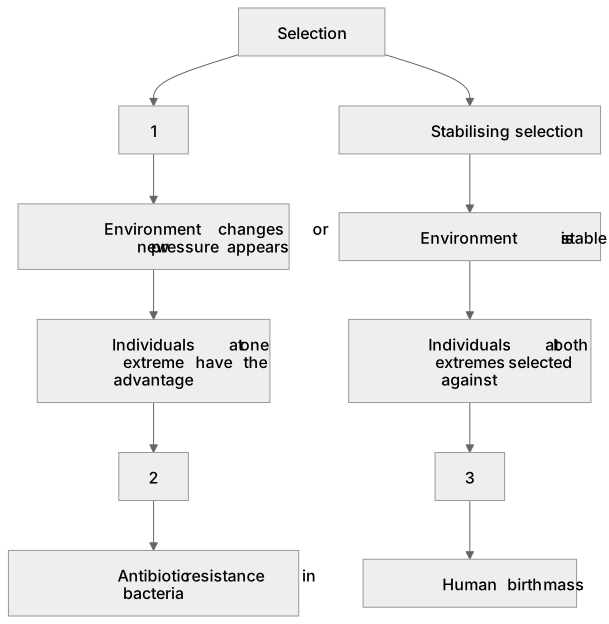
Some boxes have lost their names. Pick the right name for each number.
1Box 1
2Box 2
3Box 3
There is more to this lesson
The full lesson goes on to check your understanding and help you earn the marks. Create a free account to carry on, with your progress saved.
A week of Premium from your first lesson · Then the free plan continues · No card, no charge
Test your understanding of Genetic diversity and adaptation: Directional selection, exemplified by antibiotic resistance in bacteria, and stabilising selection, exemplified by human birth weights.
Active recall beats re-reading. Take an instant quiz now to test what you’ve learned and lock it into long-term memory.
A week of Premium from your first lesson · Then the free plan continues · No card, no charge