AQA · A-Level · Biology
Course version: 7402 · Version from Sept 2016
Natural selection results in species that are better adapted to their…
Full specification wording
Genetic diversity and adaptation: Natural selection results in species that are better adapted to their environment. These adaptations may be anatomical, physiological or behavioural.
Over generations, selection leaves a population whose members have the characteristics best suited to the environment they live in: they are better adapted.
Checked against the AQA 7402 specification (opens in a new tab) on .
- Point 9 of 11
- 4 key terms
Study notes
From the checked teaching notes for this specification point.
The idea
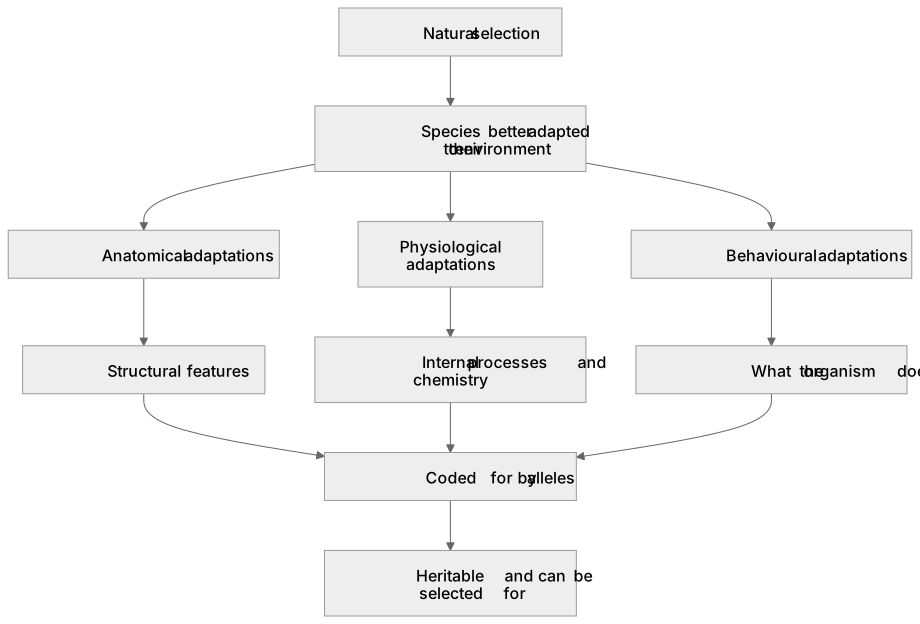
Over generations, selection leaves a population whose members have the characteristics best suited to the environment they live in: they are better adapted. AQA classifies adaptations three ways. Anatomical adaptations are structural features, such as a thick insulating layer of blubber, a streamlined body shape, or the sunken stomata of a xerophyte. Physiological adaptations are internal processes and chemistry, such as producing very concentrated urine in a desert mammal, a haemoglobin with a high affinity for oxygen at altitude, or the production of an enzyme that breaks down an antibiotic. Behavioural adaptations are what the organism does, such as migration, courtship displays, basking to raise body temperature, or the kinesis that moves a woodlouse out of dry air. All three are ultimately coded for by alleles, which is why they are heritable and can be selected for.
What earns the marks
- Stating that selection increases the frequency of alleles giving characteristics suited to the environment.
- Naming an anatomical adaptation and describing the structural feature.
- Naming a physiological adaptation, that is a process or substance produced by the organism.
- Naming a behavioural adaptation, that is something the organism does.
- Explaining how the named adaptation increases survival and reproductive success in that particular environment.
Common mistakes and how to put them right
Classifying a physiological adaptation as anatomical, for example calling concentrated urine a structure.
Describing adaptations as things the organism developed because it needed them.
Saying a species is perfectly adapted, when selection only favours the best of the variants available.
Giving an adaptation with no link to the environment named in the question.
Offering a learned habit as a behavioural adaptation when it is not inherited.
Exam tips
- Adaptation questions almost always want the explanation as well as the example; finish with survival and reproduction.
- If asked for one of each type, check that your three answers genuinely fall in different categories.
- Use the environment described in the stem rather than a textbook example from elsewhere.
Try the lesson
The start of the Genetic diversity and adaptation: Natural selection results in species that are better adapted to their environment. These adaptations may be anatomical, physiological or behavioural. lesson, made from checked teaching notes for this specification point.
Have a go first
Which type of adaptation is a thick layer of blubber in a seal?
Listen
Over generations, selection leaves a population whose members have the characteristics best suited to the environment they live in: they are better adapted. AQA classifies adaptations three ways. Anatomical adaptations are structural features, such as a thick insulating layer of blubber, a streamlined body shape, or the sunken stomata of a xerophyte. Physiological adaptations are internal processes and chemistry, such as producing very concentrated urine in a desert mammal, a haemoglobin with a high affinity for oxygen at altitude, or the production of an enzyme that breaks down an antibiotic. Behavioural adaptations are what the organism does, such as migration, courtship displays, basking to raise body temperature, or the kinesis that moves a woodlouse out of dry air. All three are ultimately coded for by alleles, which is why they are heritable and can be selected for. A strong answer earns marks for these points. stating that selection increases the frequency of alleles giving characteristics suited to the environment. naming an anatomical adaptation and describing the structural feature. naming a physiological adaptation, that is a process or substance produced by the organism. naming a behavioural adaptation, that is something the organism does. Exam tip: Adaptation questions almost always want the explanation as well as the example; finish with survival and reproduction.
See it
Key words
Say what each word means before you turn the card.
anatomical adaptation
Try answering aloud or in your head before turning the card.
physiological adaptation
Try answering aloud or in your head before turning the card.
behavioural adaptation
Try answering aloud or in your head before turning the card.
heritable characteristics
Try answering aloud or in your head before turning the card.
See every definition
- anatomical adaptation
- A structural feature of an organism, such as a thick insulating layer of blubber or a streamlined body shape.
- physiological adaptation
- An internal process or chemistry of an organism, such as producing very concentrated urine or an enzyme that breaks down an antibiotic.
- behavioural adaptation
- Something the organism does, such as migration, courtship displays or basking to raise body temperature.
- heritable characteristics
- Characteristics coded for by alleles, which is why they can be selected for.
Label the diagram
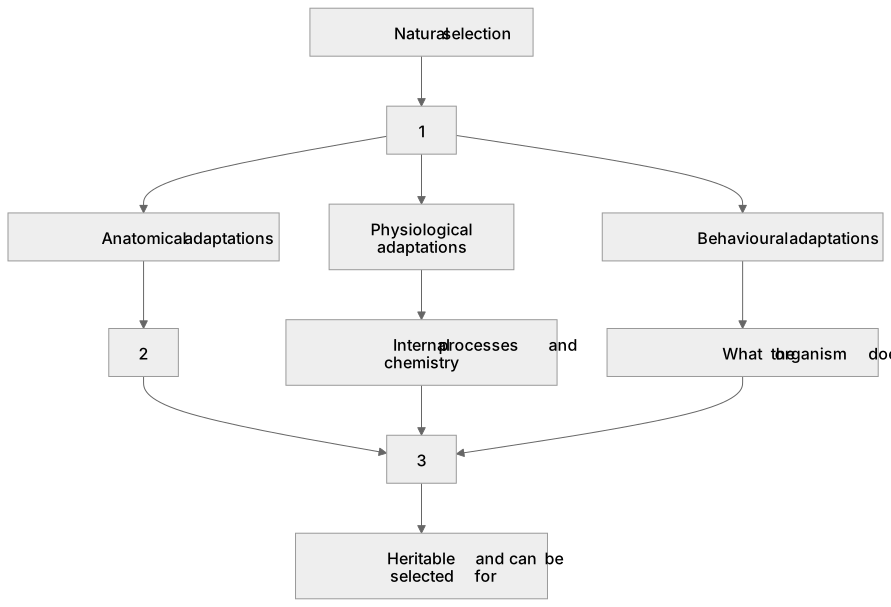
Some boxes have lost their names. Pick the right name for each number.
1Box 1
2Box 2
3Box 3
There is more to this lesson
The full lesson goes on to check your understanding and help you earn the marks. Create a free account to carry on, with your progress saved.
A week of Premium from your first lesson · Then the free plan continues · No card, no charge
Test your understanding of Genetic diversity and adaptation: Natural selection results in species that are better adapted to their environment. These adaptations may be anatomical, physiological or behavioural.
Active recall beats re-reading. Take an instant quiz now to test what you’ve learned and lock it into long-term memory.
A week of Premium from your first lesson · Then the free plan continues · No card, no charge