AQA · A-Level · Biology
Course version: 7402 · Version from Sept 2016
Students should be able to: use unfamiliar information to explain how…
Full specification wording
Genetic diversity and adaptation: Students should be able to: use unfamiliar information to explain how selection produces changes within a population of a species interpret data relating to the effect of selection in producing change within populations show understanding that adaptation and selection are major factors in evolution and contribute to the diversity of living organisms.
When applying natural selection to unfamiliar contexts, use the core sequence: random mutation creates variation, a specific selection pressure acts on the population, individuals with…
Checked against the AQA 7402 specification (opens in a new tab) on .
- Point 10 of 11
- 4 key terms
Study notes
From the checked teaching notes for this specification point.
The idea
When applying natural selection to unfamiliar contexts, use the core sequence: random mutation creates variation, a specific selection pressure acts on the population, individuals with advantageous alleles experience differential survival and reproduction, and the advantageous allele frequency increases. Always integrate the specific organism, allele, and pressure from the stem. You must also interpret data showing population changes, quoting figures with units to describe trends before explaining them. Finally, recognise that adaptation and selection are major factors in evolution; over time, these processes drive speciation and contribute significantly to the vast diversity of living organisms observed today.
What earns the marks
- When explaining selection, explicitly state that a random mutation resulted in a new allele, providing a selective advantage against the specific pressure named in the text.
- Describe how organisms with the advantageous allele are more likely to survive and reproduce, passing on this specific allele to their offspring.
- Conclude selection explanations by stating that the frequency of the advantageous allele increases in the population over subsequent generations.
- When interpreting data, explicitly quote data points (with units) to demonstrate the change in the population, before evaluating limitations such as small sample sizes or lack of statistical tests.
- Explicitly link the processes of adaptation and natural selection to being the major driving factors of evolution and the generation of biodiversity.
Common mistakes and how to put them right
Writing a generic natural selection answer without referencing the specific organism or data.
Put it right: Apply the theory to the context by naming the specific allele, organism, and selection pressure provided in the stem.
Stating that the frequency of the characteristic or gene increases, rather than the allele.
Put it right: Specify that it is the frequency of the advantageous allele that increases within the population.
Treating a correlation shown in data as definitive proof of a causal relationship.
Put it right: State that correlation does not prove causation and suggest other abiotic or biotic factors that could account for the observed change.
Exam tips
- Underline the organism, the allele, and the selection pressure in the question stem, then ensure all three are written into your step-by-step explanation of selection.
- When asked to evaluate a conclusion based on data, look for missing information such as the absence of a control group, small sample sizes, or the lack of a named statistical test.
Try the lesson
The start of the Genetic diversity and adaptation: Students should be able to: use unfamiliar information to explain how selection produces changes within a population of a species interpret data relating to the effect of selection in producing change within populations show understanding that adaptation and selection are major factors in evolution and contribute to the diversity of living organisms. lesson, made from checked teaching notes for this specification point.
Have a go first
Which statement describes the process of natural selection acting on a population of a species?
Listen
When applying natural selection to unfamiliar contexts, use the core sequence: random mutation creates variation, a specific selection pressure acts on the population, individuals with advantageous alleles experience differential survival and reproduction, and the advantageous allele frequency increases. Always integrate the specific organism, allele, and pressure from the stem. You must also interpret data showing population changes, quoting figures with units to describe trends before explaining them. Finally, recognise that adaptation and selection are major factors in evolution; over time, these processes drive speciation and contribute significantly to the vast diversity of living organisms observed today. A strong answer earns marks for these points. When explaining selection, explicitly state that a random mutation resulted in a new allele, providing a selective advantage against the specific pressure named in the text. Describe how organisms with the advantageous allele are more likely to survive and reproduce, passing on this specific allele to their offspring. Conclude selection explanations by stating that the frequency of the advantageous allele increases in the population over subsequent generations. When interpreting data, explicitly quote data points (with units) to demonstrate the change in the population, before evaluating limitations such as small sample sizes or lack of statistical tests. A common slip: Writing a generic natural selection answer without referencing the specific organism or data. Instead, apply the theory to the context by naming the specific allele, organism, and selection pressure provided in the stem. Exam tip: Underline the organism, the allele, and the selection pressure in the question stem, then ensure all three are written into your step-by-step explanation of selection.
See it
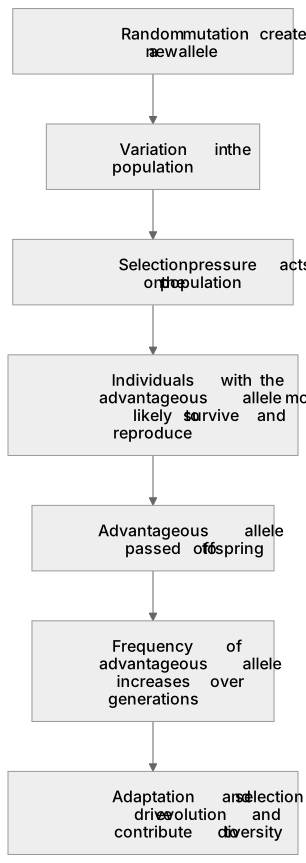
Put it in order
Put these steps in the order they happen.
- 1. Adaptation and selection drive evolution and contribute to diversity
- 2. Frequency of advantageous allele increases over generations
- 3. Selection pressure acts on the population
- 4. Advantageous allele passed to offspring
- 5. Random mutation creates a new allele
- 6. Variation in the population
- 7. Individuals with the advantageous allele more likely to survive and reproduce
Key words
Say what each word means before you turn the card.
Natural selection mechanisms
Try answering aloud or in your head before turning the card.
Data interpretation and evaluation
Try answering aloud or in your head before turning the card.
Evolution and biodiversity
Try answering aloud or in your head before turning the card.
Allele frequency changes
Try answering aloud or in your head before turning the card.
See every definition
- Natural selection mechanisms
- Random mutation creates variation, a specific selection pressure acts on the population, individuals with advantageous alleles experience differential survival and reproduction, and the advantageous allele frequency increases.
- Data interpretation and evaluation
- Quoting data points with units to describe trends before explaining them, and evaluating limitations such as small sample sizes or lack of statistical tests.
- Evolution and biodiversity
- Adaptation and selection are major factors in evolution and contribute to the diversity of living organisms.
- Allele frequency changes
- The frequency of the advantageous allele increases in the population over subsequent generations.
Label the diagram
Some boxes have lost their names. Pick the right name for each number.
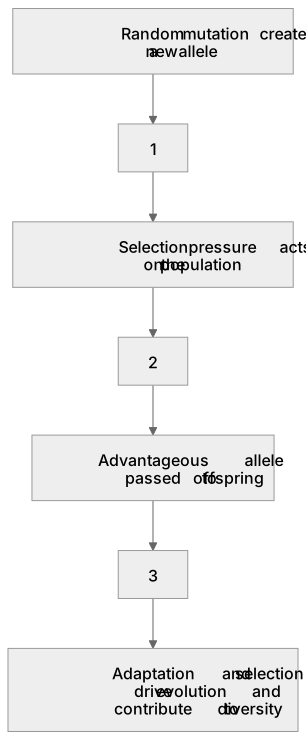
1Box 1
2Box 2
3Box 3
There is more to this lesson
The full lesson goes on to check your understanding and help you earn the marks. Create a free account to carry on, with your progress saved.
A week of Premium from your first lesson · Then the free plan continues · No card, no charge
Test your understanding of Genetic diversity and adaptation: Students should be able to: use unfamiliar information to explain how selection produces changes within a population of a species interpret data relating to the effect of selection in producing change within populations show understanding that adaptation and selection are major factors in evolution and contribute to the diversity of living organisms.
Active recall beats re-reading. Take an instant quiz now to test what you’ve learned and lock it into long-term memory.
A week of Premium from your first lesson · Then the free plan continues · No card, no charge