AQA · A-Level · Biology
Course version: 7402 · Version from Sept 2016
The advantageous allele is inherited by members of the next generation.
Full specification wording
Genetic diversity and adaptation: The advantageous allele is inherited by members of the next generation.
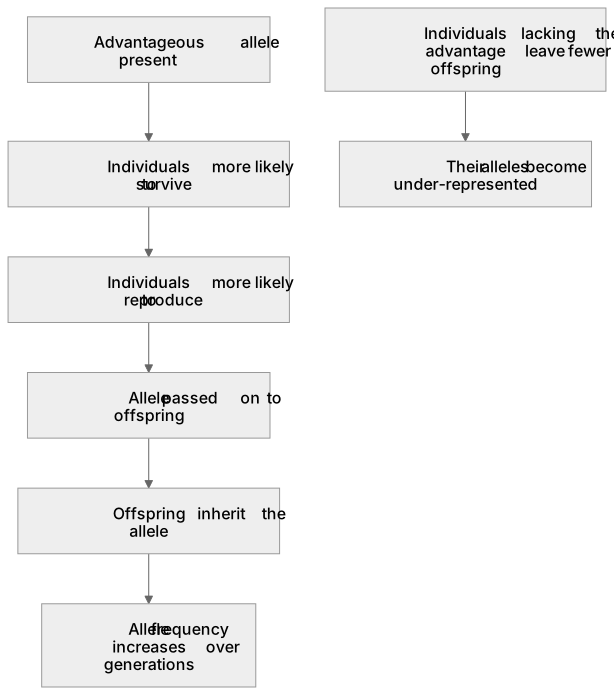
Selection only changes a population if survivors reproduce and pass the advantageous allele to the next generation.
Checked against the AQA 7402 specification (opens in a new tab) on .
- Point 6 of 11
- 4 key terms
Study notes
From the checked teaching notes for this specification point.
The idea
Selection only changes a population if survivors reproduce and pass the advantageous allele to the next generation. An organism carrying an advantageous allele is more likely to reach reproductive age and produce offspring. In sexual diploid organisms, offspring receive one allele per gene from each parent via gametes. Heterozygous parents pass the allele to half their offspring on average. In asexual organisms like bacteria, the allele is passed directly during binary fission. Because individuals lacking the advantage leave fewer offspring, their alleles become under-represented. A common omission in exams is stating that resistant individuals survive, but failing to explicitly mention they reproduce and pass on the allele, increasing its frequency.
What earns the marks
- Individuals with the advantageous allele being more likely to survive.
- Those individuals reproducing, or being more likely to reproduce.
- The advantageous allele being passed on to offspring (via gametes in sexual reproduction or binary fission in asexual organisms).
- Offspring inheriting the allele, which may be expressed in the phenotype depending on dominance.
- The frequency of the advantageous allele increasing in the population over the generations that follow.
Common mistakes and how to put them right
Treating gene and allele as interchangeable when it is one allele whose frequency changes.
Put it right: A scheme rejecting gene for allele does so once.
Stopping at 'they survive' without stating that they reproduce and pass the allele on.
Saying parents pass on their characteristics rather than their alleles.
Implying offspring acquire the characteristic from the environment rather than inheriting an allele.
Assuming every offspring of an advantaged parent must inherit the allele.
Exam tips
- Include all three verbs: survive, reproduce, pass on.
- If you have room, say the allele is passed on 'in the gametes', which shows the mechanism.
- Keep 'more likely to' in front of survive and reproduce throughout.
Try the lesson
The start of the Genetic diversity and adaptation: The advantageous allele is inherited by members of the next generation. lesson, made from checked teaching notes for this specification point.
Have a go first
Which statement best describes how an advantageous allele is inherited by members of the next generation?
Listen
Selection only changes a population if survivors reproduce and pass the advantageous allele to the next generation. An organism carrying an advantageous allele is more likely to reach reproductive age and produce offspring. In sexual diploid organisms, offspring receive one allele per gene from each parent via gametes. Heterozygous parents pass the allele to half their offspring on average. In asexual organisms like bacteria, the allele is passed directly during binary fission. Because individuals lacking the advantage leave fewer offspring, their alleles become under-represented. A common omission in exams is stating that resistant individuals survive, but failing to explicitly mention they reproduce and pass on the allele, increasing its frequency. A strong answer earns marks for these points. individuals with the advantageous allele being more likely to survive. those individuals reproducing, or being more likely to reproduce. the advantageous allele being passed on to offspring (via gametes in sexual reproduction or binary fission in asexual organisms). offspring inheriting the allele, which may be expressed in the phenotype depending on dominance. Exam tip: Include all three verbs: survive, reproduce, pass on.
See it
Key words
Say what each word means before you turn the card.
survival to reproductive age
Try answering aloud or in your head before turning the card.
gametes
Try answering aloud or in your head before turning the card.
inheritance of alleles
Try answering aloud or in your head before turning the card.
allele passed to offspring
Try answering aloud or in your head before turning the card.
See every definition
- survival to reproductive age
- An organism carrying an advantageous allele is more likely to reach this stage and produce offspring.
- gametes
- In sexual diploid organisms, offspring receive one allele per gene from each parent via these.
- inheritance of alleles
- Offspring receive one allele per gene from each parent, and heterozygous parents pass the allele to half their offspring on average.
- allele passed to offspring
- Survivors must reproduce and pass the advantageous allele on, whether via gametes in sexual reproduction or binary fission in asexual organisms.
Label the diagram
Some boxes have lost their names. Pick the right name for each number.
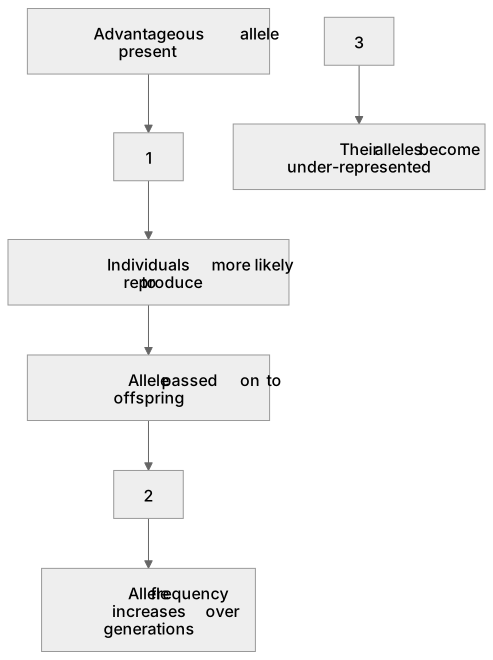
1Box 1
2Box 2
3Box 3
There is more to this lesson
The full lesson goes on to check your understanding and help you earn the marks. Create a free account to carry on, with your progress saved.
A week of Premium from your first lesson · Then the free plan continues · No card, no charge
Test your understanding of Genetic diversity and adaptation: The advantageous allele is inherited by members of the next generation.
Active recall beats re-reading. Take an instant quiz now to test what you’ve learned and lock it into long-term memory.
A week of Premium from your first lesson · Then the free plan continues · No card, no charge