AQA · A-Level · Biology
Course version: 7402 · Version from Sept 2016
Many mutations are harmful but, in certain environments, the new allele of…
Full specification wording
Genetic diversity and adaptation: Many mutations are harmful but, in certain environments, the new allele of a gene might benefit its possessor, leading to increased reproductive success.
Many mutations are harmful.
Checked against the AQA 7402 specification (opens in a new tab) on .
- Point 5 of 11
- 3 key terms
Study notes
From the checked teaching notes for this specification point.
The idea
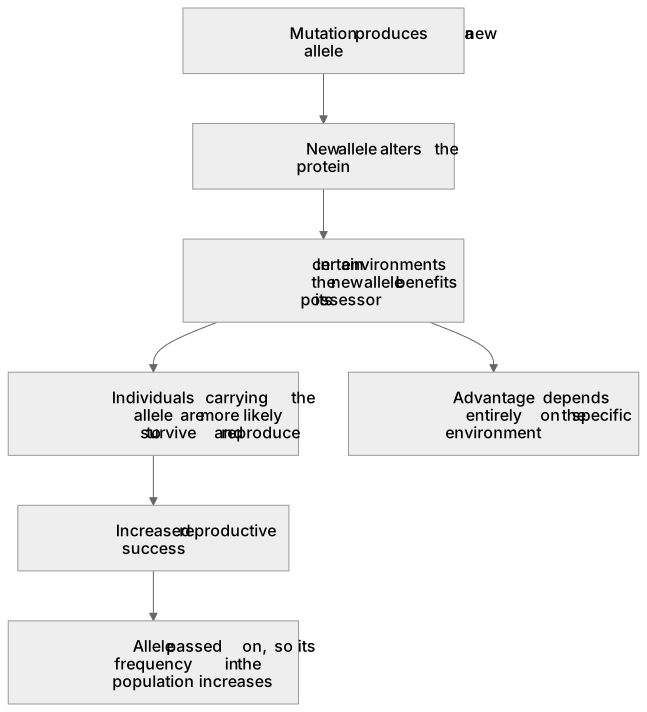
Many mutations are harmful. A theoretical model suggests that because existing proteins are shaped by selection, random changes often alter tertiary structure negatively (e.g. an enzyme's active site becomes non-complementary). However, in certain environments, a new allele might benefit its possessor. For example, the KDR allele in mosquitoes alters sodium ion channels. This provides no benefit without DDT, but is life-saving in its presence. Individuals carrying an advantageous allele are more likely to survive and reproduce, leading to increased reproductive success (producing more surviving offspring than those without it). The advantage of an allele is entirely dependent on the specific environment.
What earns the marks
- Stating that mutation produced the new, for example resistance, allele before the selection pressure was applied.
- Identifying the selection pressure in the data, such as the use of DDT or of an antibiotic.
- Stating that individuals carrying the allele are more likely to survive and to reproduce.
- The allele being passed on so that its frequency in the population increases.
- Recognising that the advantage depends on the environment, so the allele may be disadvantageous elsewhere.
Common mistakes and how to put them right
Claiming the DDT, antibiotic or pathogen caused the mutation to occur.
Equating reproductive success with survival alone and omitting the number of offspring produced.
Describing the allele as simply 'better' without naming the environment in which it is better.
Saying the mutation was needed by the population.
Assuming all harmful mutations are quickly removed by selection, forgetting that recessive deleterious alleles can persist in heterozygotes.
Exam tips
- Write 'increased reproductive success' in those words; it is the phrase the specification uses.
- In data questions, quote the figures that show the resistant type increasing over time.
- Explain why the advantageous allele is rare at the start: it has only just arisen by mutation.
Try the lesson
The start of the Genetic diversity and adaptation: Many mutations are harmful but, in certain environments, the new allele of a gene might benefit its possessor, leading to increased reproductive success. lesson, made from checked teaching notes for this specification point.
Have a go first
A random mutation produces a new allele that confers resistance to a specific toxin. Which statement describes the most likely consequence of this allele in a population exposed to the toxin?
Listen
Many mutations are harmful. A theoretical model suggests that because existing proteins are shaped by selection, random changes often alter tertiary structure negatively (e.g. an enzyme's active site becomes non-complementary). However, in certain environments, a new allele might benefit its possessor. For example, the KDR allele in mosquitoes alters sodium ion channels. This provides no benefit without DDT, but is life-saving in its presence. Individuals carrying an advantageous allele are more likely to survive and reproduce, leading to increased reproductive success (producing more surviving offspring than those without it). The advantage of an allele is entirely dependent on the specific environment. A strong answer earns marks for these points. stating that mutation produced the new, for example resistance, allele before the selection pressure was applied. identifying the selection pressure in the data, such as the use of DDT or of an antibiotic. stating that individuals carrying the allele are more likely to survive and to reproduce. the allele being passed on so that its frequency in the population increases. Exam tip: Write 'increased reproductive success' in those words; it is the phrase the specification uses.
See it
Key words
Say what each word means before you turn the card.
altered tertiary structure
Try answering aloud or in your head before turning the card.
advantage depends on environment
Try answering aloud or in your head before turning the card.
increased reproductive success
Try answering aloud or in your head before turning the card.
See every definition
- altered tertiary structure
- Random changes to existing proteins often change this negatively, for example an enzyme's active site becomes non-complementary.
- advantage depends on environment
- Whether an allele benefits its possessor is entirely dependent on the specific environment, so it may be disadvantageous elsewhere.
- increased reproductive success
- Individuals carrying an advantageous allele are more likely to survive and reproduce, producing more surviving offspring than those without it.
Label the diagram
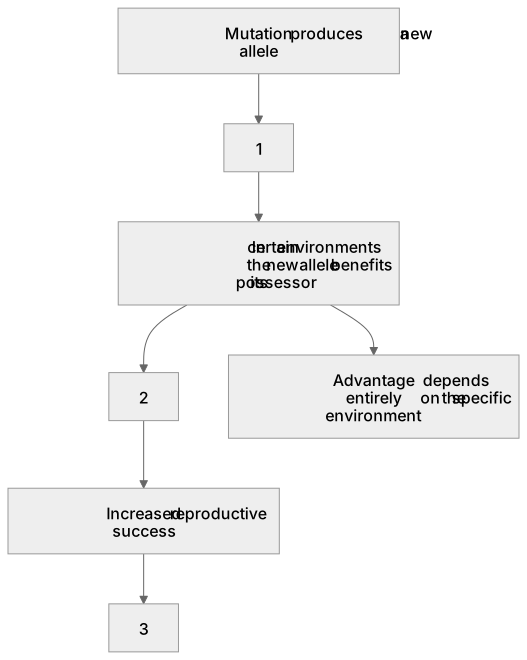
Some boxes have lost their names. Pick the right name for each number.
1Box 1
2Box 2
3Box 3
There is more to this lesson
The full lesson goes on to check your understanding and help you earn the marks. Create a free account to carry on, with your progress saved.
A week of Premium from your first lesson · Then the free plan continues · No card, no charge
Test your understanding of Genetic diversity and adaptation: Many mutations are harmful but, in certain environments, the new allele of a gene might benefit its possessor, leading to increased reproductive success.
Active recall beats re-reading. Take an instant quiz now to test what you’ve learned and lock it into long-term memory.
A week of Premium from your first lesson · Then the free plan continues · No card, no charge