AQA · A-Level · Biology
Course version: 7402 · Version from Sept 2016
The principles of natural selection in the evolution of populations.
Full specification wording
Genetic diversity and adaptation: The principles of natural selection in the evolution of populations.
Random mutation produces new alleles, creating variation within a population.
Checked against the AQA 7402 specification (opens in a new tab) on .
- Point 3 of 11
Study notes
From the checked teaching notes for this specification point.
The idea
Random mutation produces new alleles, creating variation within a population. A selection pressure (e.g. a predator, disease, or antibiotic) acts on this variation. Individuals carrying an advantageous allele have a phenotype better suited to the environment, making them more likely to survive and reproduce. They pass this allele to their offspring. Over many generations, the frequency of the advantageous allele increases. Antibiotic resistance is a key example: a few bacteria possess a resistance allele from prior mutation. When exposed to antibiotics, non-resistant bacteria die, while resistant ones survive and reproduce. Resistance spreads faster in hospitals due to high antibiotic use creating strong selection pressure, and horizontal gene transfer between bacteria.
What earns the marks
- Random mutation producing a new allele, so there is variation within the population.
- Naming the selection pressure and stating that individuals with the allele are more likely to survive.
- Those individuals reproducing and passing the advantageous allele to the next generation.
- The frequency of the allele increasing in the population over many generations.
- Applying the sequence to the named context, such as non-resistant bacteria dying while resistant bacteria survive and reproduce.
Common mistakes and how to put them right
Writing that the antibiotic causes the bacteria to produce a resistance allele, which is explicitly rejected.
Saying bacteria become immune to an antibiotic rather than resistant, which examiners reject here.
Writing gene where allele is meant.
Stopping at 'the resistant ones survive' without reproduction and inheritance.
Saying the number of alleles increases rather than the frequency or proportion, as copy number can rise simply through population growth.
Exam tips
- Use the five-step chain in order: mutation, variation, selection pressure, differential survival and reproduction, increased allele frequency.
- Name the actual selection pressure given in the stem; a generic answer loses the application mark.
- Write 'more likely to survive' rather than 'survive', because selection is probabilistic.
Try the lesson
The start of the Genetic diversity and adaptation: The principles of natural selection in the evolution of populations. lesson, made from checked teaching notes for this specification point.
Have a go first
Which statement describes the process of natural selection?
Listen
Random mutation produces new alleles, creating variation within a population. A selection pressure (e.g. a predator, disease, or antibiotic) acts on this variation. Individuals carrying an advantageous allele have a phenotype better suited to the environment, making them more likely to survive and reproduce. They pass this allele to their offspring. Over many generations, the frequency of the advantageous allele increases. Antibiotic resistance is a key example: a few bacteria possess a resistance allele from prior mutation. When exposed to antibiotics, non-resistant bacteria die, while resistant ones survive and reproduce. Resistance spreads faster in hospitals due to high antibiotic use creating strong selection pressure, and horizontal gene transfer between bacteria. A strong answer earns marks for these points. random mutation producing a new allele, so there is variation within the population. naming the selection pressure and stating that individuals with the allele are more likely to survive. those individuals reproducing and passing the advantageous allele to the next generation. the frequency of the allele increasing in the population over many generations. Exam tip: Use the five-step chain in order: mutation, variation, selection pressure, differential survival and reproduction, increased allele frequency.
See it
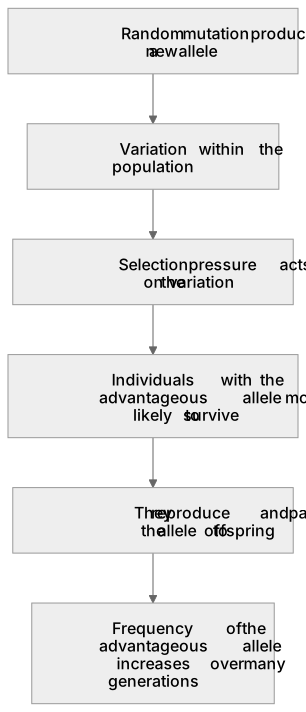
Put it in order
Put these steps in the order they happen.
- 1. Selection pressure acts on the variation
- 2. Variation within the population
- 3. Random mutation produces a new allele
- 4. Frequency of the advantageous allele increases over many generations
- 5. They reproduce and pass the allele to offspring
- 6. Individuals with the advantageous allele more likely to survive
Label the diagram
Some boxes have lost their names. Pick the right name for each number.
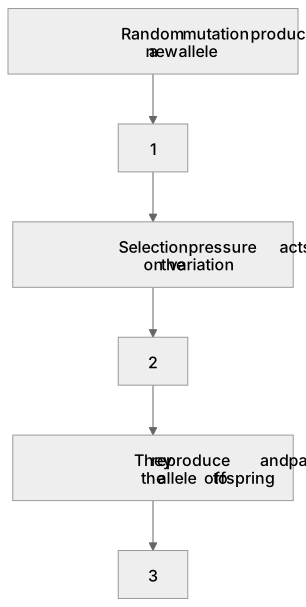
1Box 1
2Box 2
3Box 3
There is more to this lesson
The full lesson goes on to check your understanding and help you earn the marks. Create a free account to carry on, with your progress saved.
A week of Premium from your first lesson · Then the free plan continues · No card, no charge
Test your understanding of Genetic diversity and adaptation: The principles of natural selection in the evolution of populations.
Active recall beats re-reading. Take an instant quiz now to test what you’ve learned and lock it into long-term memory.
A week of Premium from your first lesson · Then the free plan continues · No card, no charge