AQA · A-Level · Biology
Course version: 7402 · Version from Sept 2016
Random mutation can result in new alleles of a gene.
Full specification wording
Genetic diversity and adaptation: Random mutation can result in new alleles of a gene.
An allele is one version of a gene, differing from another version in its base sequence.
Checked against the AQA 7402 specification (opens in a new tab) on .
- Point 4 of 11
- 4 key terms
Study notes
From the checked teaching notes for this specification point.
The idea
An allele is one version of a gene, differing from another version in its base sequence. New alleles can only come from mutation: a change to the base sequence, usually arising during DNA replication, occurring at random and independently of whether the change would be useful. Meiosis and sexual reproduction do not create alleles; they only recombine alleles that already exist. Because mutation is random, two consequences follow. First, most new alleles are neutral or harmful, since a functioning protein is far easier to break than to improve. Second, whether a new allele turns out to be advantageous depends entirely on the environment: an allele conferring resistance to a herbicide is worthless in a field that has never been sprayed.
What earns the marks
- Defining an allele as a different version of a gene with a different base sequence.
- Stating that new alleles arise by random mutation.
- Stating that mutations occur independently of any need or advantage to the organism.
- Stating that only mutations in gametes, or in the cells that form them, are inherited.
- Explaining that whether the new allele is advantageous depends on the environment.
Common mistakes and how to put them right
Writing that the environment or a selection pressure causes the useful mutation to appear.
Saying meiosis or crossing over produces new alleles, when they produce new combinations of existing alleles.
Using gene and allele interchangeably.
Claiming all mutations are harmful, or that every mutation changes the protein.
Assuming any mutation occurring in an adult will appear in its children.
Exam tips
- Open natural selection answers with 'a random mutation produced a new allele'; it is a mark almost every time.
- Keep the words random and new allele together, because examiners look for both.
- If the question describes a mutation in a body cell, state explicitly that it is not passed on.
Try the lesson
The start of the Genetic diversity and adaptation: Random mutation can result in new alleles of a gene. lesson, made from checked teaching notes for this specification point.
Have a go first
What is a new allele of a gene produced by?
Listen
An allele is one version of a gene, differing from another version in its base sequence. New alleles can only come from mutation: a change to the base sequence, usually arising during DNA replication, occurring at random and independently of whether the change would be useful. Meiosis and sexual reproduction do not create alleles; they only recombine alleles that already exist. Because mutation is random, two consequences follow. First, most new alleles are neutral or harmful, since a functioning protein is far easier to break than to improve. Second, whether a new allele turns out to be advantageous depends entirely on the environment: an allele conferring resistance to a herbicide is worthless in a field that has never been sprayed. A strong answer earns marks for these points. defining an allele as a different version of a gene with a different base sequence. stating that new alleles arise by random mutation. stating that mutations occur independently of any need or advantage to the organism. stating that only mutations in gametes, or in the cells that form them, are inherited. Exam tip: Open natural selection answers with 'a random mutation produced a new allele'; it is a mark almost every time.
See it
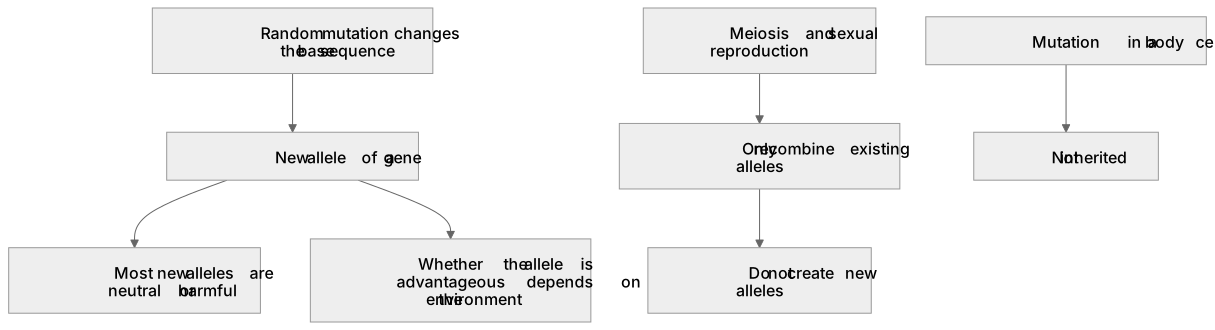
Key words
Say what each word means before you turn the card.
allele
Try answering aloud or in your head before turning the card.
mutation
Try answering aloud or in your head before turning the card.
random mutation
Try answering aloud or in your head before turning the card.
new combinations
Try answering aloud or in your head before turning the card.
See every definition
- allele
- One version of a gene, differing from another version in its base sequence.
- mutation
- A change to the base sequence, usually arising during DNA replication, occurring at random and independently of whether the change would be useful.
- random mutation
- A change to the base sequence that occurs at random and independently of whether the change would be useful, and can result in new alleles of a gene.
- new combinations
- What meiosis and sexual reproduction produce by recombining alleles that already exist, rather than creating alleles.
Label the diagram
Some boxes have lost their names. Pick the right name for each number.
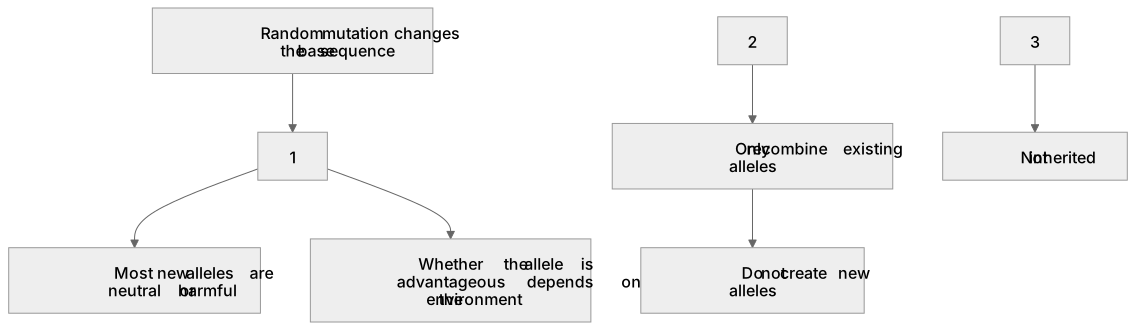
1Box 1
2Box 2
3Box 3
There is more to this lesson
The full lesson goes on to check your understanding and help you earn the marks. Create a free account to carry on, with your progress saved.
A week of Premium from your first lesson · Then the free plan continues · No card, no charge
Test your understanding of Genetic diversity and adaptation: Random mutation can result in new alleles of a gene.
Active recall beats re-reading. Take an instant quiz now to test what you’ve learned and lock it into long-term memory.
A week of Premium from your first lesson · Then the free plan continues · No card, no charge