AQA · A-Level · Biology
Course version: 7402 · Version from Sept 2016
Due to the degenerate nature of the genetic code, not all base…
Full specification wording
Genetic diversity can arise as a result of mutation or during: Due to the degenerate nature of the genetic code, not all base substitutions cause a change in the sequence of encoded amino acids.
The code is degenerate because most amino acids are specified by more than one triplet (codon), often differing at the third base.
Checked against the AQA 7402 specification (opens in a new tab) on .
- Point 3 of 8
- 4 key terms
Study notes
From the checked teaching notes for this specification point.
The idea
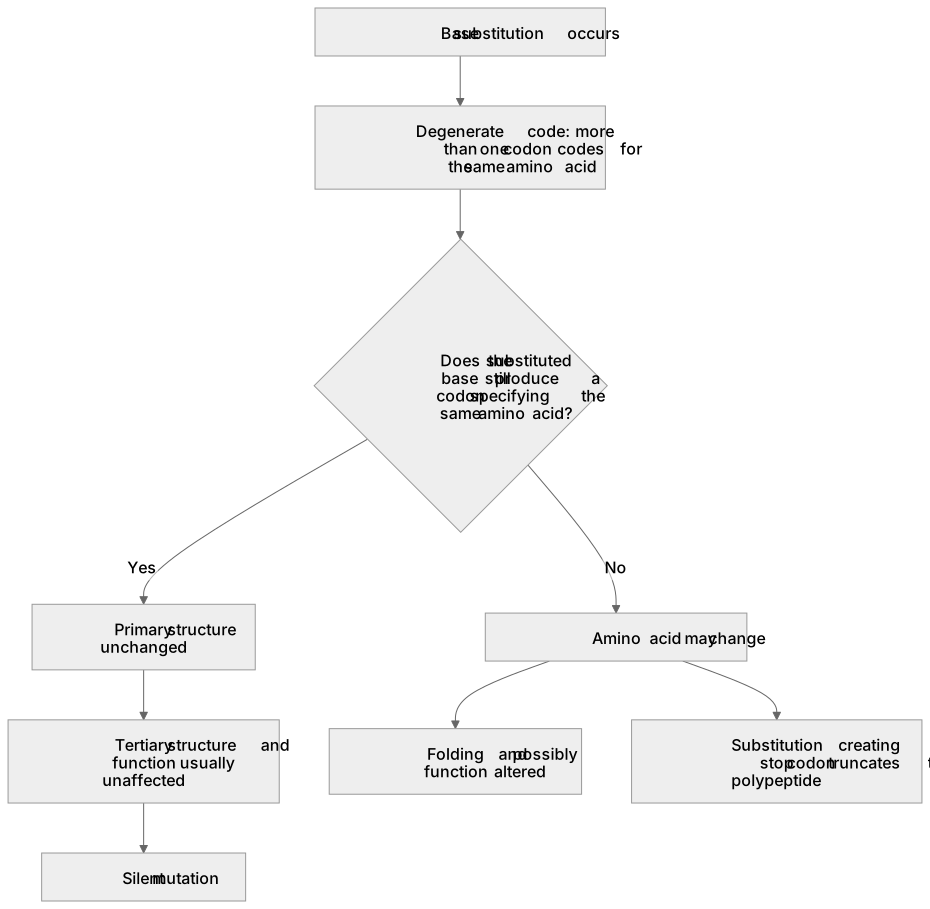
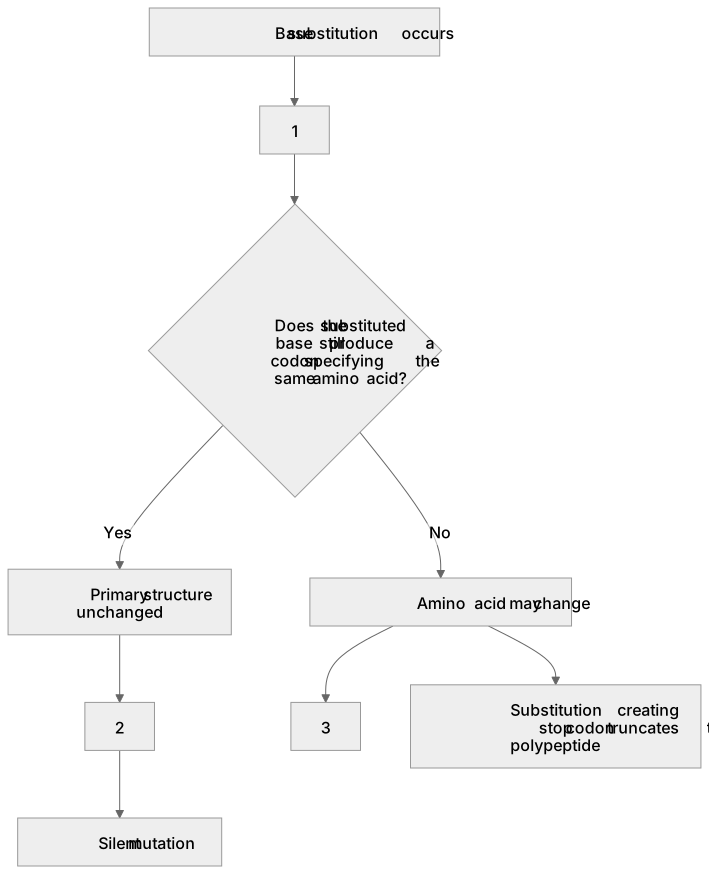
The code is degenerate because most amino acids are specified by more than one triplet (codon), often differing at the third base. A substitution that produces a synonymous codon therefore leaves the amino acid sequence (primary structure) unchanged, so tertiary structure and function are usually unaffected: a silent mutation. For example, if a codon table shows that a third-base change still specifies the same amino acid, the substitution is silent. A substitution at the first or second base is more likely to change the amino acid, altering folding and possibly function. Degeneracy buffers organisms against some copying errors, but not all substitutions are harmless: one creating a stop codon truncates the polypeptide. Degenerate (more than one codon per amino acid) must be distinguished from universal (the same codons specify the same amino acids in almost all organisms).
What earns the marks
- States that the code is degenerate because more than one triplet (codon) codes for the same amino acid.
- Explains that a substituted base may still produce a codon specifying the same amino acid, so the primary structure is unchanged.
- Concludes that if the amino acid sequence is unchanged, the tertiary structure and function of the protein, and hence the phenotype, are usually unaffected (a silent mutation).
- Uses a codon table to show that a stated substitution gives the same amino acid, e.g. identifying a third-base change that remains synonymous.
- Notes that a substitution at the third base of a triplet is the most likely to be silent, whereas first- or second-base changes are more likely to alter the amino acid.
- Recognises that not all substitutions are harmless, e.g. one creating a premature stop codon truncates the polypeptide.
- Distinguishes degenerate (more than one codon per amino acid) from universal (the same codons specify the same amino acids in almost all organisms).
Common mistakes and how to put them right
Defining degenerate as one codon coding for more than one amino acid.
Put it right: The correct meaning is the reverse: more than one codon codes for the same amino acid.
Using degenerate where the required term is universal, which would be rejected.
Put it right: Universal means the same codons specify the same amino acids in almost all organisms.
Saying a silent substitution produces a slightly different protein.
Put it right: The protein is identical because the amino acid sequence is unchanged.
Assuming every substitution is silent, so no substitution ever matters.
Put it right: A substitution creating a stop codon truncates the polypeptide, and first- or second-base changes often alter the amino acid.
Forgetting to follow the chain to the end.
Put it right: Same amino acid, same primary structure, same tertiary structure, no change in function.
Exam tips
- State the meaning of degenerate as 'more than one codon codes for the same amino acid'; equivalent wording is accepted, so focus on the meaning rather than memorising a phrase.
- Follow the chain right to the end: same amino acid, same primary structure, same tertiary structure, no change in function.
- If a codon table is supplied, use it to prove the specific substitution in the question is silent, rather than asserting it.
Try the lesson
The start of the Genetic diversity can arise as a result of mutation or during: Due to the degenerate nature of the genetic code, not all base substitutions cause a change in the sequence of encoded amino acids. lesson, made from checked teaching notes for this specification point.
Have a go first
What is meant by the degenerate nature of the genetic code?
Listen
The code is degenerate because most amino acids are specified by more than one triplet (codon), often differing at the third base. A substitution that produces a synonymous codon therefore leaves the amino acid sequence (primary structure) unchanged, so tertiary structure and function are usually unaffected: a silent mutation. For example, if a codon table shows that a third-base change still specifies the same amino acid, the substitution is silent. A substitution at the first or second base is more likely to change the amino acid, altering folding and possibly function. Degeneracy buffers organisms against some copying errors, but not all substitutions are harmless: one creating a stop codon truncates the polypeptide. Degenerate (more than one codon per amino acid) must be distinguished from universal (the same codons specify the same amino acids in almost all organisms). A strong answer earns marks for these points. States that the code is degenerate because more than one triplet (codon) codes for the same amino acid. Explains that a substituted base may still produce a codon specifying the same amino acid, so the primary structure is unchanged. Concludes that if the amino acid sequence is unchanged, the tertiary structure and function of the protein, and hence the phenotype, are usually unaffected (a silent mutation). Uses a codon table to show that a stated substitution gives the same amino acid, e.g. identifying a third-base change that remains synonymous. Exam tip: State the meaning of degenerate as 'more than one codon codes for the same amino acid'; equivalent wording is accepted, so focus on the meaning rather than memorising a phrase.
See it
Key words
Say what each word means before you turn the card.
degenerate code
Try answering aloud or in your head before turning the card.
silent mutation
Try answering aloud or in your head before turning the card.
third base position
Try answering aloud or in your head before turning the card.
unchanged primary structure
Try answering aloud or in your head before turning the card.
See every definition
- degenerate code
- More than one triplet (codon) codes for the same amino acid, so most amino acids are specified by more than one codon.
- silent mutation
- A substitution that produces a synonymous codon, leaving the amino acid sequence unchanged, so tertiary structure and function are usually unaffected.
- third base position
- The position at which codons for the same amino acid often differ, so a substitution there is the most likely to be silent.
- unchanged primary structure
- The amino acid sequence stays the same because the substituted base still produces a codon specifying the same amino acid.
Label the diagram
Some boxes have lost their names. Pick the right name for each number.
1Box 1
2Box 2
3Box 3
There is more to this lesson
The full lesson goes on to check your understanding and help you earn the marks. Create a free account to carry on, with your progress saved.
A week of Premium from your first lesson · Then the free plan continues · No card, no charge
Test your understanding of Genetic diversity can arise as a result of mutation or during: Due to the degenerate nature of the genetic code, not all base substitutions cause a change in the sequence of encoded amino acids.
Active recall beats re-reading. Take an instant quiz now to test what you’ve learned and lock it into long-term memory.
A week of Premium from your first lesson · Then the free plan continues · No card, no charge